

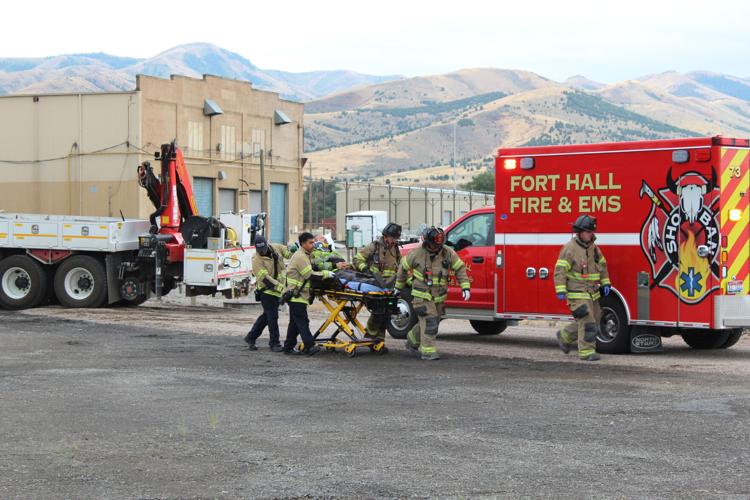
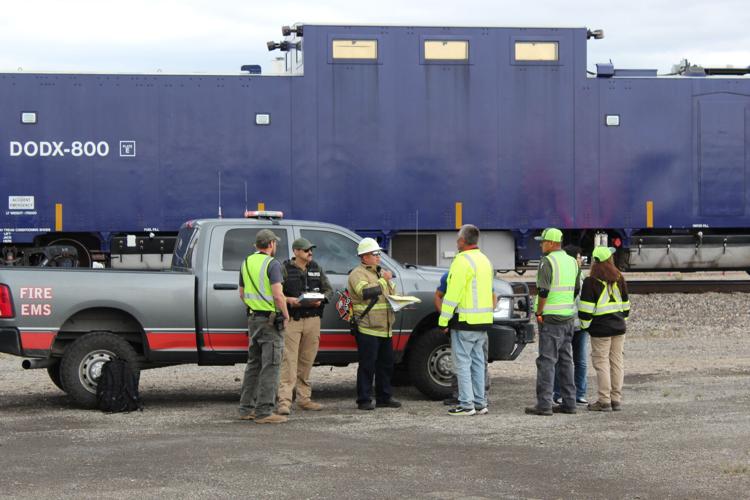
POCATELLO — Gray skies set against beautiful Idaho mountains and the industrial trappings of the Union Pacific rail yard served as the backdrop for a simulated transportation accident Wednesday morning.
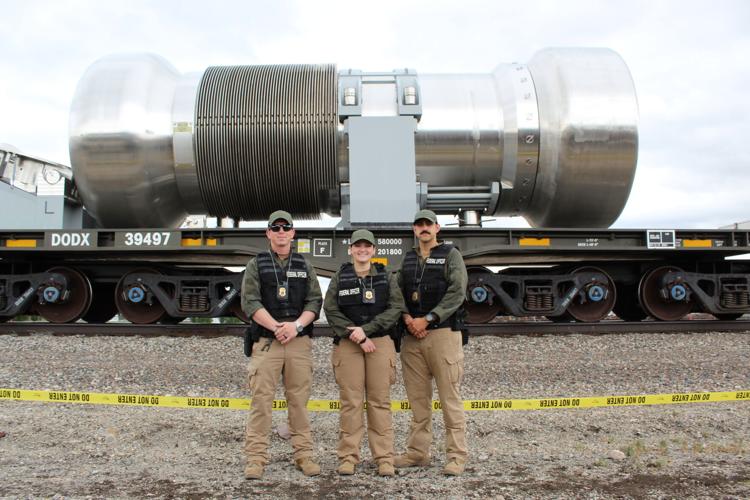
The joint exercise was a collaboration between tribal, federal, state and local government agencies that demonstrated a simulated accident in which a spent naval nuclear fuel shipping container on a train derailed due to a vehicle collision.
The exercise provided an opportunity for local emergency responders and oversight agencies to train, evaluate and improve their response actions.
“We conduct a similar exercise about once every two years,” said Matt Napoli, the spokesperson of the Naval Nuclear Propulsion Program. “We’ve been doing that since the late 1990s. This is actually the second time that we’ve done this in the state of Idaho, but the last time being in the year 2000. It’s really to demonstrate and exercise our emergency response capabilities.”
Napoli continued, “I was incredibly impressed working with the Shoshone-Bannock Tribes first responders and really having the ability to both execute that emergency response action, but to also highlight and demonstrate the safety of these shipping containers. I mentioned the fact that we’ve done numerous shipments since 1957. We have shipped over 900 containers across the nation to the state of Idaho. Throughout the entirety of the history of that program there’s never been a release of radiation to the environment.”
The exercise, which was demonstrated in front of an audience that included team members and representatives from the various state, federal, tribal and local agencies, was presented in a play-by-play fashion over a loudspeaker.
In playing out the simulation, each of the demonstrators present during the exercise were affixed with microphones and acted out their normal job roles as they reacted in real time to the hazardous scenario.
Shipments of spent naval nuclear fuel are made following refueling procedures or during the decommissioning of U.S. Navy nuclear powered warships and are sent in a 10-inch-thick stainless steel shipping container to the naval reactor facility on site at the Idaho National Laboratory.
The spent fuel is examined and packaged into dry storage containers for eventual shipment to a geologic repository, though the U.S. does not have a permanent geologic repository at this time.
Part of the disaster drill also included a simulated location, Sheepskin Road in Fort Hall, so the exercise was framed in a way that showed the escalation of events as they would naturally unfold.
“It is important to the Shoshone-Bannock Tribes that individuals understand that the Idaho National Laboratory and the naval nuclear reactor facility are located on the ancestral homelands of the Shoshone Bannock nations,” said Echo Marshall, spokesperson for the Shoshone-Bannock Tribes. “We have a long-working relationship that began in the late {span id=”docs-internal-guid-3d514914-7fff-dfbd-7a0d-a98522e1b4a4”}{span}‘80s{/span}{/span} and has evolved into the collaboration that we’re witnessing today.”
She continued, “When shipments are delivered to the nuclear reactor facility, they must go through the Fort Hall Reservation. And as a sovereign nation with the right to govern ourselves, it is imperative that collaboration is occurring between entities such as the Union Pacific Railroad, nuclear reactor facility and many other local state and federal agencies who have a federal trust responsibility and treaty responsibility to ensure the safety of the Shoshone-Bannock Tribes.”
Marshall said that the simulation is a unique and positive opportunity for all those involved to work together on real life scenarios that affect not only the state of Idaho but the nation as a whole.
“We applaud the efforts of all those who have contributed,” she said.
While the shipping container that is used to transport the hazardous nuclear fuel is designed to withstand more severe accident conditions such as falling off a bridge, contact with fire or immersion in water, punctures, or other potentially catastrophic events, the agencies involved are constantly vigilant in their training and preparedness to ensure the protection of the environment and everyone involved in the transportation process.
“Today’s exercise highlighted the Navy’s commitment to public safety and environmental stewardship regarding the shipment of spent naval fuel,” Napoli said. “Today’s exercise highlighted the robustness of the Navy’s spent fuel shipping containers and emergency communications between tribal, federal, state, local and railroad officials. Training is at the heart of emergency planning. All participants were incredibly professional.”
Napoli continued, “I would like to pay special recognition to the Shoshone-Bannock Tribes and their first responders, as well as the state of Idaho government departments, city of Pocatello, nearby localities and Union Pacific Railroad that worked very hard to prepare for today’s events. The most important aspect of this demonstration was the knowledge that all parties gained throughout the planning and execution process. As a team, we are now better prepared for future contingencies.”

(0) comments
Welcome to the discussion.
Log In