

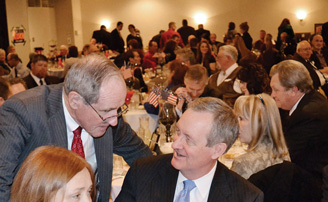
POCATELLO — While Republicans from all over the state and Bannock County converged at the Clarion Inn Friday night to build friendships and raise funds, three members of Idaho’s congressional delegation were thinking about big money.
Sens. Jim Risch and Mike Crapo and Rep. Mike Simpson all had on their minds $1.2 trillion in across-the-board cuts in federal spending over the next decade that are set to begin March 1. It’s called the sequester and all three Republican politicians are certain there will be no compromise reached with the Obama administration before the deadline.
“Most Americans don’t have a good understanding of how dangerous it is,” Risch said about the nation’s financial dilemma. “We’re borrowing 40 cents out of every dollar we spend.”
Risch was recently ranked the “most conservative” member of the U.S. Senate by the National Journal. It puts the second-highest ranking member of the Senate Foreign Relations Committee ahead of Jim DeMint of South Carolina or Mike Lee of Utah.
“I joke that people didn’t send me to Washington to be a liberal,” Risch said.
The National Journal ranking is based on a comparison of more than 100 votes taken by U.S. Senators during the past session of Congress.
“My voting is totally driven by the financial condition of the country,” Risch said.
It’s that and what he describes as an “oath to uphold the Constitution.”
He said his recent vote against the Violence Against Women Act did not come because he doesn’t abhor violence against females, it was because he doesn’t feel the federal government has any place in the regulation of issues better handled by states.
“I think violence against women is awful,” Risch said, pointing to his experience as Ada County prosecutor where he put perpetrators of domestic violence behind bars. “But I don’t want federal enforcement of laws.”
Growing federal regulations and mandates are largely responsible for the financial problems the country is suffering, according to the senator. Risch said the fact about 56 percent of the entire federal budget is spent on entitlements — unemployment, Social Security, Medicaid and Medicare — is making the financial situation even worse.
Crapo agrees.
The reason the sequester cuts will be painful to the federal budget is because they focus only on discretionary spending. And they are across-the-board for all federal agencies without flexibility. This is why cuts to the Transportation, Energy and National Park Service will be noticeable to Idahoans who use local airports, rely on the Idaho National Laboratory or frequent Yellowstone or Grand Teton National Parks.
“Across-the-board cuts hurt the agencies’ abilities to make decisions for efficient savings,” Crapo said.
Although Crapo and Risch don’t see any action on the sequester happening before the March 1 deadline, they are hopeful some plan can be drafted to give federal agencies more flexibility in absorbing budget cuts.
“The climate in Washington right now is so toxic,” Crapo said about divisions between the Obama Administration and Republicans in Congress.
“Raising taxes isn’t the answer,” Crapo said. “We must cut spending.”
Crapo was a member of the Simpson-Bowles Commission formed by Obama in 2010 with equal representation from both parties to forge a plan to reduce the national deficit. Crapo said the commission examined everything from tax reform to cuts in entitlements.
“We laid it all out and that was the problem,” Crapo said. “Lobbyists from the right and left attacked it.”
Failure to adopt a long-range plan led to fights over raising the debt ceiling and funding government. The eventual outcome was automatic across-the-board cuts should Congress and the president fail to agree. This became known as the sequester and the trigger begins March 1.
Rep. Simpson said the sequester deadline is one of three fiscal crises facing the country this spring. Funding for the federal government runs out March 29 and America will hit its debt ceiling again sometime in May.
Simpson said a “big plan” has to be forged that includes tax reform, entitlement reform and curbing spending.
“This problem needs to be solved,” Simpson said.
Crapo said President Obama seems dead set on raising tax revenue and that will be a tough sell to the Republican Party. Although some compromise will have to be made by both sides, Crapo doesn’t know who will flinch first once the sequester begins.
“It’s important for us to resolve this quickly,” Crapo said.
All three Republicans said the Obama Administration wants to the public to blame them for the pain that the sequester cuts will bring.
“The administration will try to make it as ugly as possible,” Simpson said.
Despite the mounting pressure that awaits the Idaho delegation in Washington, they enjoyed the banquet held by their local party.
In addition to Simpson, Crapo and Risch, the more than 200 people attending included state controller Brandon Woolf, state treasurer Ron Crane, Idaho Secretary of State Ben Ysursa, Lt. Gov. Brad Little, Idaho Attorney General Lawrence Wasden and state superintendent Tom Luna.
Republican legislators Kelley Packer, Ken Andrus and Jim Guthrie also attended, along with Chubbuck and Pocatello mayors Steve England and Brian Blad, and Bannock County commissioners Karl Anderson, Steve Hadley and Howard Manwaring.
The emcee for the evening was KISU station manager Jerry Miller who brought laughter from the crowd when he credited Risch with being the most conservative senator in the nation and added, “I might be the most conservative general manager of a National Public Radio station.”

(0) comments
Welcome to the discussion.
Log In