

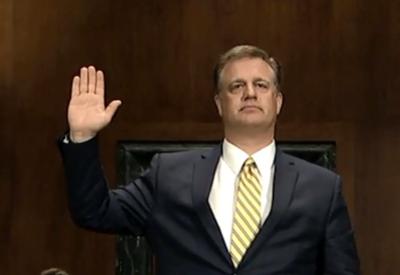

The nation’s highest-ranking judge just got involved in a case that started with a parking lot confrontation in Idaho Falls.
The U.S. 9th Circuit announced Tuesday that Chief Justice John G. Roberts, Jr. has transferred the judicial conduct and disability complaint levied against U.S. Circuit Judge Ryan D. Nelson to the Judicial Council of the 4th Circuit.
The transfer was made under Rule 26 of the Rules for Judicial-Conduct and Judicial-Disability Proceedings and at the request of Chief 9th Circuit Judge Mary H. Murguia, who initiated the complaint against Nelson on June 8 after the Idaho State Journal published a story about Nelson facing misdemeanor battery and malicious injury to property charges following an April confrontation over a parking space in Idaho Falls.
Nelson is alleged to have swiped the glasses from a man’s face, tossed them across an asphalt lot and stomped on them during the incident.
Nelson, 52, of Idaho Falls, was charged April 22 by Idaho Falls city prosecuting attorney Zachary H. Jones with battery and malicious injury to property, both misdemeanors, in Idaho’s 7th Judicial District Court. He entered not guilty pleas to both charges May 13.
According to court records and a video of the incident obtained by the Journal, Nelson got out of his truck and approached the man in the Memorial Drive parking lot after the man told him to “learn how to park.” Within roughly 12 seconds, Nelson appears to swipe at the man’s face, sending his glasses flying some 50 feet across the asphalt lot. Nelson then ran past the man toward where the glasses had landed and stomped on them.
Video of the confrontation between U.S. 9th Circuit Court of Appeals Judge Ryan Douglas Nelson and an Idaho Falls man on April 2 resulting in Nelson being charged with misdemeanor battery and malicious injury to property charges.
When reached for comment after the Journal’s initial report, Nelson’s attorney Curtis R. Smith said his client “maintains a presumption of innocence” and called the charges personal matters “unrelated to his professional position.” Nelson himself admitted to an officer that he knocked the glasses from the man’s head and stomped on them, but said he did not otherwise touch him, according to the affidavit of probable cause.
Nelson is next scheduled to appear before 7th District Magistrate Judge John C. Dewey at the Bonneville County Courthouse in Idaho Falls for a pretrial conference on July 16.
Roberts will not play a substantive role in the case; instead, his involvement is more of an administrative move that, in essence, recuses the 9th Circuit and the judges who know Nelson from ruling on a matter involving one of their peers.
By transferring the complaint to the 4th Circuit — based in Richmond, Virginia, and covering Virginia, Maryland, West Virginia, North Carolina, and South Carolina —the 9th Circuit is handing the investigation to judges who have no professional relationship with Nelson.
It’s not an unusual step in high-profile or sensitive cases involving sitting judges that’s typically done to avoid both real and perceived conflict-of-interest. The fact Murguia herself requested the transfer signals she wanted the matter handled at arm’s length from the 9th Circuit from the outset.
“Rule 26 authorizes the transfer of a complaint proceeding to another judicial council selected by the Chief Justice,” according to the federal rules governing judicial misconduct proceedings. “Such transfers may be appropriate, for example, in the case of a serious complaint where … the issues are highly visible and a local disposition may weaken public confidence in the process.”
Rule 26 exists precisely for this situation. But it does mean the 4th Circuit’s Judicial Council now owns the investigation entirely, and any future proceedings, findings or disciplinary actions will come from that body, not the 9th Circuit.
The process moving forward won’t change, just the body. So instead of Murguia, it will be 4th Circuit Chief Judge Albert Diaz who will conduct an initial review of the complaint to determine whether it warrants a full investigation. Judge Nelson may be asked to submit a written response during that process.
If the matter advances, a three-judge panel would be appointed to formally investigate — gathering evidence and potentially taking testimony before reporting its findings to the full Judicial Council. The process will be confidential under U.S. law.
The council can then impose a range of consequences, from a private or public reprimand to requesting Nelson voluntarily retire. In the most extreme cases, the council can refer the matter to Congress, where impeachment is the only mechanism for removing federal judges — who hold lifetime appointments.

(1) comment
Here's hoping that video stays in evidence.
Welcome to the discussion.
Log In