

FORT HALL — The morning of Saturday, Jan. 26, was beautiful and pleasant for the buffalo hunt unlike many of the fierce January mornings that can chill any winter lover. The morning was overcast with reminisce of fog lingering in the distance, but children’s excitement was remarkable and could be felt in the air. Families and tribal members began to meet at Timbee Hall as Larry Murillo and Tom Wadsworth gave some instructions to the children, and a prayer followed to signify their respect for the buffalo they would be hunting that morning.
Trucks and cars crowded around the south pasture corral and began piling out with the arrival of the buffalo’s caretaker Lance Tissidimit.
Tom Wadsworth, who would be assisting Lance during the hunt spoke about the importance of doing things with respect. “In our lifetime, Lance and I have learned a lot about hunting and about doing things right — we always say our prayers and are respectful. We noticed that sometimes in life we get comfortable with our routines, and we forget about prayer and respect. But for us, we noticed certain things weren’t going right in our lives; we went back to prayers, and things have been taken care of for us. I would like to encourage all of the young people to learn about the teachings in your families, and to do them according to how you were taught. We will proceed the best way we can today,” he said.
Tissidimit, who serves as the Shoshone-Bannock’s Buffalo caretaker, explained to the group the Shoshone-Bannock Tribes have 345 buffalo in their herd with varying ages from 2 year olds to the oldest, a bull that is 15 years old. The buffalo are separated into two pastures, north and south, and the hunt would take place in the north pasture.
“We try to keep them in a natural state anytime we go out into the pastures. Buffalo will run until their hearts burst. The buffalo that we received are from the Teddy Roosevelt National Park. They were brought to the Fort Hall Townsite on trains where they remained until they were moved down to the bottoms. The shorter and stocky buffalo are a cross of plains, and wood bison which are taller with longer necks and more apparent in the males,” explained Tissidimit.
Wadsworth and Tissidimit, who are experienced hunters, asked that two young boys come with them so that they may learn something valuable, and observe their first buffalo hunt.
Before getting into the truck, Tissidimit offered a closing remark. “Always wait for the best shot. Don’t force it. The best hunters will wait for the perfect shot, and that doesn’t always happen the moment you see an animal. Sometimes your first shot can drop a buffalo, but I’ve seen older buffalo drop after 20 shots, but it’s vital that you make that first shot count, so they don’t have to suffer either.”
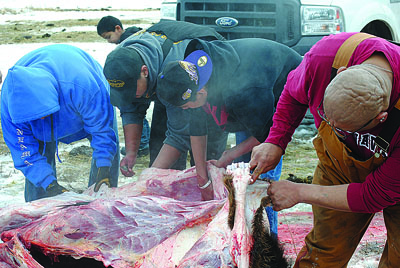
As the truck drove into the pasture, kids and adults lined the fences and posts, forgetting the numbness of their feet as many hearts young and old surged with excitement for the hunt. After the first shot, kids stomped their feet and excitedly repeated to one another that a buffalo had been shot, and it wasn’t long before cars and trucks began driving up to the pickup truck, and created a circle around the hunters and buffalo. Children crowded around the buffalo and reached out to feel the massive animal’s fur. But then the real education was about to commence; taking care of the buffalo became to focus.
Children were instructed to pay attention, and try to keep their voices to a minimum to not only show respect for the life that was taken, but also so they could one day hunt and take care of an animal on their own.
Before the cleaning began, Charlene Wahtomy said a few words. “I’m very excited that so many families have brought out their children because sometime children get pushed to the back and forgotten about. But they need to be ceremonies, at hunts like this, learning. I wanted this day to be dedicated to the children, so I’d like to ask adults to stand back, give advice, but let the children learn. And you children, I encourage you to get involved but be sure to pay attention! This hide is precious, and will be part of a drum for the Sundance,” she said.
After the hide was removed, the rest of the buffalo was transported to Buffalo Lodge where various families and children worked to cut the meat up, while some ventured outside to watch how rabbits would be taken care of, and finally some participated in making frybread. The atmosphere was joyous but ended on a solemn note, and a reminder that should man-made power disappear, Indian people will need to call on their traditional knowledge in order to survive.
“My father shared a dream with me, and it is something that I will keep sharing because one day it will happen; we will all die if we forget about our traditional ceremonies, foods and medicines. We need to keep talking to our kids about hunting, and teach them to take care of one another. I hope everyone will get a blessing today and remember that a life was taken today so that we may live another day. Be thankful,” Charlene concluded.

(0) comments
Welcome to the discussion.
Log In