

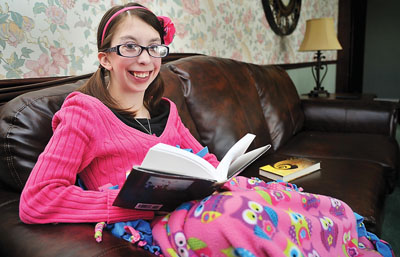
POCATELLO — After receiving some of the best news of her life just prior to Christmas, Sarah Brown is looking forward to what the new year holds for her. The Wednesday before Christmas the 19-year-old received word from her doctors that she will be eligible for a heart transplant sometime early this year.
After years of complications, multiple surgeries and endless trips to Primary Children’s Hospital in Salt Lake City, Sarah is one step away from getting on a heart transplant list that could significantly improve the quality of life she lives.
“I really want to become a runner,” Sarah said. Something that hasn’t been possible in her life up to this point due to her heart issues, but it’s something she said she’s wanted to do her entire life.
“All my friends joke with me that they can’t wait until I get my new heart so they can go running with me,” she said with excitement.
While running may be a long way off, just the thought of being able to lace up a pair of sneakers at some point down the road is a miracle of it’s own. That’s because Sarah was born with several life threatening heart defects.
Sarah was born in Rexburg, to parents Julia and Pocatello City Councilman Steve Brown, who had no idea she had any issues when she arrived in this world. Hours after Sarah’s birth, while Julia slept recovering from giving birth and father Steve was home showering, a nurse noticed Sarah was turning blue.
The nurse knew that was a sign Sarah wasn’t responding to oxygen and may have something wrong with her heart. Quickly the nurse gave Sarah a steroid medicine to keep a duct in her heart open and she was life-flighted to Primary Children’s immediately.
She had an angel that was watching over her that day,” Julia said about the nurse. “She saved our daughters life.”
Sarah was diagnosed at Primary’s with Pulmonary Artesia, Transposition, ASD/VSD Atrial & Ventricular Septal Defect, and a Hypoplastic Left Ventricle. All serious heart conditions on their individually, collectively they can be deadly.
When Sarah was 5 days old she received her first surgery when doctors put in a shunt to connect her pulmonary artery to the aorta, which helped Sarah’s blood to receive the oxygen it desperately needed. A week after surgery Sarah headed home, doctors hoped her left ventricle would begin to grow on it’s own, but it never did.
When she was 13 months Sarah began to turn purple and became lethargic, she was once again taken to Primary Children’s Hospital to have an emergency surgery to put in another shunt that saved her life. The first shunt was closing off due to scar and ductal tissue, and that’s when the family decided to go ahead with plans to do both a Glen and Fontan heart procedures. But before the surgeries could take place Sarah’s health needed to improve drastically before they could be done.
Five months after making the decision to have the surgeries Sarah’s health had improved enough to go forward with the Glen procedure, where they opened up the septal tissue between the atrium and ventricle and hooked the main arteries from her neck directly into her pulmonary artery.
After complications from that surgery and five months and two surgeries later her health improved enough to allow her to go home.
Just before her fifth birthday Sarah had a Fontan surgery that hooked the main arteries from the bottom half of her body directly into her pulmonary artery allowing the blood to flow from the body and then through the lungs into the single atrium, and then through the ventricle and pumped by the ventricle back out to the body.
The Fontan surgery allowed Sarah to resume a somewhat normal life for nearly five years until she was ten years old and her protein levels in her blood began to drop. Sarah was diagnosed with Protein Losing Enteropathy, where the proteins are not absorbed in the intestines and it produces more fluid to flush out which causes swelling, diarrhea and vomiting.
Living with the day to day symptoms of PLE Sarah resumed her life without many serious complications until she was a sophomore at Century High School when the PLE ravaged her body causing her to become seriously ill. After months of trying various medication to control the symptoms of PLE Sarah finally found one that helped her flare-ups and kept the PLE under control for awhile.
In October 2011, the Fall after Sarah graduated from high school, she contracted a stomach virus that kicked the PLE into gear again. After another visit to Primary’s and many tests later she was sent home without receiving a real solution to her illness.
Weeks passed while living with a fever that never went away and she was life-flighted again to Primary Children’s where she underwent more testing that revealed she had bacterial peritonitis, which is an infection in the fluid of the belly. Sarah was prescribed antibiotics to add to her growing collection of medications she takes daily.
Sarah says as awful of an experience as that month was, a lot of miracles came about including meeting her new cardiologist Dr. Yetman. Yetman is a heart doctor that works with adults that had heart defects as babies. During more tests Dr. Yetman found out that Sarah had cirrhosis, or scaring of the liver, and that she may also need a liver transplant.
Since Sarah is an adult now her care was transferred from Primary Children’s to the University of Utah Hospital where she was told there may be a possibility that she could receive a heart and liver transplant.
“When she was born her doctor said she had to many complications to ever have a heart transplant,” said Julia. “It wasn’t until 2011 that we were told a heart transplant could be a possibility.”
Sarah received a call from the doctor’s at the university that said they were not comfortable doing a heart transplant or a liver transplant. So Sarah made a call back to Dr. Yetman at Primary Children’s and they ran more tests on her liver which yielded no significant results of damage.
So just a couple weeks ago Sarah met with the heart team at Primary Children’s about the possibility of getting a heart transplant and all follow-up work done there. That’s when she received one of the greatest early Christmas presents of her life, a phone call the Wednesday before Christmas telling Sarah and her family that she was eligible to get her heart transplant surgery done at Primary Children’s.
“It was our Christmas miracle,” said Julia upon receiving the call.
Sarah has a checkup on January 10, where she will receive post-transplant education, more testing and best of all her name will be placed on the list for heart transplant recipients.
“I want to go to LDS business college in Salt lake City,” Sarah said. “Then I want to be an interior designer.”
After her checkup next week, Sarah says there’s a possibility she could be on the list and possibly receive her heart before the end of January. When she is atop the transplant list she’ll have to live within 2 hours of Primary Children’s and plans on staying with family in the Salt Lake area until that fateful day arrives.
“I’m so thankful that I’ll have the ability to get my surgery done where I want it,” Sarah said “Down the road I’d like to get married and have kid’s.”
More than anything the Brown family would like to raise awareness for organ donation and educate people on how donating their organs can save the lives of many, including their daughter.
“It’s all about raising awareness,” said Julia. “I have a friend that said she was never an organ donor until Sarah was born, and when Sarah was born she knew someday she may need a heart and she decided she wanted to be a donor.”
For more information about Sarah and her story, visit the blog she and her family has setup at sarahssecondchance.net.
“There’s a lot of people that don’t have the opportunity to live that should because so many people fail to register as a donor,” said Steve. “I know there are some religious reasons that some folks wouldn’t want to, but outside of that I can’t think of very many reasons why you wouldn’t want to become an organ donor and help other people at an opportunity at a longer life, especially kids.”

(0) comments
Welcome to the discussion.
Log In