

IDAHO FALLS — What started with search and arrest warrants soon turned into a rescue mission involving a host of Eastern Idaho agencies.
This wasn’t a real-life emergency, but a real-life training scenario years in the making.
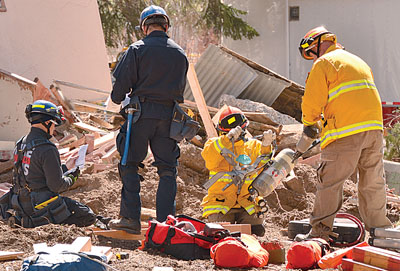
Using a vacant city-owned building on Rollandet Avenue, teams worked for three days completing objectives seldom present in training simulations.
“We were going to do this drill a year ago and because of budgets the state lost the money it was going to use, so we just had to wait,” said Brad Pettingill, division chief for the Idaho Falls Fire Department.
Members of the Idaho Falls Police Department, Region 3 Idaho Technical Rescue Team, Idaho Bureau of Homeland Security, Region 7 Hazmat and Idaho Falls Regional Bomb Squad were just a few of the agencies involved in this hands-on training exercise.
Each agency had its turn in the scenario as the hours progressed.
It started with the police department calling in the hazmat team after discovering meth lab chemicals, who then beckoned the bomb squad after finding explosives, leading to a final “explosion” that “trapped” workers in the building.
A rescue mission ensued, explained Joelyn Hansen, community projects coordinator for the IFPD.
The structural damage to the house came by way of a backhoe, not an actual explosion. Yet, it was enough damage to mimic a real-life explosion.
“The ability to have a prop like this is priceless for training opportunities because you can sit in class and learn about things but when you get here and actually put it into practice — it really is an opportunity for them,” said Robert Feeley, public relations officer for Idaho Bureau of Homeland Security.
On Thursday, members of the Region 3 ITR, which includes the Idaho Falls Fire Department and Pocatello Fire Department, were on the scene “shoring” the collapsing house with metal rods and wooden boards taken from an on-site trailer full of building materials.
Firefighters had to complete shoring the dismantled house before they could enter and search for the victims.
The concept of shoring is similar to buttressing, where boards are secured vertically against an unstable structure to stabilize it and prevent further settling.
“This is huge to be able to have something like this, real-life and be able to execute the shoring,” said Pettingill.
Early Thursday two dummies, that is — victims, were pulled from the disaster site and crews worked to free the last victim they knew of in 12-hour operational periods.
Once the first 12-hour period is finished, crews must be briefed and debriefed before the next 12-hour shift commences.
“It’s very similar to the operational periods we had during the Charlotte fire,” said Tom Sanford, battalion chief for the PFD.
“The objective is our ability to work well together as a rescue team, he added.
During a disaster drill of this magnitude, safety precautions are the first priority.
Coleen A. Rice, state training & exercise program manager for the Idaho Military Division BHS was on the scene to monitor safety.
“This is not a simulated event, it’s a real event,” she said.
“There’s always a safety officer here because that’s the most important thing.”
The city hired a construction crew to tear down and clear away the building’s remnants.

(0) comments
Welcome to the discussion.
Log In