

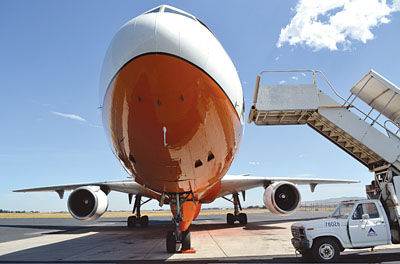
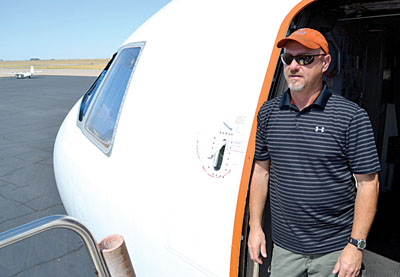

With Kevin Hopf in the pilot’s seat, his DC-10 jumbo jet floats like a butterfly and smothers like an avalanche. The payload it drops on a wildfire is 102,000 pounds of red fire retardant.
“Managing that momentum is the hardest thing,” Hopf said.
It is a skill that began when Hopf flew for commercial airlines for 25 years, often piloting a DC-10 filled with a crew and passengers. But his love for aviation and the art of fighting fires from the sky came from Hopf’s two years co-piloting smaller fire retardant planes in Arizona.
When Hopf was attending high school in Prescott, Ariz., he spent summers mixing fire retardant and helping load it on firefighting planes. His father, Jerry, who was a private pilot and airplane enthusiast pushed his son to get involved in aviation. It’s a push Hopf said he has always appreciated.
“When I was loading planes, that was a lot of hard work,” he said. But as he watched Lockheed P2 Neptune fire bombers take off, “I knew I wanted to do that,” he said.
Hopf’s drive was amplified by encouragement from his dad.
“He pushed me real hard through my flight training,” Hopf said.
The effort paid off in the summers of 1985 and 1986 when Hopf co-piloted a P2 through those fire seasons. The payload on the Neptune was 2,700 gallons of retardant. Today, the DC-10 that Hopf flies can bring 11,600 gallons of fire killer to a mountainside each sortie.
Computerized controls on tanks mounted under the massive jet allow the crew to deliver one massive trail of retardant or several smaller strikes.
The tank system is actually older technology modified from those used on Erickson Skycrane helicopters. The big difference – and it is big – is the DC-10 has three massive tanks mounted under it.
The DC-10 has managed to make nine different attacks in a single day on three different occasions during its service as a firefighter.
In the cockpit with Hopf this fire season is pilot Dan Montelli and flight engineer, Rich Joseph. Joseph served as a mechanic and flight engineer on DC-10s and Montelli flew commercial versions of the airliner just like Hopf did.
It was in 2004 that Hopf’s flying world changed. The airline where he worked was retiring some of its DC-10s and it wanted to revamp them as massive firefighting planes. They needed pilots and Hopf jumped at the chance. The new company was 10 Tanker Air Carrier and Hopf joined the crew of one of only two DC-10s fighting fires today.
“It was being at the right place at the right time and knowing the right people,” Hopf said.
There were skeptics about the widebody jet joining the aerial weapons to fight wildfires, but Hopf said the effectiveness of the large craft has proven its worth. And then there is the joy of flying a DC-10 low and into the heat of battle.
Once the crew receives a fire call dispatch, the fun begins.
Fully loaded, Hopf’s DC-10 at Pocatello Regional Airport took off after receiving a call to a wildfire near Twin Falls about 11:57 a.m. Saturday. The day before, Hopf and his crew had been dispatched to the wildfire near Lava Hot Springs.
Hopf said his crew stays glued to the radio frequency of the spotter plan working a fire as soon as the big jet is about 30 miles from the blaze.
“We make a call and let them know we’re coming in,” Hopf said. The controller in the smaller plane manages the assets in the air and keeps everyone safe. As the jet approaches a fire, instructions involving the terrain and direction of attack become more specific. At times, the DC-10 follows another smaller lighter craft into an attack – and it stays right with the smaller plane despite its massive size.
“It’s got a big, thick wing which means it’s good at maneuvering at slow speeds,” Kopf said about his McDonnell Douglas monster. “Size doesn’t matter. It’s all relative to air speed. The plane is very forgiving.”
With a giant payload, it also delivers a punch.
Hopf and his crew have fought fires in eight states so far this season. They begin their training each year in April and continue flying and fighting fires until the end of November.
Although the big plane is nimble in the hands of an experienced pilot, Kopf recognizes it does have some limitations — like narrow canyons. But the fact the jet can drop tons of retardant from a slightly higher elevation and still smother flames compensates for any drawbacks.
Inside the fuselage of the plane, there are no seats to put in the upright position or trays to worry about. The space is empty where passengers would routinely sit and the walls are lined with insulation. Weight is saved for fuel, about 45,000 pounds, and the tons of retardant in the tanks below.
Flying it to the target is Hopf’s job and he said he loves it.
“When you’re flying commercial you’re just simply a driver and everything is controlled,” Hopf said. “With this it’s up to us. It’s hands-on flying.”
It’s also something Hopf said he plans to do until he retires from the air.

(0) comments
Welcome to the discussion.
Log In