

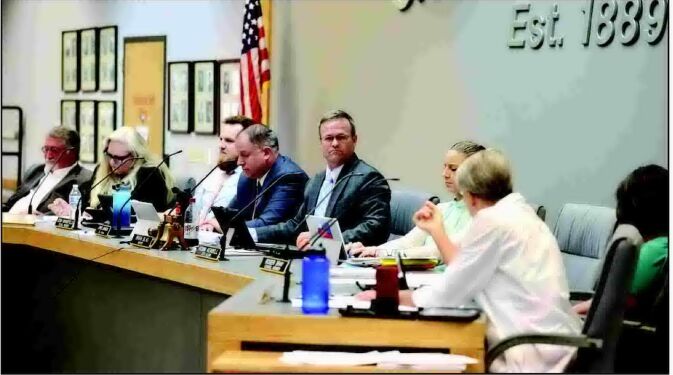
POCATELLO — Contention and conflict took center stage Thursday evening as members of the Pocatello City Council voted to censure councilman Roger Bray and reaffirm the Gate City as a welcoming and inclusive place to live.
The broken relationship among members of the City Council and Pocatello Mayor Brian Blad was on full display and tensions escalated throughout the two-hour meeting.
Statements from council member Christine Stevens were described by Blad as being some of the most racist he's ever heard.
Angry quarrels between the mayor and council members Claudia Ortega and Stevens were frequent. City Attorney Jared Johnson on several occasions during the meeting pleaded with Ortega and Stevens from delivering comments that could cause liability concerns for the city.
And lastly, Ortega walked out near the end of the meeting as a Pakistani immigrant and member of the community since 2007 spoke out about recent comments Bray made during previous council meetings, in subsequent statements and in a recent column published in the Idaho State Journal regarding diversity, crime and police staffing in Pocatello.
Those words written and spoken by Bray, who was absent from Thursday's meeting following a Wednesday COVID-19 diagnosis, have caused existing animosities on the City Council to overflow.
"It's sickening," Blad said as he walked out of the council chambers at City Hall following Thursday's meeting. "It's just absolutely sickening."
The fact Blad put the resolution on Thursday's council agenda to censure Bray for his remarks as well as reaffirm Pocatello's status as a welcoming community seemed to set the stage for the ugliness that followed.
The resolution discussion began with a failed motion from Stevens, who moved to separate the proposed censuring of Bray from the reaffirming of Pocatello as a welcoming city into two separate resolutions. Stevens and Ortega voted in favor of the motion while council members Rick Cheatum, Linda Leeuwrik and Josh Mansfield voted against it. Each member of the City
Council then read prepared statements about the resolution. After the statements from Leeurwrik and Mansfield, Stevens read a statement Bray provided to her in advance of the meeting for her to read on his behalf.
It was during Stevens' and Ortega's statements that Johnson cautioned them from referencing any city employee by name as it could put the city in a difficult legal position.
Stevens, during both her statement and while reading Bray's prepared remarks, and Ortega accused the city's police chief of retaliating against Ortega when she questioned his budget a few years ago, prompting the words of caution from Johnson.
Stevens, in her statement, questioned how much of a welcoming city Pocatello really is, citing as evidence what she described as a poor relationship between the city and members of the Shoshone-Bannock Tribes on the Fort Hall Reservation.
“Regarding the portion of the resolution stating that Pocatello has had a warm and welcoming relationship with diverse peoples, including indigenous tribes, since our inception (is) insulting and a perfect example of white culture rewriting history to make itself look good,” Stevens said.
“Did anyone run this language by the Tribal Council in Fort Hall to see if they have the same view of our inclusive, respectful relationship over the decades? If we have such a wonderful relationship with our indigenous community members and neighbors, why do they repeatedly take us to court? I certainly did not hear that the relationship between Pocatello and indigenous people was great when I was (a principal) at Hawthorne (Middle School) and served a number of Native American students and their families.”
Stevens claimed Blad made previous statements to her about the Shoshone Bannock Tribes that she deemed racist and moved to censure Blad during the meeting, though Blad and Johnson quickly rebuffed the attempt as something that was not on the agenda and therefore not up for discussion. Stevens claimed that when she, Ortega and Bray question city departments that they are “screamed at by the mayor or city employees and labeled bullies.”
In his statement, Mansfield was critical of the comments Bray made during a July 7 budget meeting and a subsequent interaction Bray had with Pocatello police officers and members of the Pocatello NAACP following a July 21 meeting at City Hall that served as the catalysts for the effort to censure Bray. Bray said during the July 7 meeting, “We have had a very efficient (police) department, we’ve been able to take care of that (staffing) ratio, because we are not as diverse a community as some.” The comment caught the attention of the Pocatello NAACP branch.
At the July 21 council meeting, Pocatello NAACP President Ken Monroe took issue with what Bray had said and expressed disappointment with the City Council for not condemning the councilman’s words during the July 7 meeting. Immediately following the July 21 meeting, a confrontation occurred at City Hall between Bray, local NAACP members and Pocatello police officers and involved Bray making racist comments, according to statements delivered by Mansfield and Leeuwrik Thursday evening. Mansfield, Leeuwrik and several others were present during the confrontation.
The Pocatello police and firefighters unions and the Pocatello teachers union called for Bray to resign in the days following the confrontation. Mansfield during Thursday evening’s council meeting said, “The argument that diversity leads to increased crime is one that’s been used for decades and most prominently in anti-immigration legislation because it’s designed to create a false dichotomy that says either you can be diverse, but have the complications that come with it, or you can just remain homogeneous with life being easy.
It’s a false dichotomy and one that we should outright reject, especially as the diverse members of our community express hurt and offense at the comments that were made.” Mansfield described Bray’s comments as “deeply hurtful and offensive” and called for their outright rejection. Mansfield also criticized Bray’s recent column in the Journal that explained his view of diversity is nuanced and his comment at the July 7 meeting was not centered around race.
“I want it to be on the record that while councilman Bray’s article in the Journal attempted to argue that diversity wasn’t referring to race, I would like to recall his final statement on the night of July 21 during his argument with members of the NAACP where he stated that, ‘We all know that Hispanics don’t get along well with certain groups.’ To directly target a specific ethnic group, generalize them and then say that their pattern of behavior is a reason why diversity is hard, is outraging.”
Leeuwrik said she was voting in favor of censuring Bray because of the comments he made and not for political gain, adding that she believes the entire situation could have been resolved had Bray simply said he was sorry. “While I do believe that the comment (Bray) originally made was inherently racist, I think that at that point the situation could have been handled with open and transparent dialogue … and an apology. That was all that was needed — some talking this through and some recognition of understanding that people have been hurt,” Leeuwrik said. “Unfortunately, that didn’t happen and things got much worse from there. So I want to be very clear that the reason I believe a strong statement of condemnation from this council is not only warranted, but is imperative, is not about what happened on July 7 or even how Mr. Bray claims that he was defining diversity.
There was a lot of argument over what he meant by that. Rather, my reason is the horrendous incident that took place on July 21 right here in this council chamber following our regular council meeting that evening. Unfortunately, that part was not on the record but many people were present…. Mr. Bray aggressively tried to argue, explain, justify and defend his original comment in a way that left absolutely no doubt whatsoever about what he meant. It was one of the most disgraceful displays that I’ve ever witnessed.”
Bray’s prepared statement delivered by Stevens began with explaining that nobody from the NAACP, the mayor’s office, the council or any of the three local unions that recently called for his resignation approached him to seek clarification or understand his position. “I have been charged and convicted and those accusing and condemning me do not care to hear what I have to say,” Bray said in his statement that was read by Stevens. “The lack of concern for objectivity is staggering. I believe this resolution is intentionally constructed to hamstring me.
If I were present to vote, I could not vote for the revised welcoming statement because I must recuse myself due to the censure being included in the same resolution.” Bray reiterated in his statement that those concerned with his remarks don’t understand what he meant when he used the word diversity and he described the censure against him as a distraction tactic. “My use of the word diverse was intentional, knowing that the current accepted definition of diversity includes many issues beyond race, such as gender, income level, educational background, urban and rural status, ethnicity, religion, culture, economic status and more,” Bray said in his statement read by Stevens.
“It seems others have defined diversity differently for themselves. I would have gladly clarified my definition had they bothered to ask me. Those who are condemning me repeatedly cut me off, refusing to let me finish my statements so they could twist my words to support their pre-planned agenda. This maneuver is designed to deflect from the current important conversation on the table, our city budget and our personnel costs.
It saddens me to see a community I grew up in and have served for three decades fall victim to this situation.” Ortega called for Pocatello Police Chief Roger Schei to resign in her statement, claiming he made a racist remark when he wrote in a 2020 federal COPS grant application requesting additional officers that “the influx of a transient population of construction personnel involved with the build up (of the Northgate development project) has and will continue to place an ever increasing drain on our current resources.” When Johnson warned Ortega about the potential legal ramifications of her statement, she replied by saying,
“I don’t care.... I am exercising my First Amendment right.” Ortega explained she is the only minority member on the City Council and said she has encountered racism herself here in Pocatello and while serving on the City Council. “I have actually experienced racism all of the time that I’ve lived in this country.
I continue to experience it today. I’ve experienced it in this room at the hands of these people over here,” she said as she gestured toward some of her fellow council members. “I know what it looks like. And I agree with every comment that there is no place in our city, in fact in our world, for racism.
There isn’t. And there’s no excuse for it.” It was during Cheatum’s statement, in which he too condemned Bray for his remarks, that a tense exchange between Cheatum and Ortega broke out. The back-and-forth required Blad’s intervention. Blad and Ortega also engaged in a heated exchange in which she yelled that city employees quit because of him.
Ortega at one point during Thursday evening’s meeting mentioned by name Pocatello police Sgt. Akilah Lacey, who was one of the individuals involved in the July 21 confrontation with Bray, and an exchange ensued between the two while Lacey was seated in the audience. Lacey reiterated from the crowded audience his belief that Bray’s comments during the confrontation were racist. Stevens at one point attempted to explain that when she was living in New York City one of the largest problems was that “black Puerto Ricans did not get along with the white Puerto Ricans,” eliciting a stern demand from Blad to refocus her comments.
“Why don’t we stop right there,” Blad yelled. “Let’s stop. Let’s stop the racial comments. This is ridiculous. This is unbelievable to me.” Stevens replied, “Only because you are naive.” Stevens then said, “We know that certain white groups do not get along with immigrant groups. That is not a racist statement.” Blad responded, “Oh my goodness. I can’t think of anything more racist.”
Eventually the City Council voted to pass the resolution by a 3-2 vote. Cheatum, Mansfield and Leeuwrik voted in favor of censuring Bray and reaffirming Pocatello as a welcoming city while both Stevens and Ortega voted in favor of the welcoming affirmation while noting on the record they were not voting in favor of censuring Bray. The censuring of Bray is a formal public reprimand by the council for his remarks and has no other ramifications on him as a council member.
During the subsequent public comment portion of the meeting, Lacey, who’s Black, said he became a police officer knowing there’s a public sentiment among some that people of color are overpoliced. He spoke about his experience living in Pocatello for the past two decades, drawing an emotional response from Leeuwrik and Mansfield, both of whom wiped tears from their eyes as he talked. “I always joke about Pocatello being a vacuum,” Lacey said.
“It sucks you in. The people are so nice, you could purchase a home, you could live the American dream and you may find a beautiful wife from Shelley. Things happen to pull you in.” Ali Khan, a Muslim who moved to Pocatello in 2007 and is from Pakistan, addressed the council, sending his well wishes to Bray in his recovery from COVID-19 so that the councilman “can come back and sit in this seat and resign.”
When Khan attempted to discuss Bray’s recent column published in the Journal, Stevens and Ortega interrupted, claiming what Khan was about to talk about was an item on the agenda and therefore not something the council rules allowed him to speak about. When Blad allowed Khan to speak about Bray’s column over their objections, Ortega told the mayor, “You just keep making the rules up as long as it suits your political purposes Brian. You’re ridiculous.”
Ortega then gathered her belongings and left while Khan spoke. Khan explained to the council that the only fear human beings have is that of the unknown. “When it is dark we are afraid and the answer is to turn the light on so we can see and not be afraid anymore,” Khan said.
“Today, I stand here with my police union who have sworn to protect me, my firefighter union who saved the life of my father, and my teachers union who educate my two children, and I ask for the resignation of Roger Bray because the answer to dispel the darkness of your thoughts is light.” Khan continued, “The answer to your you-versusus is humanity’s innate tendency to love, not exploit.”

(0) comments
Welcome to the discussion.
Log In