

Jaxon Christensen’s athletic journey feels like a hodgepodge of classic baseball movies, a never-ending montage of classic flicks about America’s pastime.
There’s the freak injury from Rookie of the Year. There’s the father-son bond of Field of Dreams. The romantic nature of the game Moneyball captures so well. Akin to Jimmy Morris in The Rookie, the doubted arm that dazzles on the mound in a body unconventional in the game.
Perhaps there are some Sandlot, Bad News Bears and Major League-type anecdotes from Christensen’s baseball odyssey, but they just don’t slip into the forefront.
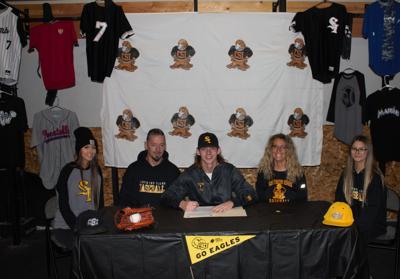
On Saturday, the closing scene of Christensen’s movie commenced. There was no John Williams soundtrack reverberating through BA2 training facility in Chubbuck, but it would have been appropriate. Sitting between his mom and dad, Christensen, the Highland High pitcher, wore a grey hoodie as his long brown hair ducked through the rear of his black hat.
Then he put pen to paper. Just over four months after Christensen committed to play baseball at the College of Southern Idaho, he signed the papers to make it official. The scene was similar to the thousands of signing ceremonies across the country — the makeshift backdrops, the school hats on the table, the college logos on every article of clothing on the table — and it immersed the room in predictable feelings of reflection.
Christensen’s day, though, offered the happy ending for a tale that so many times seemed to be spinning into a Blumhouse horror.
ACT I
Everyone describes Christensen’s pitching motion the same: Whippy. That’s a good and bad thing. On the mound, Christensen’s arm is a spring-loaded catapult. It doesn’t look like it should fling projectiles as far or as fast as it does — which brings us to the bad of a whippy characterization.
Certain frames lend themselves to a “whippy” description. Gumby was whippy. Popeye was not. In other words, at 5-foot-11, 155 pounds, Christensen has to produce velocity somehow — and it’s not coming from sheer power. So he brings his right arm high, lunges off the rubber and flicks his wrist at the top in a motion as quick as blinking.
His fastball can hit the catcher’s leather at 88 mph and if he adds 25 pounds of mass in college, most believe he can touch the mid-90s.
That, along with developing a four-pitch arsenal, has made him such an effective pitcher when his smaller build doesn’t look like the typical flame-thrower who notches college scholarships.
“You always knew he was going to be something special growing up because he just threw hard. He’s super whippy and a lightning-quick arm,” said Christian Colonel, who coached Christensen through the Idaho Prime little league organization and then at Highland High.
“If he keeps growing and developing like he is — and stays healthy and injury-free — he could continue to go on to the next level and the next level and go up to the next level.”
Colonel knows Christensen’s situation. After graduating from American Falls, Colonel was an undersized position player who didn’t receive all the offers he hoped for. His best fit turned out to be CSI, and he parlayed a strong JUCO career into a scholarship at Texas Tech and then a nine-year stint in the minor leagues.
That, to Christensen, is practically the yellow brick road. It’s part of the reason he ended up at Highland in the first place.
The Christensens came to know and form a good relationship with Colonel from their time with Idaho Prime and then hanging around the Next Level and Sandlot hitting complex, of which Colonel was a co-owner. So, before they enrolled at Blackfoot High, where Jaxon’s uncle was the baseball coach, they waited to see if Colonel was going to land a local head baseball coaching gig.
“If he didn’t, I wouldn’t have gone to Highland,” Christensen said.
“We told him, if he gets the job there, then we were going there (to Highland) for sure. Colonel has so many connections with schools and he’s a great coach, great guy. When you’re out on the field, when your dad can’t be there, he’s a good father figure as well.”
ACT II
Colonel saw Christensen’s talent early, vaulting him up to varsity right away and, though there were some consistency issues, Colonel pegged the small, whippy freshman as his ace.
Christensen posted a 5.00 ERA in his first season as a Ram, striking out 39 while walking 37. It was a solid campaign for a youngster, providing glimpses of uncanny talent and the hope that experience would help his control troubles.
But, that came with some nagging issues. Playing quarterback for the Highland freshman football team a few months prior to baseball season, Christensen took a hit in the pocket and landed funny on his butt.
Christensen received X-rays, which failed to show any major fractures or damage. So, naturally, he kept playing sports, kept pitching, kept twisting his back with every pitch, wringing the coil of his vertebrae 100 times a day. His freshman baseball season passed without any concerning or debilitating pain.
That summer, before the first game of his AA American Legion season, Christensen went over to his dad, Jared, and told his back was tight. Christensen popped a few ibuprofen and figured the pain would ease. By the fourth inning, every pitch was causing tears to swell in Christensen’s eyes.
Jared called a chiropractor friend of his, who drove down to the fields and gave Jaxon an on-site adjustment. After several doctors’ visits, the Christensens got news the X-ray failed to provide months earlier.
“Once we did an MRI, they were like, ‘It’s broke all the way through,’” Jared Christensen said. “We found a surgeon — he does three or four of these surgeries a month — and he told us, ‘(Jaxon) is young enough. If we fix it now and he lets it heal properly, I think he’s got a 90% chance to go on about life normally.’
“The baseball, he’s always dreamed of playing college baseball, pro baseball. Beyond baseball, we didn’t want to see him in his mid-30s and have to have a fusion in his back or be on pain pills.”
He knew it was going to force him to miss the entirety of his sophomore season but, perhaps naive to the ordeal, Christensen went into the surgery feeling invincible. Get a quick surgery, he thought, then recover and I’ll be back on the field in no time. Then his back actually got sliced open, the two screws were inserted and the nerves and uncertainty surrounding his future set in.
And Jared was always the one keen on listening to the doctor’s orders. He must have heard the word ‘heal’ a million times that summer, understanding the importance of not coming back too quickly. He was the one with the stop sign, there to quell his son’s urges to throw again, to be a baseball player again.
And they both couldn’t wait for that day to come. They missed the hours and hours of playing catch at the beat-up Cotant Park, just tossing the baseball until it was too dark to see. It’s the father-son bonding ritual that feels timeless, the one that is always taken for granted until it’s gone.
“My dad is my best friend,” Christensen said. “We do a lot of things together. We work out together, play catch together. If it wasn’t for my parents, 1000% I wouldn’t be where I am today.”
Added Jared: “I’ve been his sidekick through this whole thing. I can’t describe it. It’s been a blast — some of the best memories I’ve made in my life have been at the baseball diamond with him.”
ACT III
It was around the winter of his junior year when Christensen got in touch with Colonel and Highland’s varsity catcher, Dylan Jester, asking the pair if they had some free time and wanted to meet him at the school.
That day, Christensen threw his first bullpen in almost a year, his whippy arm flinging pitches once again.
“It just brought back what it felt like to do what I love to do,” Christensen said. “Being able to share that moment with the people I came up doing it with, and especially my dad, was huge for me.”
“I still get emotional,” Jared Christensen added, his voice trembling as he tried to gather his feelings. “Instantly watching I was like, ‘Is your back hurt? Are you OK?’ And he was just all smiling.”
He was smiling that spring, too, when he threw on his Highland hat once more and headed to the mound for the Rams’ first game of 2020. They played Mountain View on Southern Idaho’s campus. By that point, Christensen had an offer but hadn’t made his pledge, which perhaps made his stellar performance that much better.
With his future CSI teammates behind the backstop with radar guns and Golden Eagles’ pitching coach Nick Aiello looking on, Christensen pitched 6 1/3 innings before he hit his pitch count, taking home the victory. He was 1-0 before COVID hit.
“Freshman year, he did really great — second-team all-conference, one of my main guys. Sophomore year, he had back surgery so he didn’t play. Junior year, a freaking pandemic,” Colonel said. “So I’ve only had him one full season … It doesn’t help (his recruitment). Not playing doesn’t help. Anytime time you have an injury, that doesn’t help.”
No, Jaxon Christensen was not put in the best spot to earn a college scholarship. From a family of late-bloomers, he had trouble bulking up. When he should have been fixing his control, he was lying down, hoping his back healed from surgery. During his formative baseball years, he was either injured or in quarantine.
But that whippy arm still produces lasers and ignites hope for the future. And, now, that whippy arm will be pitching in college.
“Seeing your kids be successful and reach their potential and to be resilient, to come through hard situations, to work hard for something they know they want,” Jared Christensen said, “it’s just really, really rewarding.”

(0) comments
Welcome to the discussion.
Log In
The Idaho State Journal invites you to take part in the community conversation. But those who don't play nice may be uninvited. Don't post comments that are off topic, defamatory, libelous, obscene, racist, abusive, threatening or an invasion of privacy. We may remove any comment for any reason or no reason. We encourage you to report abuse, but the decision to delete is ours. Commenters have no expectation of privacy and may be held accountable for their comments. Comments are opinions of the author only, and do not reflect the opinions or views of Idaho State Journal.