

The Utah Conservation Corps (UCC), an AmeriCorps program dedicated to serving public lands and nearby communities through partnership projects, service, and education, is celebrating 10 years of work this year.
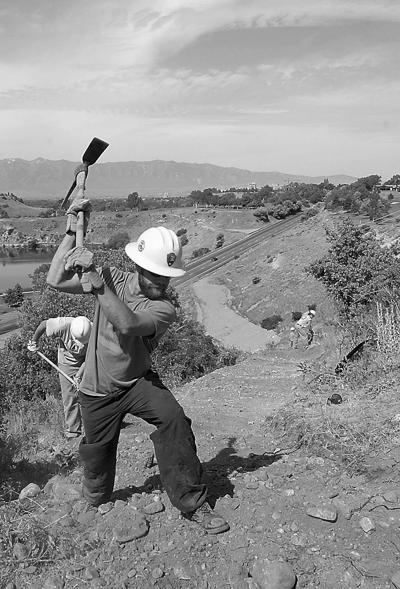
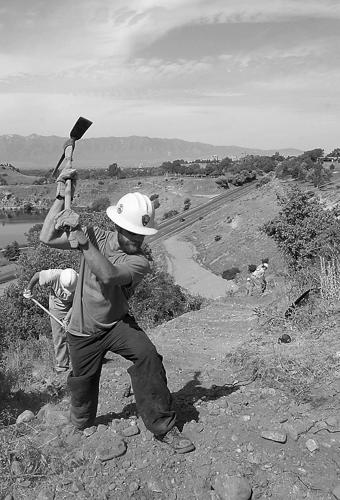
The UCC hosted a banquet honoring its members at Utah State University Alumni House on Aug. 26. The next day, UCC opened a new stretch of singletrack trail in Providence Canyon with a ribbon-cutting ceremony. UCC crews created .9 miles of new trail this summer in partnership with Providence City, Cache County Development Services and Utah Division of Wildlife Resources.
It’s just the latest project completion for the Corps, which, over the last decade, as a department of USU Student Services, has constructed or maintained 808 miles of trail; built, repaired, or rehabilitated 84.7 miles of fence; restored 4,831 acres of public land; and harnessed over 5,700 volunteers contributing 19,500 hours of service.
“Not only are we happy that we have this program, but we’re proud of it,” said James Morales, vice president for student services. “We’re proud because of the opportunity they provide students. They strengthen the community they serve. By participating in the UCC, they get to see what service is all about.”
How UCC got started
IN 1999, Sean Damitz was serving as an AmeriCorps VISTA member at the Val R. Chistensen Service Center. A friend of his at University Nevada-Reno had just started the Nevada Conservation Corp. When Damitz’s friend came back to Logan he thought Damitz would be a good person to start the Utah Conservation Corps.
“It made sense,” Damitz said. “There was no other state-wide Conservation Corps. I was an AmeriCorps member, and I was pretty familiar with the lingo and federal language around AmeriCorps.”
By 2000, Damitz and others had written an AmeriCorps grant, which was funded, and gave birth to the UCC.
Another motivator for Damitz starting UCC besides his friends was that he saw a disconnect.
“I and others thought it was increasingly hard to volunteer for the Forest Service in a meaningful way,” he said. “Declining budgets from the Forest Service at that time and now make it very hard for them to staff a full-time volunteer coordinator position.”
UCC Assistant Director Kate Stephens said she wants to see the UCC field crews — like the ones that constructed Providence Canyon trail — become more “technically savvy.”
“I think after 10 years, we’re going to be spending time this fall really taking a close look at ourselves and determine where we want to go in the future,” Stephens said.
Notable accomplishments
The first project UCC completed was an ADA accessible trail at Capitol Reef National Park. Later on they completed other pathways at High Creek Trail in Richmond and a single-track trail at Green Canyon.
In 2006, the Corps went out of state and tackled natural habitat restoration in the Gulf Coast region in the aftermath of Hurricane Katrina. For five weeks, UCC members spent time reducing fuel loads, maintaining trails, planting marsh grasses and trees and rebuilding fishing piers in the Big Branch National Wildlife Refuge near Lacombe, La.
Last year, UCC accepted applications for a new summer field crew made up of veterans who assisted with projects around the state, including Providence Canyon.
In coming years, Damitz hopes to expand the crew and plans to include disabled veterans next summer.
UCC opened field office in Moab, to add on to the office based at USU, called the Moab Education Center.
“By having staff in both places, we’re able to serve a larger number of agencies,” said Kate Stephens, assistant director of UCC.
UCC impact on Alumni
UCC has grown substantially since 2001, from just 20 to over 100 new members annually. The growth has created a total of over 500 UCC alumni since the program’s inception, Damitz said.
“It’s pretty darn exciting for me because I wasn’t really expecting people to buy into this vision that I and others had when we got started,” Damitz said. “The best part, looking back, is reconnecting with folks that have come through this program and everyone who’s really supported it. When we started it was definitely out of the normal paradigm of a Conservation Corps belonging in a higher education institution. But overtime, it’s proved itself as a worthy idea.”
UCC has formed partnerships with every state and national forest and park in Utah, with the Logan Ranger District being one of its biggest sponsors.
“They’ve helped with general trail clearing that we would not be able to get done on our own budget,” said Ron Vance, a recreation forester on the Logan District. “They’ve helped pinpoint areas where we can improve accessibility (on trails for the disabled).”
The majority of UCC AmeriCorps members are USU students, USU alumni, or local high school graduates. All members serving with the UCC receive a monthly living allowance and earn an education award from the National Service Trust.
Will Munger, a UCC alumnus, came to the program in 2006 as a Corps member and eventually became a crew leader for Las Abejas. Las Abejas was a summer jobs training program for Latino youth, in collaboration with Aggie Blue Bikes and the USU Organic Farm.
“UCC provides a real critical opportunity for youth to build real-world concrete skills, that also address the environmental crisis that we as a nation face,” Munger said.
———

(0) comments
Welcome to the discussion.
Log In