

The state Department of Fish and Wildlife has announced there will be no hunting season for brant geese in Skagit County.
It’s the second consecutive year there will not be brant season in the county.
“Recent aerial counts in Skagit County indicate numbers fell well short of the 3,000-bird minimum requirement to allow brant hunting there this season,” Fish and Wildlife Waterfowl Section Manager Kyle Spragens said in a news release. “These winter surveys, conducted over Padilla, Samish and Fidalgo bays, tallied 1,113 brant.”
A year ago, the survey tallied 1,992 brant.
“While we strive to provide harvest opportunities when appropriate, winter counts below the 3,000-bird threshold in Skagit County require us to restrict hunting opportunities for this unique coastal waterfowl species to meet our conservation objectives in Washington and the Pacific Flyway,” Spragens said.
Washington Brant Foundation founder and local waterfowl enthusiast Maynard Axelson said the low brant count has to do with erratic weather patterns and temperatures.
“We’ve just seen December flooding that usually happens in November, and we’ve got early January temperatures in the high 50s,” Axelson said. “These are the very things that drive birds to decide where they’re going to winter and whether to migrate or not.
“Once again, mild temperatures in Alaska have a large number of Brant just remaining there all winter instead of doing the rigorous flight south. The birds are using food sources normally frozen.”
Axelson added Arctic goose populations in general are down about 20% over the last year.
“Likely reasons include the unusual weather and probable negative effects of avian influenza (bird flu),” he said. “Also, the changes in federal funding and workforce retirements have reduced the amount of field monitoring and aerial surveys to evaluate recent trends.”
Brant hunting will be allowed this winter in Clallam, Pacific and Whatcom counties.
Hunting will be allowed in Clallam and Whatcom counties on Jan. 17, Jan. 21 and Jan. 24, and in Pacific County on Jan. 10, Jan. 11, Jan. 13, Jan. 15, Jan. 17, Jan. 18, Jan. 20, Jan. 22, Jan. 24 and Jan. 25.
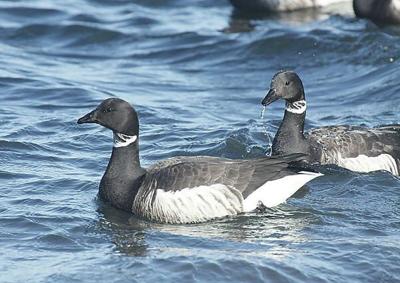
Brant are a migratory goose species with a sleek black head, white “necklace” marking, and distinct brown and black body feathers with striking white flank feathers.
They winter in coastal bays, estuaries, and lagoons, where they eat eelgrass, sea lettuce, and other aquatic vegetation.
Particular regions of coastal Washington provide good habitat, and serve as key winter and migration sites for the species.
Two brant geese stocks are found in the state during the winter. Black brant are generally found in Clallam and Pacific counties, and western high Arctic brant — also called gray-bellied brant — are typically found in Skagit and Whatcom counties.
Fish and Wildlife reminds hunters to familiarize themselves with local regulations and boundaries.
Specifically, hunters in Clallam County are advised to consult the closed zones of Dungeness National Wildlife Refuge, and hunters in Whatcom County are advised to review Lummi Nation boundaries relevant to Bellingham and Lummi bays.
Brant hunters must possess a valid migratory bird authorization and brant harvest report card, and must report their harvest by Feb. 15.

(0) comments
Welcome to the discussion.
Log In