

In the first part of this series, I talked about how bird conservationists evaluate the conservation needs of North American bird species and how those assessments guide the spending of very limited funding. I pointed out that cooperation among all the nations of the Western Hemisphere is sometimes necessary to conserve species that migrate great distances and cross many boundaries. In fact, sometimes this cooperation extends to the Old World as well, particularly for shorebirds and oceanic species we share with Japan, South Korea, Russia and the nations of southeast Asia.
I want to look a little closer at one of the main sources of grant funding — the Neotropical Migratory Bird Conservation Act (NMBCA) and its grant component. From 2002 to 2014, I participated on the panel of ornithologists who evaluated grant applications from Canada to Argentina.
Since 2002, the NMBCA has provided more than $94.2 million in grants to support 747 projects in 43 countries. These projects have benefited over 6 million acres of bird habitat and spurred partnerships on multiple levels. An additional $363 million has been contributed by those partners. This program is a terrific way to leverage bird conservation funding.
Priorities are established by the assessments I mentioned above, conducted by a partnership of public and private entities. But the U.S. Fish and Wildlife Service, the agency administering the NMBCA grants, conducts its own evaluation of those assessments to ensure the program follows all applicable federal rules and regulations. The most recent assessment is titled, Birds of Conservation Concern (BCC) 2021 (fws.gov/media/birds-conservation-concern-2021).
To give you some idea of the scope of bird conservation needs, the BCC 2021 identifies 269 species or populations of conservation concern. An example of a population of concern, as opposed to a species, are the American kestrels occurring in the southeastern U.S. Kestrels elsewhere are not of particular concern.
Among those 269 species or populations, 135 taxa are of conservation concern at the continental scale, 88 at the Bird Conservation Region (BCR) scale, 29 on Puerto Rico and the Virgin Islands, and 35 on Hawaii and the Pacific Islands. The number of taxa on the Hawaii/Pacific Island is in addition to species already listed under the Endangered Species Act. The latter have their own sources of funding, also woefully inadequate for the job.
Let’s look at some of the species and projects that have been funded by the program. You can search the projects database at fws.gov/grantsum/gsQuery. I searched first for projects that included Canada and one of the BCRs in Idaho. Those are the Northern Rockies and the Great Basin. I found six projects. Here are four of them.
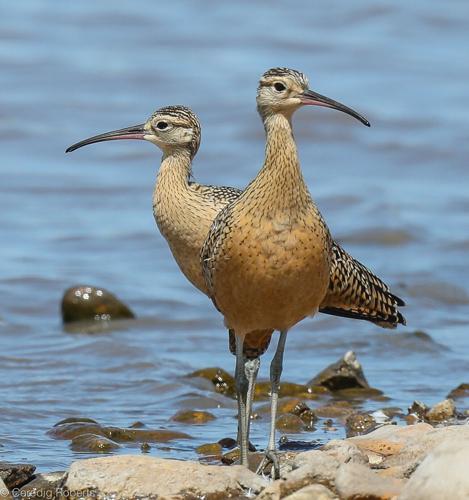
The first is titled, “Full Life-Cycle Conservation of the Long-billed Curlew.” This project also includes Mexico. The term “full life-cycle” means partners want to look at the entire annual cycle of the species, not just the breeding season or the wintering season.
Full life-cycle approaches have become the most common because, if the species has problems on the wintering grounds in Mexico, for example, it doesn’t necessarily help to take conservation action on the breeding grounds in Idaho. We must discover where and when the problem exists. This project seeks to apply best management practices for long-billed curlews on their breeding grounds and to protect 4,900 acres of wintering habitat in Mexico.
Another project addresses our inadequate knowledge of the population trends of some species. Population trends are perhaps the most important metric in assessing conservation need. If we don’t know if a species is increasing or decreasing, we could be overlooking a serious problem.
This project is, “Population Trends of Neotropical Migrants in Boreal Canada.” We have good population trend data from the Breeding Bird Survey for many species. I conduct seven of these surveys myself and have conducted five others in the past. They are conducted along roads, and the surveys are 24.5 miles long. Over much of northern Canada, there are no roads.
Thus, we have vast regions of North America with birds, and we don’t know what’s going on with them. This project will explore other sources of data and techniques for gathering data in the future to help us figure out the trends of high-priority species. Most of these are migrants that winter in Mexico, Central America, and/or South America, such as the olive-sided flycatcher.
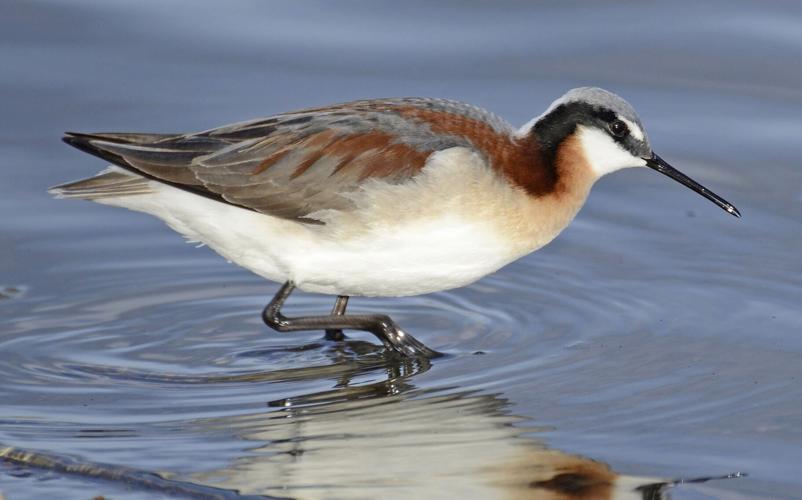
A third project is called “Tracking Phalaropes to Inform Conservation Actions.” The species is Wilson’s phalarope, and this is an example of a project that seeks to discover where birds are stopping during spring and fall migration. We typically have good knowledge about where birds breed and where they spend the winter. But we often have poor knowledge about exactly where they are during migration. If some species is suffering mortality during migration, but not so much during the rest of the year, we need to find the place and the time.
Researchers will capture and tag phalaropes with little devices that allow them to be detected by an array of Motus stations. For details on this recent technological development, see motus.org/.
One objective is to better understand how and when the species uses saline lakes. Many of these lakes in the Great Basin have suffered loss of water and changes in salinity due to human actions and climate change. It may be possible to improve water management if we know where and when it would help. This project extends to South America.
A final example of projects including Canada, the Northern Rockies BCR and the Great Basin BCR is “Monitoring Migratory Raptors from Regional to Continental Scales.” This project focuses on refining the accuracy of raptor population trend data.
In 2004, partners initiated the Raptor Population Index (RPI) Project to help address the need for better and more standardized information about the status of raptors. Work will improve the design and reporting capabilities of the RPI online data-collection system; prepare an analysis of raptor populations using data from at least 22 sites in the U.S., Canada, and Mexico; and make project information easily available to land managers and the public.
Preparing conservation assessments, assembling projects and evaluating those proposals requires a variety of expertise from different regions and organizations. Knowledge, skill, and experience are brought to bear by individuals with a sincere interest in the wellbeing of wild animals. Let’s hope we can continue this fine effort into the future.




(0) comments
Welcome to the discussion.
Log In