

He has flown wedding parties to their ceremonies.
He has searched mountain valleys for downed aircraft, locating several wrecks over the years.
He has landed on backcountry airstrips deep in the Idaho wilderness — Flying B Ranch, Root Ranch and Big Creek — where the airplane's high-altitude performance made landings that would ground lesser aircraft seem routine.
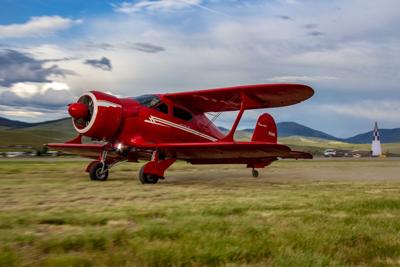
Bob Hoff, an 85-year-old Idaho Falls-area farmer and one of the last active pilots of one of aviation's most celebrated aircraft, has owned the same Beechcraft Staggerwing since 1971. After spending several years restoring it, he has been flying it since 1975 and has no plans to stop.
"You don't buy Staggerwings," he said. "You marry them."
That sentiment is the heartbeat of the Staggerwing Club, a national organization of roughly 200 owners and enthusiasts built around a machine that has fascinated pilots for nearly a century.
The club holds two annual fly-ins — one in Tullahoma, Tennessee, near the Beechcraft Heritage Museum it helped found in 1973, and one each summer at Hoff's ranch, where he maintains a private airstrip. The gatherings are deliberately casual. No agenda. Just flying, barbecue and the particular bond that forms when people have all committed themselves to the same improbable machine.
"It's a wonderful, diverse group," Hoff said. "Airline pilots, farmers like myself, doctors, lawyers — all walks of life."
The Staggerwing, officially the Beechcraft model 17, was Walter Beech's first product, designed in the early 1930s and manufactured through 1946. Designer Ted Wells gave it an unusual configuration: the lower wings staggered ahead of the upper wings, unlike most biplanes. Combined with a powerful Pratt & Whitney radial engine, the result was an aircraft that far outperformed anything expected of it.
In 1936, pilot Louise Thaden flew a Staggerwing from New York to Los Angeles and won the Bendix Trophy Race, beating military aircraft and commercial airliners along the way.
"It was probably the highest-performing airplane of its era," Hoff said.
The airplane's reputation drew a devoted following. By the mid-1960s, a loose organization of enthusiasts was gathering regularly in Tullahoma. In 1973, that community established what is now the Beechcraft Heritage Museum, which has grown to preserve the full lineage of Beechcraft products.
Hoff came to the Staggerwing the way many do — through the work. Straight out of high school, he became an airplane mechanic, working on vintage aircraft for owners who trusted him with machines they treasured. The Staggerwing fascinated him more than any other, and he bought his in 1971, knowing it needed significant repair.
His airplane carries a history that reads like a chapter of Idaho aviation lore. Before Hoff owned it, the aircraft belonged to Bill Woods, known as "the old man of the mountains," who flew it as a backcountry charter plane out of the Boise area.
Before that, it was used to instrument-train Eagle Squadron pilots, American volunteers who flew for Britain before the United States entered World War II. The British Embassy used it along the East Coast after the war before it passed to Halliburton Oil and eventually made its way back to Idaho.
Hoff has spent five decades adding to that story. He has performed flyovers at the funerals of fellow aviators and transported wedding parties to their ceremonies. In the mountains, the Staggerwing's performance allowed him to search high-altitude valleys safely — terrain that would push other aircraft to their limits. It found several downed planes over the years.
When he wasn't flying rescue missions, he was taking it places most pilots wouldn't dare. The Idaho backcountry demands short-field precision, and the Staggerwing delivered.
Maintaining a nearly 90-year-old airplane is not simple. The wood construction requires constant protection from moisture, fabric covering needs periodic replacement and engine components are growing scarce. Restoring one is not a project for the impatient — or the older.
"If they say over 55, I say you're getting too old," he said. "I've seen case after case where people in their 50s buy one they're going to restore, and they work on it and work on it, year after year, and they just never get it done."
Restoring one today almost always requires professional help.
"If you're going to restore one, you better be ready to have professionals help you," he said. "And if you have a professional, do it, you better have a deep pocket."
Today, about 35 Staggerwings remain airworthy. Hoff expects that number to fall to 20 or 25 within a decade as the airplanes approach the century mark. But at the most recent Idaho fly-in, he saw something reassuring — a younger generation of owners in their 50s and 60s stepping up.
His own son James, 58, now flies the family Staggerwing — one of the very few people Hoff has ever trusted in the left seat.
"They have a reputation for being a little bit challenging to fly," Hoff said. "So, we have to be careful who we check out in these things."
His other son Tom produces the club's quarterly newsletter, a publication that has held membership steady at around 200 for two decades.
Hoff once served as club president. Now he occupies a less official but no less important role — the person members call when they have a problem nobody else can solve.
"The airplane really rewards you," he said. "It brings you great people. It leads to other things. But you have to be ready to commit."


(0) comments
Welcome to the discussion.
Log In