

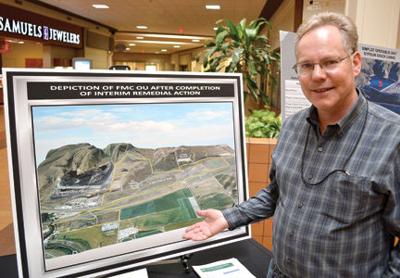

POCATELLO — As contour work is slated to resume at the old FMC phosphate ore plant west of the Gate City next week, representatives of the Environment Protection Agency were in town to share updates on the Eastern Michaud Flats Superfund Site.
It was part of the first five-year review of the superfund site that includes the Simplot Don Fertilizer Plant as well as the acreage vacated when the FMC plant was removed in 2002. FMC Corporation closed its phosphorus manufacturing plant in December of 2001, but Simplot remains an active plant.
EPA Project Manager for the Simplot area of the superfund site, Jannine Jennings, and EPA Project Manager for the FMC area, Jonathan Williams, set up posters and artistic renditions inside the Pine Ridge Mall on Thursday evening to share updates with the public.
“Next week they’ll start up again with the groundwork,” Jennings said about the grading of the old FMC plant area to prepare it for a soil cap.
Work also continues on the gypsum pile behind the Simplot
plant where portions of the pile are being lined to collect and control runoff water. Water on the hill will go into lined cells and then to a decant pond before being processed for reuse inside the plant.
Simplot began construction of the synthetic lines on the stack in 2010, and about 75 percent of the area has been lined. The project will continue through 2017.
To monitor and eventually treat runoff from the FMC site that contains phosphorus and arsenic, three test wells have already been drilled on the northeast corner of that property.
Williams said preliminary data indicates it may take up to 11 treatment wells along the border of the FMC property to treat runoff before it enters the Portneuf River drainage. Twelve treatment wells are already in operation on the Simplot property.
And the effort is paying dividends, according to data shared by Jennings.
Phosphorus levels leaking from the superfund site have dropped from 1.6 milligrams per liter five years ago to less than .50 milligrams per liter.
“They still have some work to do,” Jennings said. “But the phosphorus going into the river is dropping.”
Although both plant sites were sources for phosphorus contamination in the groundwater, the processes that led to the problem are different. Simplot uses a liquid wet process to produce fertilizer and FMC used massive furnaces and a dry heat process to produce elemental phosphorus.
The soil in and around the old furnace area is saturated with elemental phosphorus.
From 1949 until 2001, FMC Corporation operated the world’s largest elemental phosphorus plant in Power County just west of Pocatello. The physical plant and all structures were removed within two years of closure, but soil at the site and massive piles of radioactive slag — a byproduct of phosphate ore processing — remain.
Chicago Bridge & Iron or BC&I has contracted to do the contour and soil capping work at the FMC site.
Williams said the five-year review of the Michaud Flats site is just part of an EPA responsibility that will go on for decades.

(0) comments
Welcome to the discussion.
Log In