

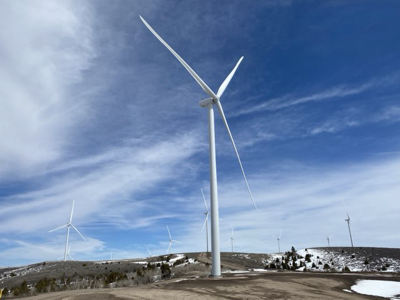
Two days before Global Wind Day on June 15, the Cedar Creek Wind farm east of Firth became fully operational with a celebratory ribbon cutting, attended by local landowners, global project partners and state and local government officials.
Contrary to prevalent fears that wind and solar power companies are using Idaho to light up California, the reality is that Idaho doesn’t have enough power to export to other states.
And, whether they put the power on the western states power market or not is up to PacifiCorp, who purchases the power that solar and wind farms produce.
Unless they can sell to California for a higher price and then purchase closer power for less for local needs, they aren’t likely to export the power.
Instead, Idaho imports power. Hydropower is no longer able to handle all of Idaho’s increasing power needs for two reasons. First, according to Tim Solomon of PacifiCorp greater electricity demands began with new call centers being built. Those power demands then increased with greater use of electric vehicles and now with the rapidly expanding Artificial Intelligence industry. Secondly, with Idaho being one of the fastest growing states, its power needs are also rapidly increasing.
According to Idaho’s Office of Energy and Mineral Resources’ 2024 Energy Landscape Report, 40 percent of Idaho’s electricity is created in Idaho. That leaves about 60 percent of its energy needs coming from outside the state. Knowing this, PacifiCorp is encouraging wind, solar and nuclear power sources as they juggle the energy market to keep the lights shining in Idaho.
At the time of the study, wind power constituted 17 percent of Idaho’s electricity – though that figure is growing with each new wind farm. The Cedar Creek Wind farm will produce 152 megawatts, which can power at least 60,000 homes every year.
Besides adding to Idaho’s goal of becoming energy independent, Cedar Creek Wind farm is also a shining example of working with the local community – both in the designing of the farm and during the construction.
The first ten years of designing the wind farm involved escalating plans with more and more turbines being planned until it reached 129 turbines. That plan stalled out until rPlus Energies bought the land in 2019.
Luigi Resta and his team at rPlus Energies were the ones that truly resurrected the wind farm. They began with working with the neighbors and community about their design plans, establishing a trust with the community based on handshakes, not mandates.
As Bingham County Planner Tiffany Olsen said, “They handled adversity kindly.”
By listening, they were able to amend their plans to fit the community and still provide significant power. The project now involved one phase of 47 sturdy turbines that would be only 550 feet tall instead of 610 feet. New technology with blades purchased and installed by General Electric produces more power on less wind, despite a smaller diameter.
Each turbine at Cedar Creek Wind has the capacity of producing 3.4-megawatts of power, which is more than double what the older turbines can produce. The Goshen North Wind Farm in Bonneville County has 83 turbines that produce about 1.5-megawatts each to collectively produce 124.5 Megawatts. The Goshen farm is using almost double the number of turbines on four times the acreage to produce 27.5 MW less than the Cedar Creek Wind farm.
With the new scaled down but still significant production capacity, Resta secured a power purchasing agreement with PacifiCorp and sold the wind farm to Clearway Energy Group.
Not only did Clearway and Wanzek Construction finish the project early, but they also found time to significantly support Bingham County. Idaho law requires 3 percent of their gross revenues annually, that is distributed back to the taxing districts their farm is a part of. But, that benefit to the community starts after they are operational.
Going above the law, they began helping their neighbors during construction. Wanzek donated 250 new backpacks to The Village in Blackfoot that assists foster and adopted kids. And, for the Firth School District they purchased a variety of coats and winter gear since it was late fall, and the weather was cooling. They also contributed towards Thanksgiving meals for those struggling.
Between rPlus Energies, Clearway Energy Group, General Electric and Wanzek Construction the Cedar Creek Wind farm has set an industry standard of efficient power for local needs and a civic standard of supporting and working with the community they have moved into.
In contrast, the currently disputed Lava Ridge Wind farm near Twin Falls has had to downsize its plans for 400 turbines of up to 740 feet high to 241 turbines no greater than 660 feet due to a BLM ruling after much controversy and opposition. They still don’t have the support of Idaho lawmakers from the governor, lieutenant governor and attorney general to the congressional lawmakers, including Senators Mike Crapo and Jim Risch and Representative Mike Simpson. There are many battles ahead.
The Lava Ridge approach of coming in with “huge and high” wind farm plans, without negotiating with neighbors, didn’t work. Thanks to Cedar Creek Wind, perhaps there is now a better blueprint for planning and proposing wind farms.


(0) comments
Welcome to the discussion.
Log In