

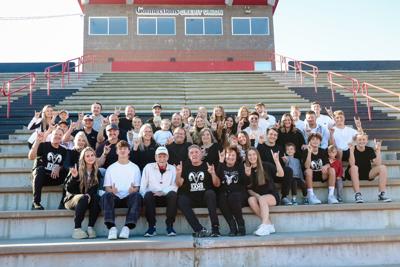
Welcome to Thanksgiving with the Bells. One thing is for sure, when this family gets together, there is a much fun to be had: relay races, talent contests, and basketball — always basketball. And on Thanksgiving, there used to be an annual Turkey Bowl touch football game — but that got kind of out of hand. A little too competitive.
So who is this Bell family?
Christian Bell probably put it best when summing up what it means to be a part of the Bell family.
“Absolutely the standards were high for all the Bells,” said Christian, who was a star defensive tackle, a soccer goalie and a track athlete during his Highland High School days. “I can’t think of a branch of our family that has a low standard as far as athletics. If you’re not very good, you better be comfortable being uncomfortable until you’re good.”
Starting with Veryl and Beulah Bell and their six Baby Boomer generation kids up through today, there probably has not been any family that has had more impact on athletics in southeastern Idaho than the Bells. Nothing better illustrates the ubiquity of the Bells than a recent typical weekend in the life of Troy and Jamie Bell.
It started with their daughter-in-law Marci’s Idaho State volleyball game at Reed Gym. That was followed by watching their daughter Tambree’s Boise State soccer game on video, followed by daughter Devree’s soccer game at Highland High School. The weekend came to an appropriate conclusion at ISU’s ICCU Dome for son Jayden’s Bengal football game.
“I said this is kind of like a life that doesn’t exist,” said Troy, who, along with his wife, are both former ISU and Highland star athletes themselves. “All these kids playing sports. How did we get here?”
It is a fair question to ask of all the Bells, their progeny and the in-laws who have married into the athletic dynasty. Because of both the sheer number of outstanding athletes in the Bell family, and the magnitude of their achievements, it’s nearly impossible to accurately quantify their impact. But with the help of Robyn Bell, Troy’s mother, we can give it a shot, with apologies to any of the Bells we are leaving out.
The Bell dominion all starts at Highland High School, where Veryl and Beulah’s kids went to school in the 1960s. There the boys first came under the influence of Jim Koetter, the aspiring young coach who may have been the only person in Pocatello more competitive than the Bell boys.
By Robyn Bell’s count, there have been 30 Bells or progeny who have participated in athletics at Highland, beginning with twin brothers Ned and Ted in 1966. Of those 30, 11 Bells or progeny have earned the Highland All-Around Athlete Award, including Ted and his brothers Leonard and David. Nine went on to compete in athletics at Idaho State. And nine won at least one — and in some cases multiple — state championships as Rams.
Swing across town and Leonard’s four children all competed at Pocatello High School, winning state titles of their own.
And there have been Bells achieving athletic success in Boise and Northern Utah as the family has expanded as well.
Where It All Began
Veryl and Beulah ran a tight ship, Veryl operating a trucking company and, later, an ice cream store, and Beulah was in charge of an A&W Restaurant the Bells purchased out on Highway 30 west of Pocatello.
Veryl was a good athlete and very competitive in his own right, and he engaged his kids in various games at neighbor Wally Kelly’s house on the corner, or he’d rent the gym at Almeda Junior High School for pickup basketball on Tuesday and Thursday evenings with his peers that the kids would attend.
“He was just as much into athletics as we were,” Ted said of his father. “That’s why we loved it, I guess.”
While all Veryl and Beulah’s kids were competitive, none were more so than their twins, Ted and Ned.
“It was a blessing and a curse,” said Ted, who was born a few minutes before Ned. “We were so competitive, because Ned and I were twins and everything we did was a competition. We had to win. We both got so competitive, it wasn’t just between each other. Any sport we played, if we didn’t win, it was like the world ended. I mean, we were over the top. I’m still today overly-competitive.”
Ted met Robyn in high school, and they were married after he returned from an LDS mission to Scotland. She gave birth to Travis, their oldest child, ten months later, and thus began a steady procession of future Bell athletes. Robyn recalls standing in center field while playing for the Bells A&W softball team and pronouncing the contractions were two minutes apart and the softball game best come to a conclusion soon.
Travis said those early A&W Root Beer softball games were the beginning of his introduction to the world of competitive athletics, Bell style.
“Watching my dad and my uncles play fastpitch — and watching my dad play racquetball,” said Travis of when he first realized the Bell family was different. “I was probably 3, 4, 5 years old, watching them all compete in fastpitch… Watching my dad play racquetball on weekends in big tournaments and come home with a black eye and broken teeth, from diving. Just watching them compete at all levels.”
As the family expanded and the children grew, the Bell family home became the center for every kind of contest you can imagine.
“We were very competitive,” said Travis. “We were wrestling. My dad would carpet the wall halfway up — he was a carpet installer, and we’d be pitching the ball against the wall. We had no idea we were busting the sheet rock. Dad would take us out in the cul de sac and we would play catch. We’d play home run derby, wiffle ball, football. I don’t know how many couches we broke playing football. Troy being the youngest, we’d give him the ball and tackle him.”
Travis came of age first and his reckoning came when he moved up to varsity to wrestle in the state tournament as a ninth-grader. “My very first match was against Poky,” Travis said. “I was wrestling against a senior, and back then the Poky-Highland match was a huge deal. I was a 98-pounder and I was sent out there and I think I pinned him. I finished third in the state — it taught me what you had to do to get there.”
Travis followed that up with three state wrestling championships. He also played on Highland’s 1987 state championship football team, then placed in the national junior college wrestling tournament at Ricks College for two years. He coached wrestling at Highland for many years, and now is the assistant principal and athletic director at Highland.
Then came Shane, who won state wrestling titles as a sophomore and a senior, and played on that 1987 state title football team. Followed by Trevor, who was a three-time second-place finisher in wrestling at state, was a late bloomer physically, returned from his mission and became an all-American safety at Idaho State, an ISU Hall of Famer and he is still the all-time interception leader at ISU.
The last boy in the group was Troy, who eschewed the family wrestling legacy after going undefeated during his junior wrestling career. He simply set the record for most rushing yards in a state championship game in football, and played on Highland’s boys’ basketball state title team.
“Ever since I was a young man, I noticed and recognized with my dad, all my aunts and my uncles, and even my grandfather and my grandmother that winning and excelling was very, very important,” said Troy, now the co-owner of TanaBell Health Services. “I’m named after my grandfather Veryl, he was a military, Air Force guy, he was an entrepreneur and he was extremely competitive. And I could see in both my dad and my uncles that competition was something they thrived on. They loved it. It was just a part of the family mentality to compete and to strive to excel and to push yourself to the limits that some other people may not be willing to push to.”
The Women in the Group
Ted Bell’s sister Janet was an outstanding runner, but back in her days there weren’t varsity sports for girls in high school. Female athletes had to satisfy themselves with club competition. But Ted and Robyn’s girls got the opportunity to compete in high school that their mother and aunt were denied.
The Bells had three girls, Mandy, Heidi and Camie, and they spent a lot of their early years following their brothers around southern Idaho watching them compete in baseball, wrestling and football. They were excellent cheerleaders, proud of their brothers. But they had their own competitive drive.
“I did dance and cheer, all the sports — basketball, softball, track,” said Heidi Bringhurst, the middle daughter of Ted and Robyn. “It was just instilled in us from the time we were little. We were always going to games.”
When it was time for the girls to compete, though, the Bells were there for their daughters as well.
“My mom and dad were really good examples,” said Heidi. “Like my senior year I was cut from the volleyball team. To play from the time I was in seventh grade clear up to my senior year to get cut was really hard. My parents were adamant about just pushing through those hard times. My basketball season was a little rough and I had some senior girls quit. I chose to keep going. I think they just taught me to always work hard, they instilled that work ethic in me and all my siblings, and to just not quit when things get hard.”
Heidi still holds several weight-lifting records at Highland. Her daughter Lauryn is similarly built, competes in basketball and track, and was invited to a combine in Salt Lake City to train for the skeleton bobsled U.S. Olympic team. She was the youngest competitor there, and finished in the top three in every testing category.
Meanwhile Mandy, Heidi’s older sister, was a sprint star at Highland, running on three state championship relay teams for her Uncle Ned’s Ram track teams.
“None of our boys had speed like Mandy,” said Robyn. “She had her dad’s speed.”
“When she was a senior, she said, ‘Dad, I can outrun you,’” said Ted. “I just started laughing. I said, ‘Mandy, don’t even go there.’ We went out in the street, somebody said go, we ran down the street, we had 100 yards marked off, and she beat me by about five yards.”
The Coach
Ned Bell was not a great athlete — after graduating from Highland, he walked on to the ISU football team, where his biggest claim to fame was being “salt” to Bengal all-American wide receiver Eddie “The Flea” Bell’s “pepper.”
But Ned, who was a middle-distance runner in his track days, found his niche in coaching sprinters. First at Pocatello High School, then at ISU, and finally back at Highland, Bell developed a reputation as one of the finest sprint coaches in the state.
“I read a ton, I really did,” said Ned, who led Highland to three state titles, Pocatello one as head track coach. “One of the things I did, one reason I had so much success with sprinters, with just in my own mind, I thought, ‘we ought to work out one day a week running nothing but hills.’ I mean steep. We did that every Wednesday, and I think the kids ate it up. Going up hill, then when you finally run on the flat, you’re just so much faster.”
Ned joined ISU head track Coach Jerry Quiller’s staff in the 1980s. He coached numerous Big Sky championship indoor and outdoor relay teams, as well as 400 and 500-meter champions. Twice, he coached four-by-four relay teams that qualified for nationals. After leaving ISU, Ned returned to high school coaching at Highland, where he built a power house.
“I spent some time with Ned at Highland and he did a phenomenal job of preparation,” said Brent Koetter, who coached Wade Bell at Pocatello and Troy Bell at Highland in football. “His preparation in track was meticulous. Their work ethic was unbelievable, the attention to detail — they just did things right.”
Ned and his wife Michele Pond-Bell had only one future athlete to lend to the Rams’ cause — Christian. He was an excellent defensive tackle during his days with the Rams, and was recruited to play football at Idaho State. But a funny thing happened on the way to the locker-room: Christian fell in love with a local girl who was part of the cheerleading squad at ISU and he was recruited to the squad as well.
“He showed me the mark on his arm, and I said, ‘What’s that?’ ” Michele said. “He said, ‘I tried out for cheerleader today and I made it.’ And I said, ‘You tell your dad.’”
“That year and a half I cheered at ISU was pretty intense,” Christian said. “I got in the best shape of my life, we ran and lifted, it kept us in great shape.”
And the Bell drive continues in Christian’s family, where he’s raising his four children to appreciate the joy of competition. “In my house, we hate losing more than we love winning,” Christian said. “My kids take sports more seriously than most 9- and 6-year-olds. They care when they lose, they care when they win.”
The Outlier
In case you hadn’t noticed by now, if you are a Bell, you are expected to compete at Highland High School.
“We moved twice in our life just to be in the Highland area,” said Christian. “If you’re a Bell, you’re a Highland family… My mom went to Poky. Whenever we played Pocatello, my mom would say, ‘A little part of me will cheer for them.’ How dare you!”
But things didn’t work out quite out that way for Leonard Bell’s kids.
“Growing up, I planned on going to Highland,” said Wade, the oldest of Leonard’s four children who all competed at Pocatello High School. “The summer before high school started, my family ran into some financial situations and I was living in the Pocatello boundary. At first it was a shock, all my friends were at Highland. I was kind of bummed for that. But it ended up being really good for me. I had great coaches, great friends and teammates, and we had a lot of success in all three sports.”
Wade, now an insurance manager in northern Utah, played football and baseball and wrestled at Pocatello. His brothers Trent and David also played football and wrestled for what was then known as the Indians, and his sister Michelle participated in volleyball, basketball and softball.
Despite their deep Highland roots, Wade said none of the Ram cousins ever gave him a hard time about being a West-Sider.
“No, not to my face,” he said. “I think I felt a little awkward at first, but it is what it is. I tried to make the best of it. I know Highland and Poky are big rivals and sometimes it got a little heated. We both wanted to do well against each other. It wasn’t an ugly situation, it was friendly.”
Ironically, both Jim and Brent Koetter were coaching at Pocatello High School at that time. Wade’s cousin Trevor, meanwhile, was competing for the Rams while Wade was wrestling and playing football for Pocatello.
“I was very fortunate,” Wade noted, “during my time at Pocatello both my wrestling team and my football team won state my junior and senior years.”
Probably Wade’s best sport was baseball, where he played third base and pitched. He played college baseball at Snow and Ricks Colleges, and was set to continue his career at Wyoming when that school shut down its baseball program. He and his wife have enjoyed watching their blended family compete in a similar rivalry involving the Ridgeline and Mountain Crest high schools in the Logan area.
“I just enjoyed growing up with all the aunts and uncles and cousins,” said Wade. “When we got together it was a lot of fun, and we were able to build those memories and support each other in whatever we did. I wouldn’t change it.”
The Current Generation
Jayden Bell was the only boy in Troy and Jamie Bell’s family, and as the older brother, he felt the obligation to set the example for his three sisters.
“I think my three sisters are some of the most competitive women I know,” said Bell, who is a starting safety on the Idaho State football team as a redshirt freshman. “They’re pretty feisty.”
One of his sisters, Saydree, is a forward on the ISU soccer team, where she transferred after starting her collegiate career at Weber State. Sister Tambree is a freshman reserve on Boise State’s Mountain West Conference championship team. And youngest sister Devree is a standout on the Highland soccer team.
As if that’s not enough competitive juice in Jayden’s family, he’s married to the former Marci Richins, an attacker on the Bengal volleyball team.
“I met my wife my freshman year, two weeks after she got into volleyball, and we instantly clicked,” Jayden said. “I knew she was right for my family — she’s super competitive as well. I met her family, her five siblings are all just as competitive. I knew she was the one.”
Like many of the Bell athletes, both Jayden and Saydree are having to overcome injuries to continue their athletic careers. After returning from his LDS mission and joining the ISU football program as a true freshman, Jayden suffered a rare eye infection that caused him to sit out most of the season. Then, after a successful summer with new coach Cody Hawkins, he incurred a Lis Franc injury, a very complex foot injury that almost ended his
career. He eventually underwent surgery that involved the injection of bone marrow from his back into his foot, which has healed enough to allow him to be one the leading tacklers on the ISU football team this fall.
Meanwhile Saydree was the second-leading scorer on the ISU soccer team after her transfer for the 2023 season, but she has suffered an avulsion fracture and a hernia and was forced to sit out much of the 2024 season.
“I’ve been experiencing this pain and I tried to push through it,” said Saydree. “That is one of my downfalls, pushing through injuries… I don’t know when to lay off the gas. When I’m hurt, I need to step back.”
One of the challenges that comes with competing at high levels, like the Bells have, is the threat of injury. Ted Bell has had three knee replacements and multiple broken legs. Trevor lost part of a kidney as a senior at Highland, but still returned to play the final four games of his high school career. Troy had a bad ankle and didn’t practice the week before the state championship game his senior year — then carried 52 times for 278 yards.
“They are a super family,” said Brent Koetter, “Just hard workers, great attitude.”
“The bottom line in all of this,” said Ted Bell, “is that because they played sports, they’ve learned how to win and they’ve learned how to lose, and they’re going out in life now and they’re winning. All of them.”

(0) comments
Welcome to the discussion.
Log In