

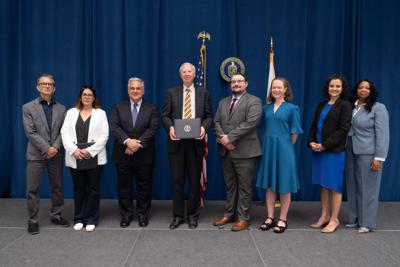
Richard “Dick” Stroh of Pingree said he had no idea the U.S. Department of Energy had plans to recognize him for his work during an annual awards ceremony until literally hours before he had to confirm he was even going to the event.
“It was a big surprise to me. I had no idea,” Stroh said. “I found out the day before I had to register.”
Stroh has spent 47 years as a mechanical engineer working for the DOE’s Bonneville Power Administration Conservation Group in Idaho Falls. His work for BPA is within a district that includes much of Idaho, and parts of Wyoming, Northern Utah, Northern Nevada and the West Yellowstone area.
The award he received was part of the DOE’s Federal Energy Management Program’s 2025 Spotlight Honorees ceremony for work he did on the Michaud Project, which included substantial upgrades to the Falls Irrigation District in American Falls and the Fort Hall Irrigation District in Fort Hall.
His primary function with BPA is to help new and existing power customers and public providers come up with options to conserve energy.
“It is far more efficient and cost-effective to conserve energy than it is to build a whole new power plant and all that infrastructure that has to go with it,” Stroh said.
What the DOE says on its page dedicated to the 2025 FEDS Spotlight Honorees is that Stroh “identified improvements” in the project “that BPA would implement to better match water supply with demand. In the first year, these efforts resulted in more than 717,000 kWh of energy savings. The combined improvements are projected to conserve 550 million gallons of water and 386,000 kWh of energy annually, with potential for replication across BPA-served irrigation districts.”
Stroh downplays his contribution, preferring to say simply that he was part of numerous individuals who contributed to the project. He said that once a decision was made regarding upgrading the two irrigation districts, a Pocatello engineering firm was hired to do the design work.
“It is something we worked on with them,” Stroh said. “We helped identify the savings that occur on these projects.”
He said the Fort Hall Irrigation District project started in 2023 and was completed in the spring of 20204, while the Falls Irrigation District project began in 2024 and was completed in the spring of 2025. But the groundwork for both projects began well before that, and Stroh was part of the conversations from the beginning.
“Our initial work on the Fort Hall Irrigation District was done in 2018,” he said. “The work at Falls Irrigation goes farther back.”
Not only was he there in the beginning to help identify what was needed to move the project forward, but when it was completed, he was again asked to look at everything. Stroh said there were some setbacks on both projects, part of each that didn’t function as expected. He went in and helped troubleshoot those issues.
“There was a commissioning period of one year to get all the bugs worked out,” he said. “That was one of the things I worked on, was coming up with a resolution.”
Stroh was recognized during a ceremony in Washington, D.C., on May 20.

(0) comments
Welcome to the discussion.
Log In