

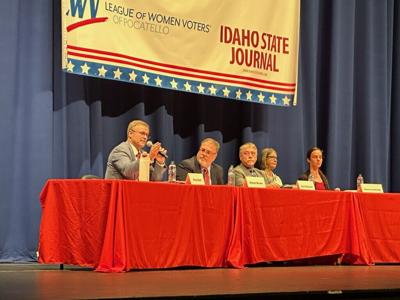
POCATELLO — Four candidates vying for Pocatello mayor presented contrasting visions for the city’s future at a Monday night forum at Pocatello High School, tackling economic development, housing affordability, police accountability and airport viability.
About 350 people attended the Idaho State Journal and League of Women Voters forum featuring incumbent Mayor Brian Blad and challengers Steve Brown, Mark Dahlquist and Alana Leonhardy. Candidates Greg Cates, Nate Kessel and Idaho Law-Carta Sierra-Idaho Lorax did not participate.
Blad touted the city’s turnaround during his 16-year tenure, noting unemployment dropped from 10.8 percent to 3.7 percent and average hourly wages have increased 134 percent.
“The average hourly wage when I took office was about $9.40,” Blad said. “Today it’s over $22 an hour.”
Blad also underscored downtown’s 94 percent occupancy, noting the availability of some high-paying jobs, albeit not enough.
“I think we need to work on getting high paying jobs, although I will tell you there are jobs available,” Blad said. “There’s about 2,500 jobs available and some of those pay at first in the six digits.
Dahlquist, executive director of NeighborWorks Pocatello for 18 years, challenged this rosy picture, saying small business owners he’s spoken with aren’t exactly flourishing. He called for better follow-up with companies that chose not to locate in Pocatello and advocated for a “one-stop-shop” approach to economic development.
“I think our small businesses out there are struggling…” said Dahlquist, who previously held management positions at Farmers Insurance. “I’m talking to a lot of small business owners that are just having a tough time right now. I’m also hearing a lot of missed opportunities. I think the city has built up a reputation that we’re not closing the gap. We’re not paying attention to the little details and we’ve got to figure that out.”
He continued, “I think we need to do follow-up surveys to see what the issues were. You need persistence in the mayor’s office. You need to negotiate. You need to have good communication.”
Brown, who formerly served on both the Pocatello City Council and Bannock County Commission, spoke about a desire to increase regional collaboration while proposing an economic development coordinator position to bring together various stakeholders.
“We kind of have gotten into this pattern of going at it alone,” Brown said. “We really need to focus on utilizing the resources that are within our reach regionally and helping everyone. A rising tide raises all boats.”
Pocatello, Brown said, “would benefit from … a coordinator position that actually works with all of our economic development resources and business groups (and) the Chamber of Commerce to bring everybody together and create a beautiful economic development vision.”
Leonhardy, who grew up in Moscow and moved to the Gate City in 2023 for a position at Idaho State University, opposed large tax breaks for corporations while favoring support for local entrepreneurs through business fairs and other initiatives.
“I am not a proponent of giving bigger companies tax breaks to come in and crush our small businesses,” Leonhardy said. “And I really would like small businesses to come here so encouraging local entrepreneur fairs to incentivize local, small community businesses to come in because we can create jobs ourselves.”
Video of the Idaho State Journal and League of Women Voters Pocatello mayoral candidate forum on Monday night at Pocatello High School.
Housing affordability emerged as a critical issue, with each candidate offering different approaches.
Drawing on his experience with NeighborWorks Pocatello, Dahlquist said he has played a role in developing over 200 affordable homes that have added $42 million to the tax base. He advocated for more flexible zoning codes and transparency, pointing to the Bonneville Commons development as an example of innovative infill housing.
“The proof is in the pudding,” he said. “We involve our residents all the time… We put together the Bonneville Commons subdivision and that’s 26 units over at Bonneville school… Before we even did anything, before we broke ground, we went and talked to the Bonneville Neighborhood Association. We went two or three times before we even went to the school board and asked them to buy that school…People hate surprises, so you have to be proactive.”
Leonhardy proposed community-owned housing cooperatives where rent payments build equity, and called for clearer, more consistent city codes to reduce frustration for developers.
Blad said Pocatello remains the most affordable place to buy a home in Idaho, adding that although the city has issued over 1,000 housing permits for the coming year, it’s the overall lack of homes in general that affects the market the most. He also questioned what truly constitutes “affordable housing,” pointing particularly back to some of Bonneville Commons project.
“What is affordable housing?” Blad said. “Mr. Dahlquist has built a block full of houses at $400,000 a home. I couldn’t afford that house. So what is affordable housing? What really is it?”
He added, “I think we have a lack of housing stock in the city of Pocatello. In fact, I know we’ve got 200 houses on the market right now. The fewer houses you have on the market, the more expensive houses are going to be.”
Brown proposed streamlining the permitting process, with help from his idea to create an economic development coordinator position. He also spoke about the need to reduce impact fees and creating a long-term strategy of growing the economic base to lower overall tax burdens, referring back to his new economic coordinator position idea.
“The second thing that we need to look at is impact fees,” Brown said. “(Building in Pocatello) is harder because you gotta pay for sewer up front.”
The candidates’ responses to a question about police reform following the death of Victor at the hands of four Pocatello Police officers in April revealed significant differences in approach and communication style.
Leonhardy called for community policing experts to guide reforms but declined to elaborate extensively, saying she didn’t feel comfortable “pontificating about the death of someone’s son.”
Blad, citing ongoing litigation, offered limited detail but defended the officers’ response, noting the department handles 40,000 public contacts annually. He added the Idaho Attorney General’s Office cleared the officers for what he described as a tragedy for everyone involved.
“Victor Perez was a tragedy,” he said. “It was a tragedy for the community. It was a tragedy for the family, and for the police officers who were involved.”
Brown emphasized the need for ongoing communication with the public during critical incidents, proposing a public safety summit and citizen advisory panel.
“Continual communication with the public from the moment an incident happens is critical, even if there’s not a lot to report, because we’re talking about liability issues and lawsuit issues, and so it’s very difficult to be able to share that information,” Brown said. “However, in the absence of ongoing communication with the public, people fill in those gaps with whatever they can imagine.”
Brown added, “And so what I’d like to do is I’d like to create the community engagement initiative. Part of that has to do with office hours and going out into the community…. I want to hold a public safety summit and I want to create a citizen advisory panel as well as update, and educate citizens and our responders on the latest crisis resources.”
Dahlquist said he feels for the officers involved who work for a “very good police force’ and that reforms must involve external input, not just internal police review. He criticized the lack of immediate communication following the incident.
“If I were the leader, I would have been out there that evening or within 24 hours with the mic reassuring the community we’re going to fix this,” Dahlquist said. “Sometimes you have to take the blame. When there’s shortcomings, I would take the blame immediately and ... have made statements that reassured the community that this mistake was not going to happen again. And I would have visited the family at the hospital.”
On fiscal policy, the candidates diverged sharply.
Leonhardy proposed reducing the mayor’s salary to $57,000 and hiring a CFO to audit the budget, adding that “slashing cuts are popular but unrealistic.”
“I want to reduce the mayor’s salary to the median household income,” Leonardy said about the pay for the city’s top executive, which currently earns about $95,000 per year.
“I should be taking care of the community, and don’t believe I should be making twice as much,” she added.
Blad defended the city’s current approach, noting minimal tax increases in recent years while maintaining services and building excess reserves after inheriting a city that borrowed money to make payroll.
“Budget and taxes is a very difficult thing at the city, of any city level,” Blad said. “You’ve got so many different things that people are asking for. We have asked a number of times, what would we do without? And every time I ask that people don’t have a clue what they would do without because we love our services that we have right now. We have a good balanced budget. The City Council has worked … very, very hard in making sure we have a good, solid budget for the city of Pocatello.”
Brown spoke about a “return and report” process he helped initiate when he was on the City Council that required city departments to discuss spending before budget preparation, noting that no singular cuts, rather a robust economic development long term program would move the needle most.
“One of the things that I was able to get done is have a return and report process for the departments before we started building budgets,” Brown said. “They came in and they reported on the activities of the year. They reported on the money that was allocated and how they spent that money, but I’ve got to tell you, for the most part we didn’t find fraud, we didn’t find anything that was out of the ordinary.”
Dahlquist, citing his turnaround of NeighborWorks from “vulnerable” to “exemplary” financial status, spoke of the need to grow the tax base through economic development.
“Economic development, I think, is the key,” he said. “Grow, Grow, grow — We’ve got to grow our tax base to get past this problem.”
All candidates agreed the Pocatello Regional Airport represents untapped potential, though they offered varying strategies.
Blad explained the unique challenges — the airport is city-owned but surrounded by the Fort Hall Indian Reservation and located in Power County, with restrictions preventing land sales.
Brown called for engaging the Shoshone-Bannock Tribes as partners and integrating the airport into broader logistics planning.
Dahlquist emphasized the airport’s strategic location at the intersection of major highways and rail lines, calling it an “underdeveloped gem” for distribution and trucking companies.
Leonardy said the airport could benefit from flight schools or junior operator programs, adding that in order for it to truly thrive “the city of Pocatello needs to become the destination.”
The election will be held Nov. 4, 2025.

(1) comment
His honor (Blad) in his first campaign, complained that Roger Chase has been in office too long. Now in turn about fair play, Blad has been in office too long. Time to go quietly Blad. I know your retirement is not what you would have it be. If you could serve for 20 years your retirement income could be a bit more palatable. On the other hand, a visiting professorship at ISU might supplement your income. Oh, I forgot Dean, now president, Hunt, is not available to provide such a lucrative landing spot in the business college. Maybe in the Alumni and Engagement Center could be available. Just think, both you and Mrs Blad could work together.
Welcome to the discussion.
Log In