



POCATELLO — A Bannock County jury on Friday convicted a local man of shooting two Pocatello police officers.
The guilty verdicts against Todd Vernon Brewer, 48, of Pocatello, marked an end to an emotional trial at the Bannock County Courthouse that began Monday.
Bannock County Prosecutor Ian Johnson along with deputy prosecutors Janet Franklin and JaNiece Price proved Brewer’s guilt by presenting witness testimony, evidence from the scene and very impactful body camera footage from the police officers who responded to the May 5, 2022, shooting outside the East Bridger Street home of Brewer’s then girlfriend and her young son.
Brewer now faces a maximum sentence of 80 years in prison for the multiple aggravated assault and aggravated battery charges he was convicted of, which include enhancements because his victims were police officers.
For Johnson, who took office in January, this was his first trial as the county’s prosecutor.
Johnson described the trial as “very emotional,” adding that he was “glad to see justice served.” He was adamant that the conviction was the result of “quality law enforcement work by the city’s great police officers and some amazing attorneys in the prosecutor’s office, not including me.”
Brewer’s attorney, John Scott Andrew, Bannock County’s chief deputy public defender, tried to prove that Brewer’s actions were caused by serious mental health issues exacerbated by prescription drug use and excessive alcohol consumption on the night of the shooting.
Judge Javier Gabiola presided over the case and will sentence Brewer on June 12. Andrew asked that a psychological evaluation be performed on Brewer prior to sentencing.
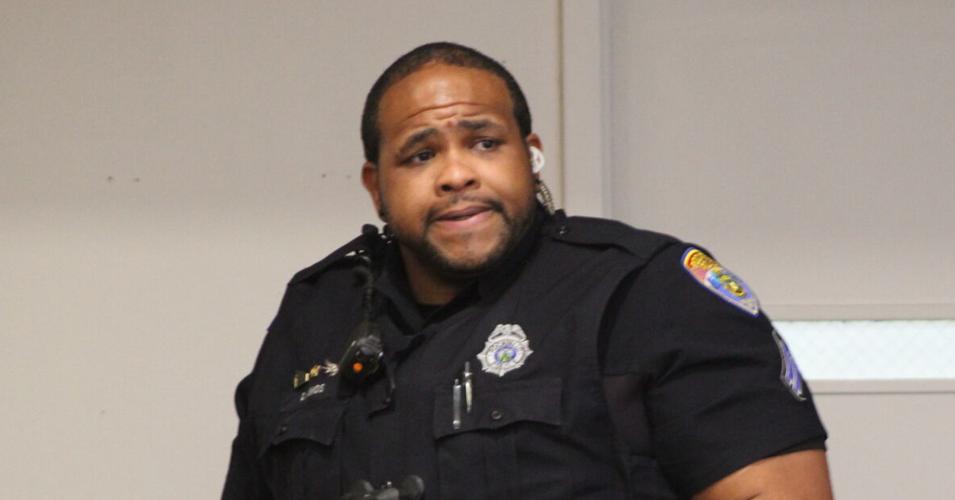
The emotional trial reached a crescendo with the powerful testimonies of Pocatello police officers Demetrius Amos and Mackenzie Handel who were both shot by Brewer when they and other officers responded to the East Bridger Street residence after the young son of Brewer’s then girlfriend called 911 because he feared Brewer was going to kill him and his mother.
Amos arrived first on the scene with officer Russell Comstock, who was a trainee at the time. Handel would arrive shortly after with officer Breyvon Johnson, also a trainee at the time.
Once additional Pocatello police officers arrived, they all exited their patrol vehicles and approached the East Bridger residence on foot.
Amid the splashing lights of the officers’ flashlights in the nighttime darkness, Amos received information from the police dispatch center that the disturbance suspect, Brewer, was armed.
In fact, there were multiple firearms in the home, including an AR-15 rifle.
Within moments Amos would identify Brewer armed with that rifle outside the residence. Amos commanded him to put his weapon down.
Multiple officers testified during the trial that Brewer then raised his AR-15 mounted with a flashlight and pointed it at Amos, who responded with two quick shots from his pistol.
Brewer then ran to the other side of the house and when the officers pursued he unleashed a barrage of bullets at them as they came around the corner of the residence.
Amos testified that he felt a sharp pain in his face and heard a crunching sound as the bullets hit him, followed by a dreamlike fog and haze.
“It was hard to breathe after that,” Amos said from the witness stand.
At this point in his testimony Amos struggled to compose himself in the courtroom and tearfully continued, still emotionally impacted by the events that occurred nearly three years ago.
Amos said that it felt like he was going to die after being shot by Brewer multiple times. Amos recalled asking a fellow officer to tell his family that he loved them.
Handel, struck by the same barrage of gunfire from Brewer that had wounded Amos, testified that a bullet hit him like a 4x4 smashing into his abdomen.
Some of the bullets pierced the officers’ body armor.
Both Amos and Handel testified that as they ran around the corner of the house in pursuit of Brewer they saw his silhouette a moment before he opened fire.
Handel testified that he fired back at Brewer while falling to the ground, seriously wounded and bleeding.
Handel added that he felt a wave of relief upon realizing that Amos was still alive despite being shot multiple times. Brewer had been hit by the officers’ return fire and was himself on the ground badly wounded.
Handel and Amos described their injuries during the trial, explaining the physical limitations and mental strife still caused by the wounds.
Dr. Andrew McRoberts of Portneuf Medical Center testified that Amos arrived at the hospital in a gruesome state. The officer had gunshot wounds to the face, chest, abdomen and hand. The wound to the hand resulted in the amputation of parts of Amos’ fingers.
McRoberts also testified about the severity of Handel’s abdomen gunshot wound.
Both officers were rushed to PMC from the scene via police patrol vehicles because officers didn’t want to wait for ambulances to arrive. In Amos’ case, the move likely saved his life.
The prosecution played body camera footage from several of the responding officers during the trial. The intense and emotional footage from Handel and Amos’ body cameras was played following their testimonies.
The footage showing the officers’ suffering gunshot wounds as Brewer sprayed the scene with AR-15 bullets had a profound impact on the entire courtroom.
Pocatello Police Chief Roger Schei, who attended the trial, moved to the bench where Amos’ mother and sister sat while the body camera footage from Amos was played for the jury.
Both women, like many in the courtroom and even some members of the jury, were visibly emotional while watching the footage, showing first-hand what Amos was experiencing as bullets tore into him.
One member of the jury was openly weeping in the courtroom.
Schei said the trial was one of the most emotional he’s ever witnessed, adding that at certain points he too was crying.
After the guilty verdicts were read late Friday afternoon, Schei expressed relief that Brewer was convicted, adding that the 24 hours the jury spent deliberating were “gut wrenching” for him and his officers. The police chief also expressed the utmost praise for his officers, saying “real heroes wear badges, not capes.”
Schei continued, “The men and women of the Pocatello Police Department put their lives on the line every day for this community. Our officers charge toward danger and knowingly put their lives on the line for strangers. They do it time and time again. Being a police officer is the toughest job in this country.”
Johnson said the body camera footage was emotional to watch but hearing the words of the police officers who were there during the shooting was probably an even bigger factor for the jury.
“The reality is there were witnesses who took the stand and shared one of the most horrific experiences of their lives,” Johnson said in reference to the testimony of Amos, Handel and other Pocatello police officers who took the stand. “The (body camera) video helped but the truth is what really drove this. When you have the reality of life-threatening events, witnesses sharing their deep personal experiences, that’s what resonated with the jurors.”
On Thursday morning Brewer took the stand to not deny that he had shot the officers but to explain his mental state at the time and why he opened fire.
The defense claimed that Brewer acted in self-defense and did not have the mental fortitude to understand the entirety of the incident.
The defense put forth that Brewer is a paranoid schizophrenic who has had delusions that he was the victim of “gang stalking” for close to 20 years.
Brewer was taking anti-psychotic and anti-anxiety prescription pills during the night of the shooting and had also been excessively drinking alcoholic beverages, his attorney Andrew stated.
In his closing statement, Andrew alleged that Brewer was not aware the people he shot were police officers and was functioning under the delusion that they were gang members or perceived enemies out to get him.
The jury began deliberating the case late Thursday afternoon and to the surprise of many did not come back with immediate verdicts.
Instead it was late Friday afternoon, minutes before Gabiola was going to send them home for the weekend, that the jurors announced they had reached a consensus.
When the guilty verdicts on all counts were being read, Amos wept while seated in the back of the packed courtroom.
“Waiting for a jury is always stressful,” Johnson said. “It doesn’t matter if it’s 15 minutes or three days. I’m very happy with how it turned out. A lot of people were involved. I definitely didn’t do it on my own.”

(0) comments
Welcome to the discussion.
Log In