






BOISE — In its first round of budget enhancements before the Joint Finance-Appropriations Committee, members reversed course on certain cuts and, after much debate, deferred action on others.
A key reinstatement of funds was approved for the Idaho State Tax Commission after Division of Financial Management Administrator Lori Wolff sent a letter to the Joint Finance-Appropriations Committee members highlighting the cuts to the commission were anticipated to delay this year’s tax processing by as much as 24 weeks and delay tax refunds by up to six weeks.
Addressing these concerns, the body voted to both add funding to the commission to assist with the current tax filing season and restore future funding which was cut when setting the commission’s baseline budget.
JFAC firstly voted unanimously to supplement the Tax Commission with $765,300 in funds to assist with overhauling their systems and forms for the tax changes within the One Big Beautiful Bill, which were signed into law by Gov. Brad Little last week.
In a 15-4 vote, the committee also moved to restore the $903,000 in general funds previously subtracted from the commission’s budget next fiscal year.
In both cases, the funding changes will need be passed by the House and the Senate to become law.
Though enhancements to the Idaho State Tax Commission passed without fanfare, the same could not be said for the Idaho National Guard’s State Education Assistance Program (SEAP), which provides enlisted soldiers and airmen up to $8,000 per year for tuition and fees at Idaho institutions.
Maj. Gen. Timothy J. Donnellan went before JFAC in January to discuss the military division’s recent modernization efforts as well as cuts headed their way. In that meeting, Donnellan said the agency has been able to “absorb” the 3% reduction recommended by Little, but it came at a cost to SEAP by reducing the education reimbursement amount for enlistees.
“Many of our enlistees join the National Guard, one (because) they want to stay in Idaho, but two because Idaho offers this state education assistance,” Donnellan said in January. “So we’ve had to reduce that fund and I am concerned if we were to reduce it further, we would break faith with our soldiers and airmen who have enlisted.”

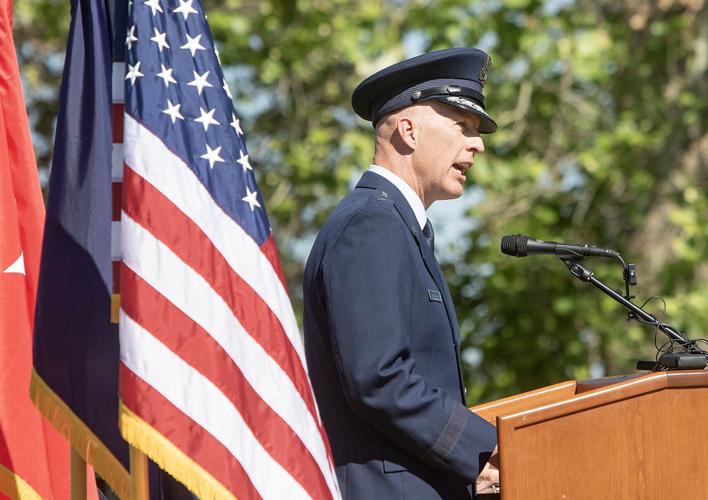
Maj. Gen. Timothy J. Donnellan speaks as he takes command of the Idaho National Guard during a Change of Command ceremony at Gowen Field, Tuesday, June 25, 2024.
He added any further cuts to the program “would concern me,” remarks that arrived prior to JFAC voting to reduce the agency’s budget by an added 2% starting next fiscal year.
Now several weeks removed from this meeting, the committee considered a budget enhancement that would restore $190,800 in funding to SEAP from the state’s general funds for the next fiscal year, maintaining 69% of the program’s funding.
Rep. James Petzke, R-Meridian, spoke in favor of the funding being added back. He noted Idaho lags behind neighboring states (including Oregon, Washington and Utah), which offer 100% tuition reimbursement through their respective programs.
“This is a pretty key thing that we are already behind the ball on,” Petzke said.
Several legislators, including Sen. Codi Galloway, R-Boise, and Sen. Glenneda Zuiderveld, R-Twin Falls, prefaced their remarks with their families’ respective military histories.
Galloway, whose father was previously a pilot with the Idaho National Guard, said there was “conflicting information” on the program that needed to be resolved before an affirmative vote could be given.
Zuiderveld, after outlining a long family history of military service, questioned why the program was being subject to cuts in the first place for those who have chosen to give their lives for their country. She claimed legislators were being “gaslit” over the cuts and questioned why other, less impactful military programs were not presented as options.
Sen. Janie Ward-Engelking, D-Boise, who presented an initial motion to provide the full $190,800 requested for SEAP, said the agency doesn’t have “unlimited places that they can take an additional 2% decrease in funding.” In many cases, alternative cuts to the Idaho Military Division would lead to a loss of federal matching funds and in turn lead to more significant financial consequences, she said.
With several committee members asserting they lacked the necessary information to vote for funding the education program, Rep. Kyle Harris, R-Lewiston, introduced a substitute motion to hold the budget request and have the program brought back for consideration at the committee chair’s discretion.
Since the committee votes on the newest motions first, Ward-Engelking’s initial motion to fund SEAP would not be put up for a vote if Harris’ were to pass first.
To force a vote on the matter, Sen. Jim Woodward, R-Sagle, followed Harris with a separate motion to provide $100 in additional funding beyond the original motion from Ward-Engelking. He framed the vote as being whether or not to “support the education of those who have taken an oath to give their lives for ours.”
Woodward’s motion failed on a 7-11 vote, with the following opposed:
Sen. Scott Grow, R-Eagle
Sen. Phil Hart, R-Kellogg
Sen. Cindy Carlson, R-Riggins
Sen. Zuiderveld
Sen. Galloway
Rep. Josh Tanner, R-Eagle
Rep. Steve Miller, R-Fairfield
Rep. Harris
Rep. Chris Bruce, R-Kuna
Rep. Elaine Price, R-Coeur d’Alene
Rep. Brandon Mitchell, R-Moscow
The committee then returned to Harris’ motion, voting 11-7 to consider the reimbursement program at a later date, leaving Ward-Engelking’s original motion without a vote.
In tabling the issue, it is up to JFAC’s committee chairs to reintroduce the budget request. If the matter is not addressed again prior to the close of this year’s legislative session, SEAP will be reduced to 39% of its previous funding level next fiscal year, decreasing significantly the tuition reimbursement for current and future National Guardsmen.

(0) comments
Welcome to the discussion.
Log In