

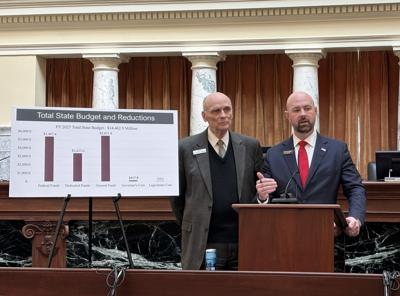
BOISE — The co-chairs of the Joint Finance-Appropriations Committee defended additional agency cuts Thursday, saying they were required to achieve structural balance for the state.
“We do not spend money we do not have,” Sen. Scott Grow, R-Eagle, said. “We cannot print money like the federal government does and we do not want to spend more money than current revenues. Our goal is to have ongoing revenues to match ongoing expenses.”
During a press conference uncommon for the body, the key sticking point for the co-chairs was Gov. Brad Little’s recommendation for a variety of one-time cash transfers and spending cuts to right the state’s budget for the current fiscal year.
Grow said this manner of balancing puts the state in “jeopardy,” and, as he has done since the start of the legislative session, Rep. Josh Tanner, R-Eagle, characterized Little’s recommendations as not “not structurally sound.”
Though tighter than state budgets of recent years that brought surpluses totaling hundreds of millions of dollars, the budget framework put forward by Little was still positive, with a bottom line balance of about $32 million for this fiscal year and $25 million for the next under his office’s revenue projections.
“We had a positive ending balance, but not a positive structural balance,” Tanner said, adding he wanted to avoid “one-time gimmicks” to right the state’s budget into the future.
This comes in reference to a series of budget recommendations from Little including one-time cuts to the Idaho Transportation Department and transfers from several of the state’s interest-earning accounts.
To achieve what the co-chairs described as “ongoing structural balance,” JFAC moved to adopt Little’s recommended 3% cuts for most state agencies earlier this month, but added 1% cuts for this fiscal year and ongoing 2% maintenance, or baseline budget reductions starting next fiscal year.
In some cases, agencies such as the Idaho Department of Correction, Idaho State Police and Medicaid were exempt from the additional budget cuts. In others, agencies previously exempted by Little are now slated to see a full 5% reduction starting in fiscal year 2027, a reality that could be the case for Idaho’s court system.
After adopting the cuts, JFAC’s co-chairs lamented now being “blamed” for the Medicaid cuts after not going beyond the governor’s recommendations. Tanner noted much of the outcry on Medicaid reductions has centered around the proposed elimination of home- and community-based services and said he believed it was a “crucial program” keeping Idahoans out of other high-cost areas of the health care system.
It remains to be seen the exact Medicaid programs subject to cuts as each will need respective legislation to be reduced or eliminated.
Though Medicaid remains a central concern, other agencies have repeatedly raised alarms that cuts beyond Little’s recommendations would end up cutting other necessary services for Idahoans.
A recent letter to JFAC from Division of Financial Management Administrator Lori Wolff highlighted the additional cuts for the coming fiscal year, even if only totaling $30 million of a $5.5 billion general fund, would come at significant cost. These expected consequences include delaying tax return processing by 24 weeks and reducing the seasonal firefighters hired by the Department of Lands, impacting the state’s ability to combat wildfire.
The crucial cuts that were the focus of Wolff’s letter totaled $13 million and Tanner said Thursday he didn’t disagree on their necessity, but said they should be added back through enhancement budgets, which would require separate legislation for each state agency in addition to their maintenance budgets.
While maintenance budgets are seldom reduced from one year to the next, Grow said this approach allows the departments to find where they could be “more efficient” and then come before the legislature with requests that incorporate these findings.
Wolff questioned the need for the added 2% cuts entirely, however, noting Little’s revenue projection provided the state with a buffer of around $30 million for the next fiscal year while JFAC’s own projection was closer to $200 million. For many of the agencies staring down deep cuts and even layoffs, the downstream impact could exceed the cost savings.
In the case of the Commission of Pardons & Parole, the removal of one member for a savings of $80,000 keeps more people in prison longer, and is “much more costly” to the state, she said.
”We tried to point out the really absolutely have-to-do,” Wolff said of her prior letter. “That does not mean, and I do not support if they said that those additional 2% (cuts) elsewhere were just bloat, because it’s not true.”

(1) comment
These two losers are the Peter Principle personified. They have achieved their highest level of incompetence. Walk back the tax break for the rich and drop the school vouchers, dummies.
Welcome to the discussion.
Log In