

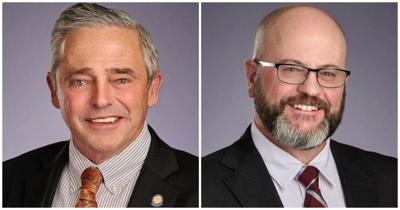

POCATELLO — A new nonprofit is inviting community members to pull back the curtain on Idaho’s legislative process and become better civil servants through a bipartisan effort featuring two notable local senators.
The Idaho Civic Hope Project will host Legislative 101, a civic education event for the community, at 6 p.m. June 18 in the Wood River Room at the Idaho State University Student Union, 921 S. 8th Ave.
Featured speakers include District 28 Republican Sen. Jim Guthrie and District 29 Democratic Sen. James Ruchti.
The event is the nonprofit’s third community seminar and aims to walk attendees through how the Idaho Legislature actually works, showcasing the process of how a bill is introduced, moves through committee and eventually reaches the governor’s desk or is shut down.
“How is the sausage made in Boise?” said Ryan Cameron, a co-founder of the Idaho Civic Hope Project. “As we start to look at candidates and their backgrounds, qualifications and skill sets, are we choosing the right people to represent us?”
The Idaho Civic Hope Project was founded in March by three couples — Ryan and Trissa Cameron, David and Danielle Bagley, and Justin and Jamie Wood. The organization came together organically through conversations stemming from School District 25’s closure of Washington Elementary School.
“Our experience in dealing with the local school board highlighted our inadequacies in understanding how our local governments can affect our lives,” Ryan Cameron said. “That you can’t wait until it’s at your doorstep to try to get involved. We need to be active and engaged citizens always.”
The couples decided to establish a civic nonprofit whose purpose was to educate themselves and fellow Idahoans in civic responsibility. Cameron says engaging in that process begins to restore principle and service-oriented governance by becoming involved in the legislative process from the beginning — a proactive rather than reactive approach.
The group’s mission centers on civic education rather than political advocacy. It deliberately avoids endorsing candidates or pushing particular policies, focusing instead on government processes and how residents can participate more effectively.
Co-founder Trissa Cameron said the group is proud of its commitment to putting community above partisanship, bridging political divides and unruly discourse by pairing common-sense Republicans and Democrats on the same stage.
“We find ourselves in no man’s land because we don’t subscribe to a political party,” Trissa Cameron said. “But by gaining education and valuing community over partisanship, that feels empowering.”
She said watching the two senators collaborate across party lines has been one of the most encouraging parts of organizing the event.
“We shouldn’t see those across the aisle as the enemy,” Trissa Cameron said. “Watching these two senators of different parties work together is heartwarming and it is the way things should work. We should be able to disagree and move forward in good faith and with hope — and that’s why the word ‘hope’ is in the name of our nonprofit.”
The forum will also touch on a question that Cameron hopes participants will ask: how can citizens make their voices heard as legislation moves through the political process?
“Your elected officials represent you,” Ryan Cameron said. “In a representative democracy, you have to make your voice heard — whether that’s emailing, picking up the phone and calling, or finding their town halls. We’re trying to make it a little bit easier for people to learn about the government that affects their lives every day.”
The Idaho Civic Hope Project has also incorporated training from the Dignity Index, a nonpartisan framework developed to evaluate the tone of political speech on a scale from dignity to contempt. Trissa Cameron said the tool has become a focal point of the group’s events, encouraging both speakers and attendees to engage in civil discourse with each other.
“When we become aware of how we speak about or to others — whether we treat them with dignity even when we disagree — that’s a really powerful tool for our community,” Trissa Cameron said. “How we treat each other really matters. We should expect that and demand that from our elected officials.”
Legislative 101 is free and open to the public.

(3) comments
Wow! The republicans who are threatened by bipartisan cooperation in the state legislature have begun their whining. I'm looking forward to hearing from politicians from opposing parties who actually get along.
A bill only progresses if Lord "Honest Jim Guthrie" deigns to allow it to be heard. And if it doesn't interfere with his... um... "social life."
Is it bipartisan if they're both Democrats?
Welcome to the discussion.
Log In