

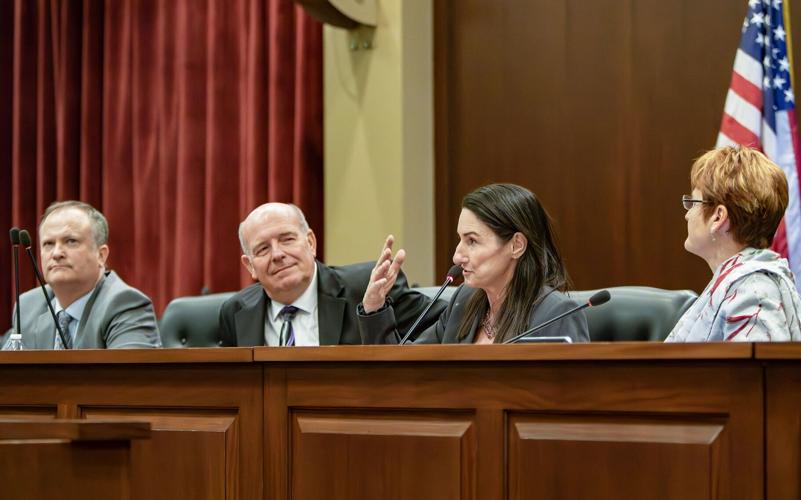
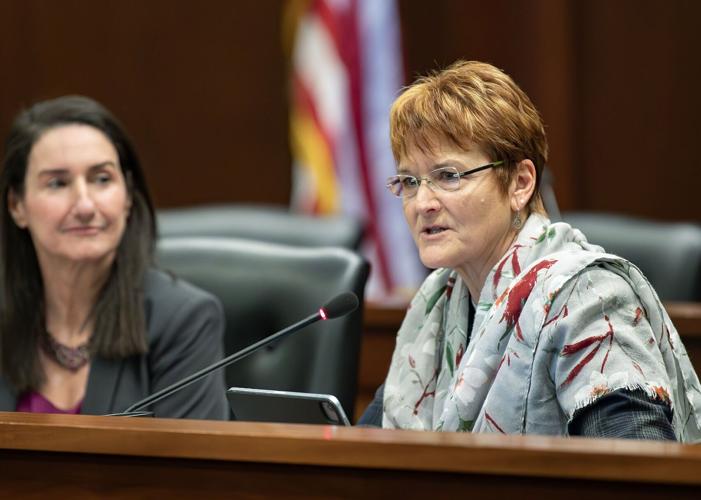
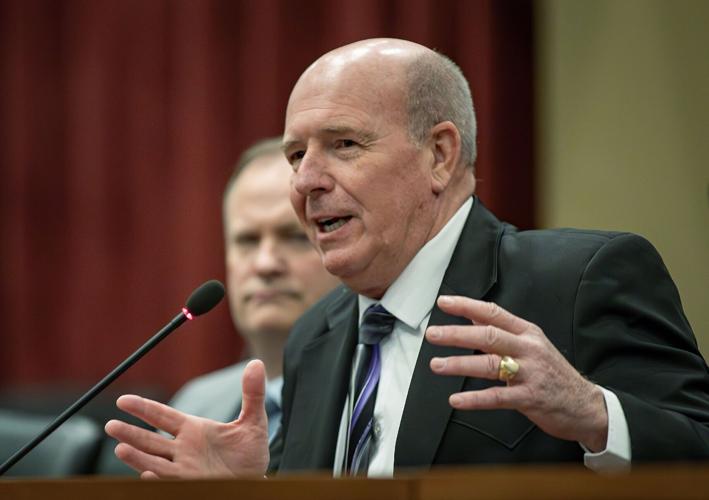
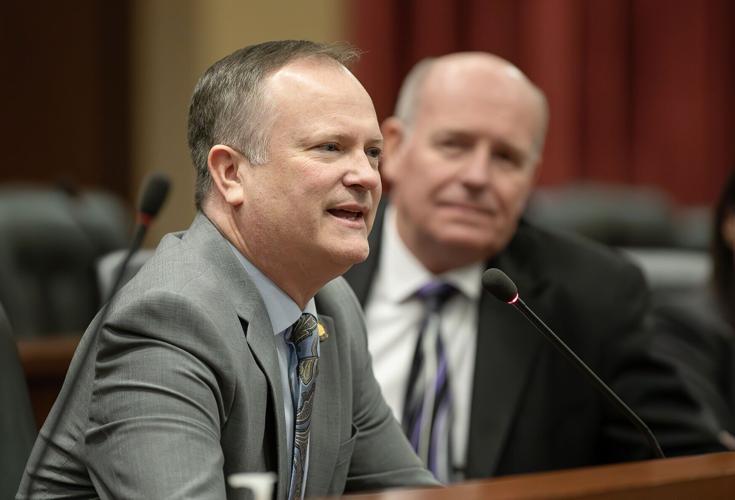
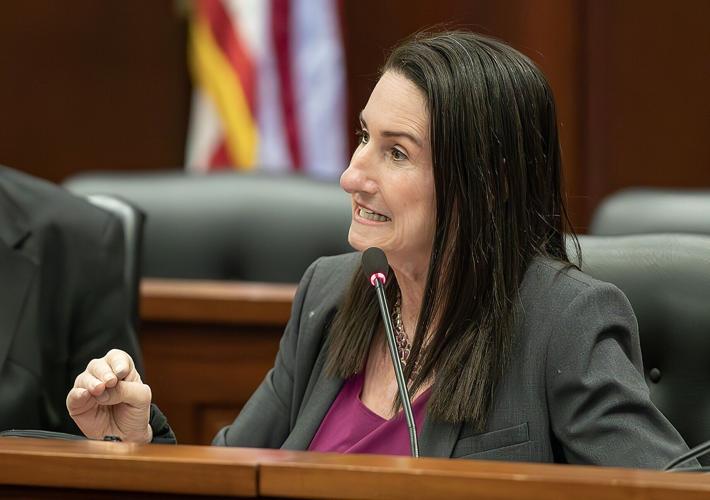

Senate Majority Leader Kelly Anthon, House Majority Leader Mike Moyle, House Minority Leader Ilana Rubel and Senate Minority Leader Melissa Wintrow appear before members of the media during a legislative preview event at the Idaho State Capitol on Thursday.
BOISE — Gov. Brad Little and legislative leadership within Idaho’s House and Senate came before members of the press Thursday to discuss the issues the state will be looking to address heading into the legislative session.
The discussion within the Idaho State Capitol’s Lincoln Auditorium was budget-heavy in light of the state’s forecasted shortfalls and provided a picture among the differing solutions favored between the governor and the two sides of the legislative aisle.
STATE OUTLOOK
Little opened his remarks seeking to dispel any notion that Idaho’s current budget situation is in any way reminiscent of what was observed during the Great Recession. The state’s unemployment remains low at 3.7%, personal incomes are forecasted to continue rising and, while noting the agriculture sector is struggling with depressed crop prices, mining in the state remains “red hot,” he said.

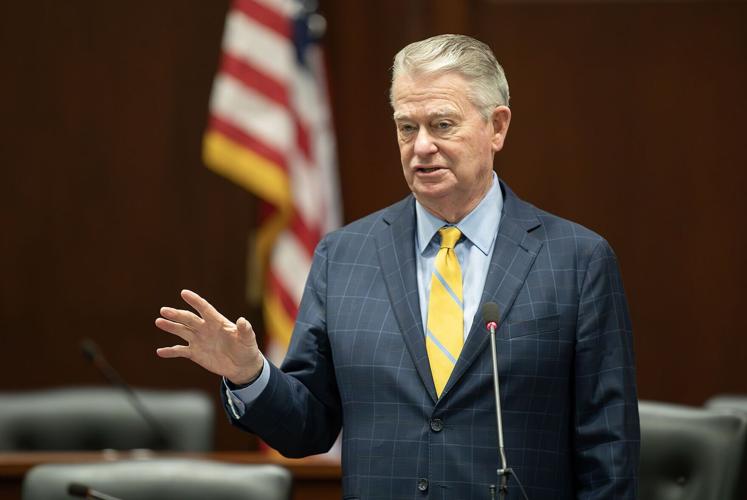
Gov. Brad Little answers questions from members of the news media during a legislative preview event at the Idaho State Capitol on Thursday, January 8.
Despite broader economic positives, he acknowledged there continues to be cause for concern in the standing of the state’s budget. Little said “clouds” were first visible over the state’s budget at the close of session last year and have since manifested into a forecasted $40.3 million deficit for this fiscal year’s budget, according to a December report from the Legislative Services Office.

Senate Majority Leader Kelly Anthon speaks with members of the media during a legislative preview event Thursday at the Capitol.
Senate Majority Leader Kelly Anthon stated he held a “very positive outlook” for the state, but noted that cuts will need to be made to right the budget situation. “Sometimes we have to go without and those who know me inside of the Legislature know that I care very much about the rural communities,” Anthon, R-Rupert, said. “I’m going into the session knowing that we may have to pause on some of the programs that I love.”
House Majority Leader Mike Moyle was resolute, saying the state was in “amazing shape” and underscoring the circumstances of the Great Recession required “more draconian” double-digit percent cuts, well above what has been asked of state agencies to this point.

House Majority Leader Mike Moyle speaks with members of the media during a legislative preview event at the Idaho State Capitol on Thursday.
Little ordered 3% holdbacks across executive agencies in August, a measure he said he has subsequently recommended for fiscal year 2027 in light of budget forecasts. In this area, Little said acting sooner rather than later was imperative. A 3% holdback, Little said, would be more akin to a 12% holdback if implemented near the close of the fiscal year. If such action were taken, agencies would have far less maneuverability with funding that has already been allocated.
These holdbacks have notably exempted K-12 education funds. Asked whether those funds would continue to be held harmless if additional cuts were required, Anthon said he has “not heard any chatter of trying to back off from” the state’s support for public education.
Moyle, R-Star, did not commit to whether cuts would be pursued in this area, but said declining enrollment in public education would have an effect on these budgets as the Legislature wouldn’t want to “fund kids that don’t exist.”
Democratic legislators in attendance were comparatively pessimistic in sharing their assessment of the state budget. Senate Minority Leader Melissa Wintrow said last session’s actions of passing legislation before knowing how much revenue was available has brought cuts that are “pulling the rug” from under the basic public services people rely on.

Senate Minority Leader Melissa Wintrow speaks with members of the media during a legislative preview event at the Idaho State Capitol on Thursday.
”We’re the fastest-growing state in the country, I think, and with that population and growth, you have more people on the roads, more kids in class, more emergency calls being made, Wintrow, D-Boise, said. “That means … we need to have the revenue to pay for those basic services and now we’re going to cut that to the bone.”
House Minority Leader Ilana Rubel said the holdback requests have already inundated her office with calls from constituents concerned about disability care providers and behavioral health programs that have been impacted.

House Minority Leader Ilana Rubel speaks during a legislative preview event at the Idaho State Capitol on Thursday.
“We are not in a situation where we are overspending,” Rubel, D-Boise, said. “We have incredibly lean staffing on everything, so any cuts at this point are excruciating.”
ADDRESSING THE SHORTFALL
It remains unclear what further actions the state will take to reconcile its forecasted state budget shortfall, which could balloon to over $550 million in fiscal year 2027 if state agencies maintain current budgetary requests.
Rubel said she was in favor of examining how to put revenue back into the state budget, particularly by repealing House Bill 93, which allocated $50 million for a school choice tax credit that can fund private education, and repealing House Bill 40, which provided $253 million in income tax cuts, both pieces of legislation that passed last year.
Wintrow said she would also be in favor of putting revenue back into the state through a reconsideration of the school choice tax credit program and further scrutinizing funding for programs like the Idaho Home Learning Academy (IHLA), which was the subject of an Office of Performance Evaluations report examining how taxpayer dollars were being spent for virtual education.
Lt. Gov. Scott Bedke previously floated the idea of tapping into the state’s $1.4 billion rainy day fund as a means of maintaining the state’s bottom line. Little said the position of the executive branch on using these funds to square the state’s budget will be more clear Monday after he presents his state of the state address and initial policy recommendations.
Last year showed a significant difference in degree between Little’s recommendations and the bills passed by the Legislature. While initially proposing $100 million in tax cuts, the Legislature concluded the session having passed over $400 million in tax cuts across bills Little signed but expressed reservations toward, as previously reported by the Idaho Press.
Little said the state will need to get its “arms around” the cost of implementing the Big Beautiful Bill before talk of any significant tax cuts are put on the table.
UNCERTAIN CONFORMITY COSTS
Beyond balancing executive agency expenditures, state budget writers will also be tasked with incorporating the costs of conforming to the Working Families Tax Cuts and Jobs Act (also known as the Big Beautiful Bill) that continues to bring uncertainty when it comes to determining what provisions will be conformed to and their associated cost of implementation.
If taking the number provided by the Tax Foundation, a tax policy nonprofit, the cost of conforming to the OBBBA’s federal income tax cuts — including deductions for tips, overtime and seniors — as well as business provisions will be at least $284.4 million for Tax Year 2026.
Though the state previously decoupled from federal bonus depreciation tax law, Little said Thursday that he doesn’t want the state “to not comply with bonus depreciation anymore.” The Idaho Center for Fiscal Policy, a non-partisan fiscal research organization, has calculated the cost of conforming to income tax changes and previously-decoupled-from provisions to be “at least $435.4 million.”
Legislators were in agreement that the true cost of conformity remains unknown to this point.
”I don’t like jumping off of ledges where I don’t see where the bottom is,” Rubel said.
MEDICAID EXPANSION REPEAL
As a way to cut down on costs for the state, Idaho’s Department of Government Efficiency (DOGE) committee signaled in December they would be recommending the Legislature look into a repeal of Medicaid expansion, which passed by voter initiative in 2018 to expand the program to Idahoans making 133% of the federal poverty level.
When asked about whether he would support a repeal of Medicaid expansion, Little offered a simple “no,” but fell short of committing to a veto on the matter, saying he doesn’t “commit to bills” until they are on his desk.
Wintrow said repeal would be “one of the most expensive cuts” the state could make as each dollar put in is matched by $9 from the federal government. At present the state receives $1.03 billion from the federal government for the program, according to the Legislative Services Office, a number shared earlier this week by Rep. John Gannon, D-Boise.
Moyle and Anthon expressed displeasure with the fact that the cost of expansion for the state has grown to just over $100 million and both similarly expressed a desire to seek out fraud and exploitation in the Medicaid system.
”We literally have people that know, if they only work this many hours, they can get those benefits,” Moyle said. “We are incentivizing a bad deal for the (state) of Idaho and the business in Idaho. We’ve got to look at fixing this problem.”
Rubel said the cost of repeal would be greater for the state, however, pointing to 2023 data that showed the cost savings from the program were about $78 million compared to state costs of $73 million.
Doing away with Medicaid expansion, Rubel said, would be “mathematically nonsensical.”

(1) comment
Sounds like the GOP will put a bandaid on the sucking chest wound that is Idaho's budget deficit.
Welcome to the discussion.
Log In