




BOISE — The Senate State Affairs Committee voted Friday to amend a bill requiring social media companies to receive parental consent and advanced to the Senate floor a bill clamping down on what flags cities and counties in the state can fly. In both cases, the bills have already been passed out of the House and await full consideration by the Senate body.
Named the Stop Addictive Social Media Act, House Bill 542 seeks to add requirements for social media platforms to remove various addictive qualities for accounts belonging to children and obtain parental consent for accounts of children ages 16 years old and under. Seeking to target the largest companies in the sector, the bill only applies to these platforms when they have generated at least $1 billion in advertising revenue in a single year.
The addictive features that are to be removed under the bill include infinite scrolling, the displaying of media feed corresponding with a person’s profile, push notifications, auto-play video, metrics for reactions to a post as well as awards based upon hours spent on the platform, follower numbers or engagement levels.
To determine whether these measures need to be restricted for a certain account, social media platforms will be required to estimate the age of the account holder and shut down until parental consent is provided.
If age estimation software employed by a social media platform concludes at an 80% confidence level or higher the account holder is over 16 years old or older, they will not be subject to the addiction-related restrictions. These estimates are then required to be updated with every 100 hours spent on the platform by the amount holder.
Sen. Cindy Carlson, R-Riggins, who sponsored the legislation, said the changes were a matter of providing parents “one more avenue to protect kids.”

Cindy Carlson
Senior Counsel for the Alliance Defending Freedom Chelsey Youman, who assisted legislators in the creation of the bill, said a secondary aim of limiting child social media accounts is limiting the ability of these companies to “commodify” their child users by utilizing their data for targeted advertisements.
Public testimony on the bill was mostly delivered by various tech industry representatives who voiced concern the bill would both burden companies — which would have to swiftly change their platforms to comply with the bill’s July 1 effective date — and introduce First Amendment concerns by limiting what information is available to certain users.
Jennifer Hanley, Meta’s director of North America youth safety policy, said there was discussion with the bill authors to move the effective date back, but additional concerns persisted. In her statements against the bill, Hanley argued limiting its application to certain companies that meet an advertising revenue threshold as well as those with a “primary” function of sharing content will lead to an inconsistent application of which companies are subject to the new regulations.
Zachary Lilly, director of government affairs for NetChoice, spoke on behalf of a trade association representing major internet companies including Amazon, Google and Meta. Lilly said the bill as written violates First Amendment protections for the association’s members, and a preferable avenue to continual age verification was educating parents to make informed decisions as opposed to having “big government” decide for them.
”Young people and adults have a right to engage with information and speech platforms without the government placing preconditions on that engagement,” Lilly said. “Verification is synonymous with identity verification, which goes against an American tradition of anonymous free speech that stretches to the founding.”
Sen. Mark Harris, R-Soda Springs, citing concerns raised about the effective date, motioned for the bill to be sent for amendments. In a 7-2 vote, the committee aligned with Harris, opting to have the bill retooled before it is sent to the Senate floor for a vote.
Flag bill advances to Senate floor
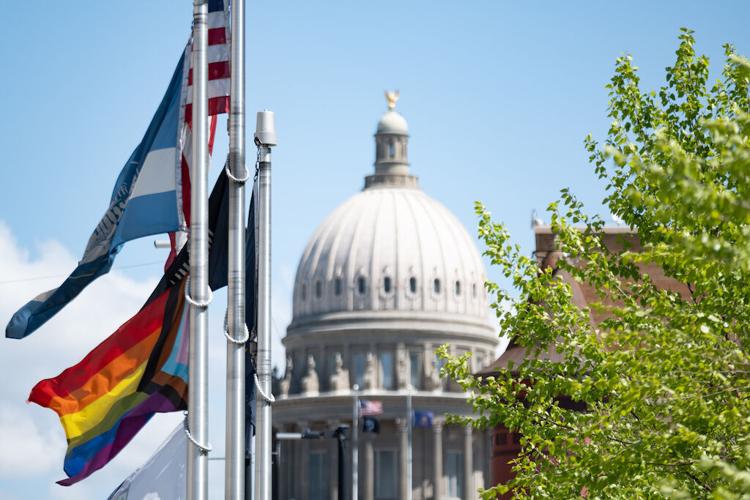
After passing out of the House last week, the Senate State Affairs Committee also took up a hearing for House Bill 561. The bill is a revised version of last session’s House Bill 96, which significantly limited what flags cities and counties could fly. The new bill adds a $2,000-per-day fine for noncompliance — an enforcement mechanism lacking under the current law — and restricts the “official” flags flown by cities and counties to those established prior to Jan. 1, 2023.
In the case of both revisions, the bill aims to respond to the city of Boise continuing to fly the LGBTQ+ Pride flag. Though initially lacking compliance with the law, the city aligned itself with the legislation by making the Pride flag an official city flag in May of last year. Rep. Ted Hill, R-Eagle, who sponsored the legislation, said the aim is to ensure flags flown by cities remain “innocuous and not political.”
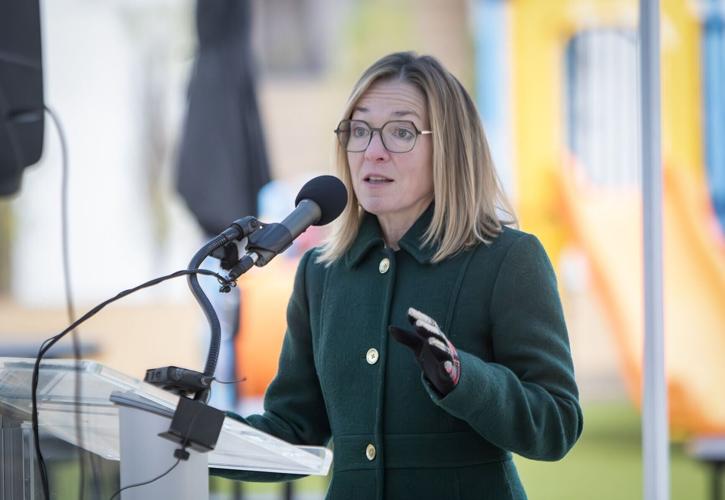
Boise Mayor Lauren McLean, who appeared before the committee to testify, said the bill, in denying communities the ability to fly flags that align with their values, fundamentally restricts local control previously afforded to them.
“It was designed to prevent one city from flying one flag, and it’s no secret that the bill in front of us here today, as already discussed, is designed to punish Boise and Boiseans for lawfully flying the Pride flag,” McLean said. “Something we’ve been doing for over a decade.”

Boise Mayor Lauren McLean speaks during an opening celebration of the Denton Apartments on Tuesday, Dec. 9, 2025.
Both remarks from committee members and testimony also highlighted the unique impact the bill would have on Bonners Ferry. The Boundary County city located about 30 miles south of the Canadian border has flown the Canadian flag and the American flag for over 50 years in recognition of the close economic ties.
Sen. Treg Bernt, R-Meridian, highlighted Bonners Ferry as one of the first cities seen when someone is making their way from Canada into Idaho and questioned whether the practice could continue under Hill’s effort.
According to the text of the bill, the official flags of countries other than the United States may only be flown for “special occasions.” Hill responded that a 24-hour, year-long flying of the Canadian flag would not fit the definition of special occasion under the bill.
Sen Jim. Woodward, R-Sagle, testified before the committee to advocate a carve-out be made in recognition of this relationship. Woodward, himself a Boundary County senator, remarked that Canada ranks No. 1 amongst Idaho’s trading partners and has a variety of physical connections ranging from natural gas pipelines to Lake Koocanusa (short for Kootenai-Canada-USA).
Woodward said the lake was of particular importance as its creation in 1972 by the Libby Dam — a joint pursuit of the United States and Canada — addressed Bonners Ferry’s propensity for flooding. “That cooperation now prevents that,” Woodward said.
Harris motioned for the bill to be sent for amendments to address outstanding concerns, but the effort failed in a 4-5 vote. The committee instead voted to approve a motion from Sen. Lori Den Hartog, R-Meridian, sending the bill to the Senate floor without further adjustments.

(0) comments
Welcome to the discussion.
Log In