



BLACKFOOT — An era in television news broadcasting in eastern Idaho is coming to an end Friday.
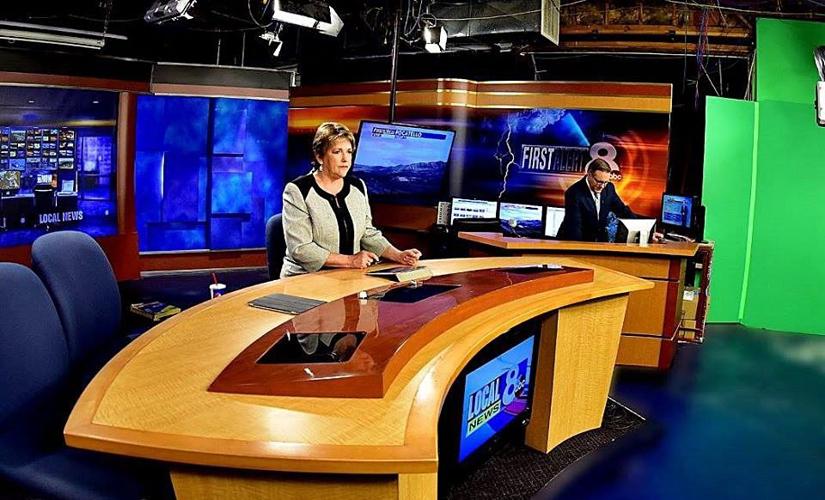
That’s when Karole Honas will say farewell as an anchor with KIFI Local News 8 after 30 years with the Idaho Falls station, along with several years spent helping to get the news operation of KPVI Channel 6 in Pocatello off the ground before that.
Honas has been breaking ground for women in local television news broadcasting ever since her first days spent learning the profession at the University of Idaho.
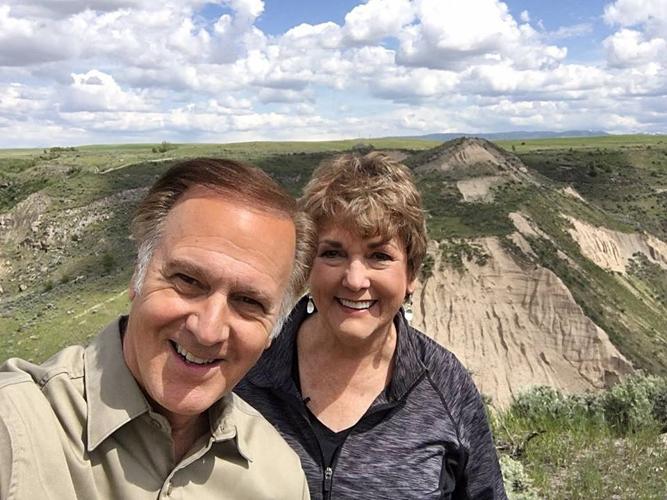
Right after graduating from the UI with a degree in radio/TV communications, she married her husband of 43 years, Ken, and they settled in Blackfoot. Just a couple of weeks after getting married, she dove into the television news business as one of the pioneers of the news team at KPVI.
“I spent six years there,” Honas said. “I loved Pocatello. I have a tender spot for Channel 6 to this day.”
Starting out at KPVI, Honas was one of three people on the news team starting out, each doing pretty much everything in the way of news gathering and reporting. She remembers working from 8 a.m. to 8 p.m., doing a live broadcast at 6 p.m., recording the 10 p.m. newscast, leaving a hole for sports and going in again at 9:30 or 10 p.m. to fill that sports hole with scores.
She relied on her husband, more of the sports fan, to guide her in that area until she felt more comfortable in that role.
“We were so full of youth, vitality, energy,” Honas said. “I loved the old days where the product was what counted.”
It was then that Honas found herself speaking in front of local civic organizations promoting the Pocatello station.
“You’ve got to support this station, that was my mantra,” she recalls. “People still support it because that’s ‘the Pocatello station.’ I was the one carrying that banner back in the day.”
In the earliest days of KPVI, Honas says, they didn’t have desks. The crew sat on the floor. The first main location for KPVI’s crew was an old bar on Pocatello’s Main Street, the film lab was in a red barn at the Pocatello zoo, and a studio was set up in an old garage with an eight-foot-tall ceiling.
The immediacy of communicating among crew members came through a two-way radio, a far cry from the cell and smartphones of today.
“Channel 6 gave me a great start,” Honas says. “I was there for six years. It was a wonderful experience.”
A change to her career came about when Karole and Ken started a family, made up of sons Kristopher, Karson, and Kreighton. She took six years off to focus on the family.
That changed in 1990 when KIFI news anchor Jay Hildebrandt gave Honas a call.
“(Former KIFI news anchor) Susan Furniss had a baby several weeks early,” Honas recalled. “Jay called and said, ‘I understand you used to be an anchor. We need someone to fill in for Susan.’
“After six weeks, I thought I was done, the contract was done. They called back and said, ‘Why are you not coming to work?’ No one said anything.”
When Hildebrandt wasn’t on the air, Furniss and Honas worked together as the first local female anchor team until Furniss went to a larger market.
Honas remembers when a consultant was brought in to evaluate the team.
“The consultant wanted to change me,” she said. “He said, ‘You’ll never take it on the road.’ Well, that was fine because I never wanted to take it on the road.”
But, she says, she could have “taken it on the road” after all. Without sending out an audition tape, stations in larger markets in the south and in Reno would see the tapes of other reporters trying for a job. They’d see Honas throwing to the reporters on live shots and show more interest in Honas as an anchor and ask about her interest in a job.
“It proved to me that I could have taken it on the road,” she said. “But this was my home, this was my state. This was everything I ever wanted.”
Honas gives a lot of credit for making it work between her work life and her home life to husband Ken. Karole would do all the cooking on weekends for meals for the days ahead, Ken would throw the precooked meals in a bowl and microwave them while Karole was at work in Idaho Falls.
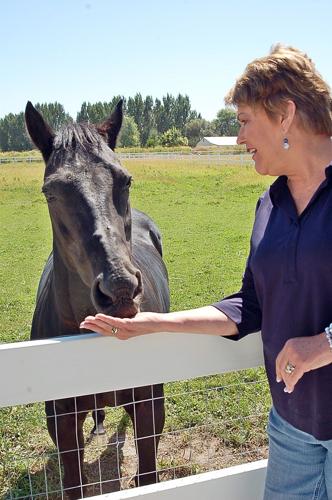
She was able to get to soccer games and other activities on a Saturday in most cases, but she had a harder time getting to football or basketball games on weeknights. Ken was the “soccer dad.” As a self-employed contractor, he could leave work early and take the boys trick-or-treating, church activities, or 4-H events.
“I loved it,” Ken says. “It wasn’t a burden, it was a blessing.”
“There I was, in an air-conditioned office typing away, and there he was having horses and kids to handle. He did it all,” Karole noted.
Honas has had a lot of roles through the years aside from being an anchor, adding on assignment editor, news director, producer, and reporter. Being a Blackfoot resident, her main reporting beat was Blackfoot and Bingham County.
“You took care of your town, you know it, you love it,” Honas said. “I liked owning my beat. I took great pride in that.”
Honas doesn’t see the years she spent sharing a set with Hildebrandt — who was at KIFI for 35 years before his own retirement last year — as something likely to be seen again with the learn-and-move-on mindset seen in the business today.
“That was a fluke,” Honas says of her years with her longtime broadcast partner. “Jay is the quintessential gentleman; we represented the yin and yang of the market. Our politics, our religions, our perspectives were different, but our goals were the same. We learned very early on we’re never going to change each other’s opinion. The length of time we spent together as a team is unheard of in this business. We didn’t have a cross word in 30 years together. In those two-minute (commercial) breaks we shared a lot, you learn a lot about each other in those times.”
Through the years of presenting so many stories, Honas has seen the good and the bad. The bad has come in cases like the Vallow children, little DeOrr Kunz disappearing from a campsite near Leadore in July 2015, Angie Dodge, the disappearance of Stephanie Crane in Challis, murder cases involving Richard Leavitt and Paul Ezra Rhoades.
“Those kinds of cases strike me in the gut,” she said. “It hurts to think there’s that kind of evil in the world in Southeast Idaho. It drives me nuts, to think of wallowing in evil. We have to recognize evil in our own back yard. Those are the things I’ll never get out of my head. That sticks with me. But there’s always the good with the bad.”
Honas says she’s gotten much joy out of so many people in the area doing great things.
“It’s so much better to do a good feature story on things like 4-H kids,” she added. “I love those stories, they’re something uplifting.”
Honas has spent a lot of time mentoring the “new blood” in the business. Of the things she tries to instill in the fresh faces she sees, old journalistic ethics rises to the top.The things she will miss come down to the atmosphere in a newsroom, the people who’ve gone through a liberal arts background who like to communicate, making the newsroom a fun place to be, having the right to call to find details when something is going on.
Much has changed in the years Honas has been in the business. Journalism hasn’t been the most respected profession around, but what saddens her is how bad that reputation has gotten recently.Among the parting words Honas has shared with her audience since the announcement of her retirement has been something that goes to her United Methodist upbringing, words attributed to Methodism founder John Wesley.
“Do all the good you can, in all the ways you can, at all the times you can, to all the people you can, as long as ever you can.”

(0) comments
Welcome to the discussion.
Log In