

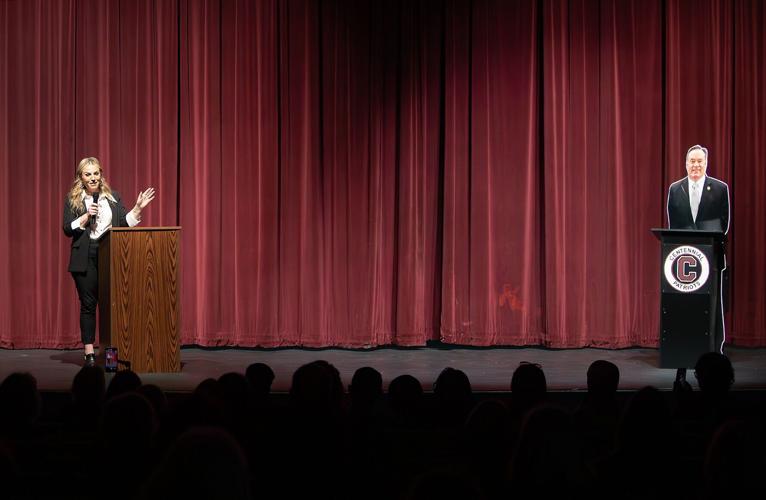


BOISE — Over 100 attendees shuffled through the doors of Centennial High School’s Little Theater on Thursday for the opportunity to hear from Congressional candidate Kaylee Peterson, who took the stage opposite of Idaho First District Representative Russ Fulcher — at least his likeness, anyway.
Peterson, the First District’s Democratic candidate for 2026, announced earlier this week she would be hosting the “debate” with or without Fulcher and she ended up being true to her word, propping up a cardboard cutout of the congressman and using audio cut from interviews and statements he made in the House of Representatives to convey where he stood on several hot-button issues.
While the two have yet to meet on the debate stage, Peterson ran for the First District — which encompasses the western half of the state from the Idaho-Nevada border to the panhandle in the north — in 2022 and 2024, losing out to the incumbent Fulcher who twice garnered over 70% of the vote.
Outside of a few technical difficulties during the playback of Fulcher’s statements, the event was carried out with a similar question-by-question format employed by standard political debates, though moderator Lindsay Van Allen, the former host of the City Cast Boise podcast, made clear at the outset that there would not be an opportunity for rebuttals for either of the two candidates.
Van Allen opened the debate with the biography available on Fulcher’s website that speaks to the four-term congressman’s fourth-generation-Idahoan roots, his upbringing in Meridian, his extensive private sector experience with Micron and Preco Electronics, his 10 years of experience serving in the Idaho Senate and his representing Idaho’s First District since 2019.
A spokesperson for Fulcher’s office did not respond to requests for comment on the congressman’s debate attendance.
Fulcher has been in Washington, D.C., and introduced legislation last week that seeks to extend short-term limited-duration insurance (STLDI) plans to improve flexibility for those that are transitioning between healthcare coverage. He also released a letter this week urging for Idaho to have greater control over the federally owned public land within the state.
In her introduction, Peterson described herself as a 35-year-old working class mom of two whose family first came to what is now the North Eagle foothills over a century ago. Peterson spoke to her time in public speaking and debate during her school years, her decision to return to college at the age of 30 and her being recruited to run for Congress in 2022 while attending the College of Western Idaho.
The key aim of her campaign this year, she said, is “connecting working class Idahoans with the political process … showing them how to have a seat at the table.”
With introductions out of the way, the first question centered around the candidates’ stances on public lands and the federal stewardship that characterizes most of the land in the state.
The issue has come back into headlines recently after Gov. Brad Little and the U.S. Forest Service announced a new agreement that could double timber production across federal and state-owned public lands.
The same questions were offered to both candidates and each time Fulcher was given the first word.
“Idaho is in a completely different position from a standard of governance than most states, because we simply don’t control the resources under our feet,” a playback of past statements from Fulcher said, “so I’ve made a statement on multiple occasions that we’re tenants in the state to the federal government.”
Fulcher’s recording went onto say the current dynamic means Idaho doesn’t “control its own destiny,” bringing with it a more limited ability to harvest timber — that brings profit and improved wildfire resistance. The answer, the recording said, is, if not shifting ownership, shifting management of these lands from the federal government to the state.
Peterson responded that the fear many have around a change in public land ownership stems from the fact that much of Idaho’s public lands have been sold off by the state in the past.
To this point, she noted that over 1.7 million acres, or 41% of the state’s publicly owned land has been already been sold off and added that Idaho taking on the federal burden that holds 63% of the state’s public lands while have a forecasted budget shortfall of over 50 million for this physical year was “unrealistic.”
Speaking to the present challenges the U.S. Forest Service has in managing these lands, Peterson said much of the present difficulty stems from the Trump administration’s layoffs of Forest Service workers.
“When I talked to our Forest Service employees, their biggest fear was that they no longer had enough employees to have relief crews during the fire season,” she said.
Peterson’s overall performance was well-received by audience members who gathered in the high school’s small auditorium as she went through a gamut of issues including abortion, rural healthcare, Big Beautiful Bill cuts and the state’s shift towards private education, frequently erupting in cheers as she expanded on her positions that frequently were opposed to the sitting congressman’s.
Outside of the set debate questions, Peterson also responded to several comments she received online questioning the intent or benefit of the Thursday “debate” and she opened by saying that her past campaigns and present effort made her realize that even in a conservative Republican state, everyone defines their political label differently.
“They talk about wanting to decrease the deficit, they talk about wanting to increase the local revenue and boost local economies and offer local students opportunity,” Peterson said, citing her time speaking with conservative voters in the First District. “They talk about how important it is to support small business and competition in the markets, and I agree with all of those things.”
The broad aim of her campaign, she said, was to start a movement to unite Idaho’s communities, no matter what political label they ascribe to themselves.
Responding to a remark online that she was an “unserious candidate,” Peterson said seriousness should be determined by whether or not someone will be fighting for their constituents and she recalled speaking with District 1 constituents who spoke of being harmed by current policies, but lacked the opportunity to see Fulcher in-person to voice their concerns.
“I want us to start defining serious candidates differently,” Peterson said. “The amount of time that they spend in communities, listening to voters, the amount of time that they spend trying to understand the other side, understand across the aisle … I care about whether or not you will show up and do the work.”
Attendees who spoke to the Idaho Press were positive on the event, and expressed a consistent desire to have more of these kinds of in-person opportunities to connect with elected officials, as well as those who are running for office.
“I think she’s an amazing young woman,” Rita Sherman, a debate attendee, said of Peterson, “and I’m disappointed that Fulcher chose not to show up.”
Sherman added that she wished Idaho’s congresspeople hosted more in-person town halls to present their viewpoints, as opposed to leaving voters to listen to “sound bites” of their remarks.
While Fulcher has hosted several telephone town halls throughout the year in which he fields questions on various issues concerning to Idahoans, these have not been in-person events.
Peterson said Thursday that she intends to continue hosting these “debates” and other forms of outreach across the First District to allow people to connect with her and her campaign in advance of the November election. The invitation for Fulcher to attend remains open, she added.
“Hopefully Fulcher does show up,” Sherri, an attendee who declined to give her last name, said. “I’m sure the people would like to ask him questions and it was great to see this number of people.”

(1) comment
How did they discover this was a cardboard Fulcher? You can't tell the difference.
Welcome to the discussion.
Log In