

Students from 10 rural communities in East Idaho now have state-of-the-art virtual access to Idaho State University courses from their own small towns.
In 2016, the Idaho Legislature expanded the state’s Fast Forward program, which allocates $4,125 for students in grades seven through 12 to use toward advanced educational opportunities, such as dual enrollment college credit courses.
However, the funding disproportionately benefited students in urban school districts, who could more easily commute to college campuses to take advanced classes.
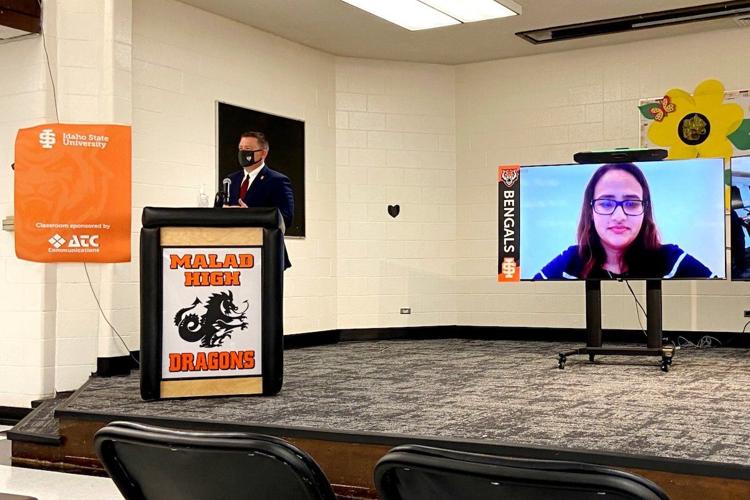
At the start of the current school year, however, donations from private communications companies funded high-tech video conferencing cameras and large video screens to be added at Rockland High School, Malad High School and at an ISU conferencing center serving students in the Blackfoot area. The Shoshone-Bannock Tribes also purchased the equipment for Shoshone-Bannock Junior-Senior High School students.
Last month, additional cameras and equipment were added in Soda Springs, Marsh Valley, Butte County and Ririe, as well as in North Fremont and South Fremont high schools.
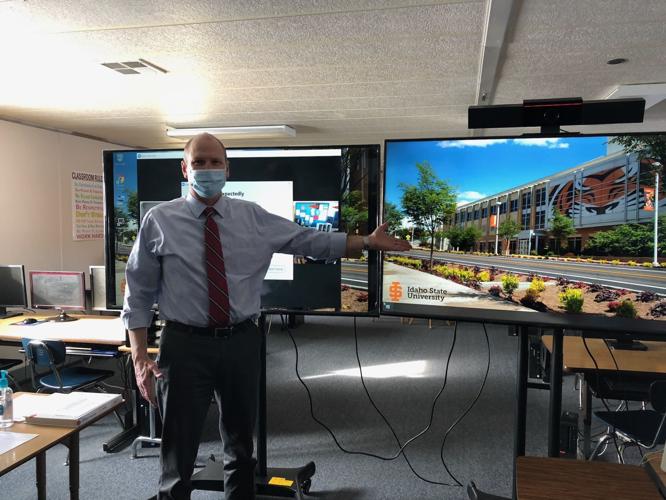
ISU has invested both institutional funding and federal Coronavirus Aid, Relief and Economic Security Act funding into purchasing video conferencing technology for its own classrooms and lecture halls. ISU uses video screens and voice-activated, external 360-degree video conferencing cameras with microphones and speakers, called Meeting Owls.
Rural students may also use their personal computers and laptops to access the ISU cameras and take courses for college credits in every discipline. The classroom experience is significantly enhanced, however, when they participate using the new technology purchased for their communities.
“It’s as close as you can get to taking that class in the classroom while not actually being in the classroom,” said Madison Shumway, director of marketing and recruiting for ISU’s College of Arts and Letters.
Marsh Valley High School senior Jeremy Nielsen had previously taken dual enrollment courses offered by his high school. The new virtual technology has removed a transportation barrier and enabled him to also remotely take Communications 1101, Sociology 1101 and Geology 1101 through ISU for nine additional credits.
“Gaining these nine credits this semester will fulfill the requirement to start as a sophomore in college,” Nielsen said via text message. “These classes are preparing me for the mentality of studying under a college professor compared to a high school teacher.”
Shumway said the program for rural school students was planned well in advance of the COVID-19 pandemic, but it’s taken on new importance now that distance learning has been emphasized to prevent the spread of the virus.
She said some rural schools have used their cameras to provide virtual access to regular high school courses for students quarantining at home.
Holly Kartchner, director of outreach and retention with ISU’s College of Arts and Letters, said ISU has been in communication with more than 30 additional rural schools interested in obtaining the video conferencing equipment and providing improved dual enrollment access to students.
“We really want to expand because Idaho is a rural state,” Kartchner said.
Some schools used their equipment to provide virtual training and meetings with staff when Idaho schools had to suspend in-person instruction due to COVID-19, Kartchner said. She said the technology will soon be used for virtual field trips and ISU campus visits, saving high students the time away from class needed to take a bus ride. By next fall, she said ISU professors will likely be using the technology to facilitate virtual professional lectures for students at specific rural schools.
“When you see what the potential is it’s really amazing,” Kartchner said.
Major donations to help the rural communities acquire the technology were made by Direct Communications in Rockland, ATC Communications in Malad and Blackfoot Connect.
Direct Communications made the largest gift, totaling $50,000.
“With everything that’s happened with COVID it’s turned out to be even more of a necessity with classroom learning,” said KaLee Ralphs, marketing manager with Direct Communications.
Ralphs said her company hopes to continue investing in equipment to help additional rural schools within their service territory, especially in the Bear Lake, Soda Springs and Grace areas. She hopes more students will take advantage of the technology to earn college credits in the coming years.
“Our focus has always been on building these small communities and especially schools,” Ralphs said. “We know when we connect Idaho’s rural communities it’s going to ignite the growth of economies, health care, agriculture and especially education.”

(0) comments
Welcome to the discussion.
Log In