

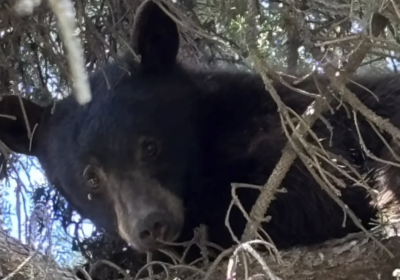
NAMPA — A yearling black bear got a rare second chance on June 14 after wildlife officials decided to relocate it rather than put it down, following a report that it had been spotted in a tree in a Nampa neighborhood near Boise.
Idaho Fish and Game enforcement officers and biologists, working with the Nampa Police and Fire Departments, on June 14 sedated the bear, loaded it into a trap and drove it to a release site north of Ola.
The bear was likely a yearling male recently driven off by its mother and learning to survive on its own, according to Fish and Game. It hadn’t caused any known problems, wasn’t conditioned to seek out food, and showed a clear, healthy fear of humans — all factors that led Fish and Game staff to relocate it instead of euthanizing it.
“It’s not an everyday, or even yearly, occurrence for a bear to end up roaming a Treasure Valley neighborhood, and it’s even rarer for us to relocate one,” said Fish and Game Regional Wildlife Manager Ryan Walrath. “Often, euthanizing a bear in town is our only option.”
By the time Fish and Game typically hears about a bear in town, it’s usually been causing problems for a while, getting food from people, and losing its natural fear of humans, the agency said. Relocating a bear under those circumstances would risk more conflicts and a public safety threat. Even without those complications, sedating and moving any large animal carries risk to the public, the animal and Fish and Game staff.
“Our priority is public safety and the safety of our staff, followed by the safety of the animal,” said Fish and Game Regional Supervisor Josh Royse. “We don’t always have the resources to mitigate those risks to an acceptable level, but in this case, we did. It is rare that we can do anything other than euthanize a bear that is in a place that we don’t want it. This was one of those very rare exceptions, and we took advantage of it.”
The Nampa case may be a sign of things to come. Wildlife biologists in southwest Idaho are seeing more bear-in-town reports than usual this year and earlier in the season than typical — a trend they attribute to ongoing drought conditions.
“We wouldn’t be shocked to see even more bears in places they wouldn’t normally be as we get into late summer and early fall, as we expect that natural food sources will be harder to come by,” Walrath said.
Fish and Game officials say residents should remember that the Treasure Valley sits at the edge of bear habitat — essentially all of Idaho qualifies.
As summer and fall progress, the agency is asking people to take a few precautions to avoid attracting bears: remove bird feeders between April and mid-November, feed pets indoors, put trash out the morning of pickup rather than the night before, and avoid keeping coolers, refrigerators or freezers outside.
If a bear has already found food at a property, officials say those same steps should be taken immediately — the bear will likely return a few more times, but should eventually move on if it keeps finding nothing.
Fish and Game also encourages residents to report bear problems early. Catching an issue before a bear tries to break into a home gives staff more options for a non-lethal resolution. Bear sightings in the Treasure Valley can be reported to the Southwest Region Office in Nampa at 208-465-8465.


(0) comments
Welcome to the discussion.
Log In