



BOISE — Perhaps the world’s most famous exoneree, Amanda Knox was more than a year into her wrongful imprisonment when Boise State professor and Idaho Innocence Project founder Greg Hampikian contacted her family.
The Seattle native was in the midst of what would be the first of three trials for the 2007 murder of her British study-abroad roommate, Meredith Kercher, in Italy. She was convicted, acquitted and released, then re-convicted in absentia — ultimately spending four years in prison and four more on trial before the Italian Supreme Court definitively exonerated her in 2015.
“Tons of people were reaching out to my family at the time, including crazy amounts of press who were all descending on my family’s homes, but he was the first person who had specific expertise in DNA science and wrongful convictions,” Knox, now 39, said. “He became this incredible resource to them, even just to explain to them what was going on.”
Hampikian’s independent DNA analysis and demonstrations of contamination played a role in freeing Knox at her 2011 trial. In 2014, after she was re-convicted and potentially facing extradition, he invited her and her mother to attend their first Innocence Network Conference — introducing her to a community of other wrongfully convicted people.
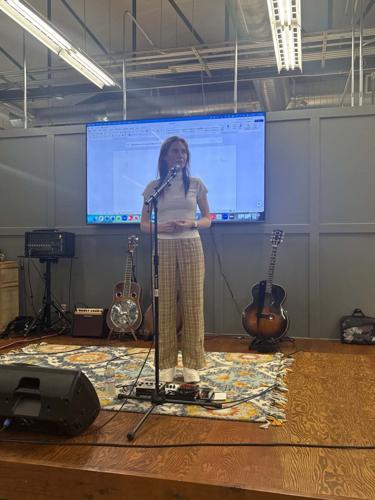
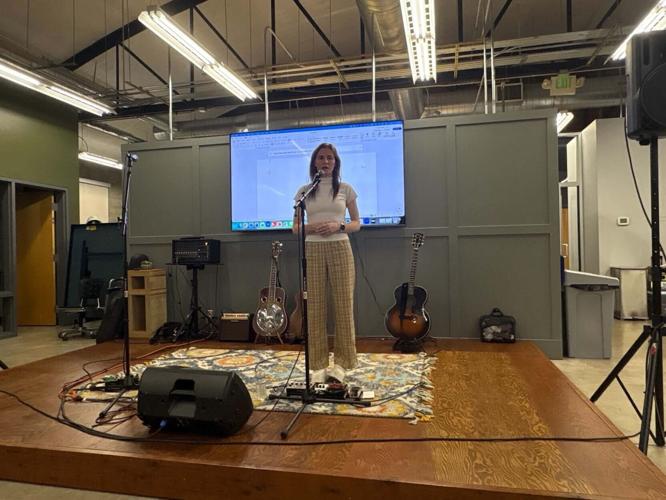
And Thursday night, Knox was in attendance as a keynote speaker for “Legacy of Freedom,” a celebration of Hampikian’s career and retirement held at Inspiration Alley. The Idaho Innocence Project’s work will now come under the purview of the San Diego-based Innocence Center, on whose board Knox sits.

Amanda Knox speaks at the Idaho Innocence Project’s “Legacy of Freedom” event Sept. 17, 2026, in Boise.
“I can rest a little easier, because I have a bunch of letters from people who are in prison in Idaho that I can’t do anything about,” Hampikian said. “I can do the DNA work, the analysis, and have labs tested and write affidavits, but I have to work under the authority of an Idaho lawyer.”
The Idaho Innocence Project suspended its legal services in 2024 due to a lack of funding. Hampikian searched for over two years to find someone to rekindle that mantle, ultimately landing on Innocence Center director Mike Semanchik, who took the Idaho bar exam just so he could take up the project’s work.
“Until we have enough money raised to hire somebody who lives here, he’s going to represent clients that they take from here. I’ll still be involved with the DNA, to the degree they want me,” Hampikian said.
Prior to 2004, Hampikian lived in Atlanta, where he was a co-founder of the Georgia Innocence Project. When he took a position in Boise State’s biology department that year, the university’s then-president Bob Kustra encouraged him to start a project in Idaho.
One of the first cases he took up was that of Christopher Tapp, who at the time was serving 30 years to life for aiding and abetting the 1996 rape and murder of Angie Dodge in Idaho Falls.
Tapp would ultimately spend two decades in prison despite all the DNA at the scene belonging to an unknown man, based on a coerced confession to participating in the crime.
A 2017 appeal resulted in the vacation of the rape conviction and a reduction in the murder sentence, freeing Tapp, but Hampikian continued to aid the search for the actual perpetrator based on the DNA samples.
“It ended up being the first genealogy exoneration,” Hampikian said.
Genetic genealogy led to the apprehension of Brian Dripps of Caldwell, who pleaded guilty to killing Dodge. Tapp’s conviction was fully overturned, but he only enjoyed a few years of freedom before becoming a homicide victim himself in Las Vegas. A former professional wrestler and congressional candidate has been charged in his death.
Also speaking at the event was state Sen. Doug Ricks, who introduced a bill arranging for compensation for wrongfully convicted Idahoans that was signed into law in 2021 — and Charles Fain, one of the beneficiaries of that law who was exonerated of murder after 20 years on death row.
Knox reflected on her own case, considering herself lucky to have only spent four years behind bars and to have had the opportunity to fully rebuild her life. She went on to become an author and journalist, podcaster, stand-up comedian and mother of two.
Of Hampikian’s efforts, she said “it is heartbreaking work. It will take and take and take from you, but in the end, there is another human being and another life that is saved on the other side.”
“It’s someone like me,” she said, then turned to Fain. “Someone like you.”
Semanchik, the man Hampikian passed the proverbial baton to, was late to the event itself due to a series of airline mishaps. But he found a way to analogize this ordeal to that of freeing the wrongly convicted.
“You go and you fight and you spend 10 years, 15 years, working on a case. Just when you think you’ve got it and you’re bringing somebody home, they turn the plane around and they go back to Sacramento,” he said. “But you know what, the flight made it, and we got here, and that’s how this works. It’s about getting people home from prison who don’t deserve to be there.”

(0) comments
Welcome to the discussion.
Log In