

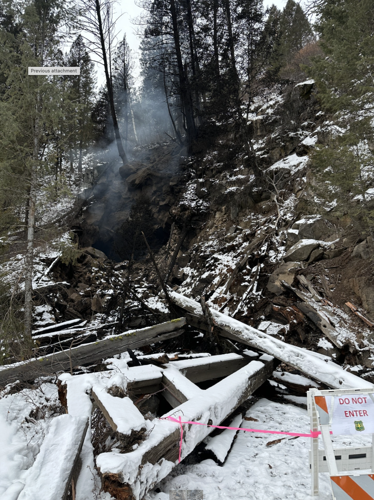
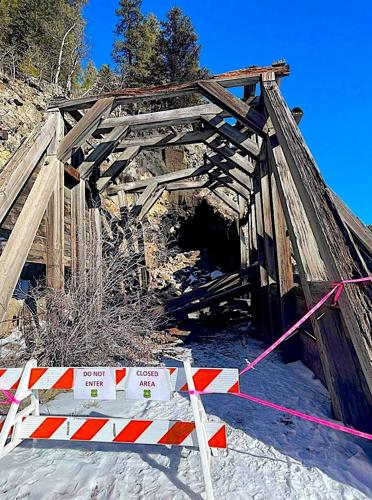
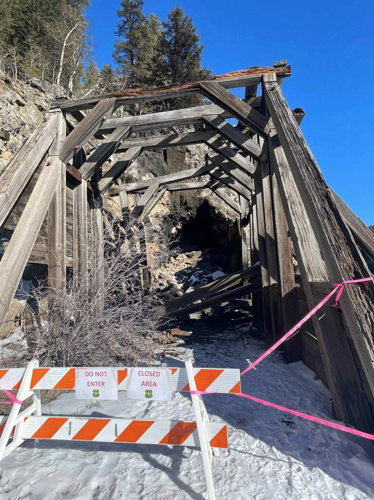
ASHTON — The Bear Gulch Train Tunnel Fire continues to burn near Ashton.
The U.S. Forest Service reported that on Thursday it would “initiate burning piles” eight miles west of the Tunnel Fire. The fire continues “smoldering and creeping.”
“Smoke will be visible from local communities,” it said. “Fire crews performing this action will continue to monitor the burned piles for fire activity following today (Thursday) to ensure combustible materials are extinguished prior to the release of the snowpack.”
The forest service reported the long-abandoned tunnel caught fire on Sunday. It wasn’t known who or what started the fire.
The service has kept personnel stationed at the tunnel during the day. There have been no injuries and no property damage.
The train tunnel is near the Bear Gulch parking lot. Timbers supporting the tunnel caught fire, but flames won’t be threatening anything or anyone as the tunnel is surrounded by snow, the service said.
Forest Service Public Information Officer Thomas Pence, who is assigned to the Tunnel Fire, reported service personnel are monitoring the tunnel throughout the day. They plan to do so until the fire burns itself out, he said.
“The fire is being contained, but it is within the tunnel,” Pence said. “We are going for a containment strategy to limit risk to our firefighters. This is because the fire has structurally weakened the tunnel. There is a lot of wood and a lot of debris in there. We don’t have a good completion date for it to be 100% contained.”
Ashton’s Grace Larsen visited the burning tunnel on Tuesday and again on Wednesday.
“When we got there (Wednesday) at noon, there was more information on the signs, and the Forest Service was there,” she said. “All they told me was that they were there to talk to people who were going on the Bear Gulch Hike.”
Museum of the Henry’s Fork volunteer Tom Howell reported the railroad putting in the tunnel around 1906.
“Originally it went around the outside where the ATV trail is now,” he said. “They had trouble with rockslides. The railroad backed it up — I think it was 1916. A good friend who was a railroader (told me) when the train got to the tunnel, they would go through it real slow as to not set up too much vibration.”
Howell grew up in the Warm River community near Ashton and often rode the train on school trips to Yellowstone.
“That was kind of a rite of passage in first grade,” he said. “We would — all of us little kids — we would jump on their passenger cars.”
The train tunnel was in constant need of repair, Howell said.
“They would send a special crew in there every year to work on that,” he said. “I remember as a kid, they would go in there and replace timbers. They would take the old timbers out and throw them down into the canyon. You can still see them.”
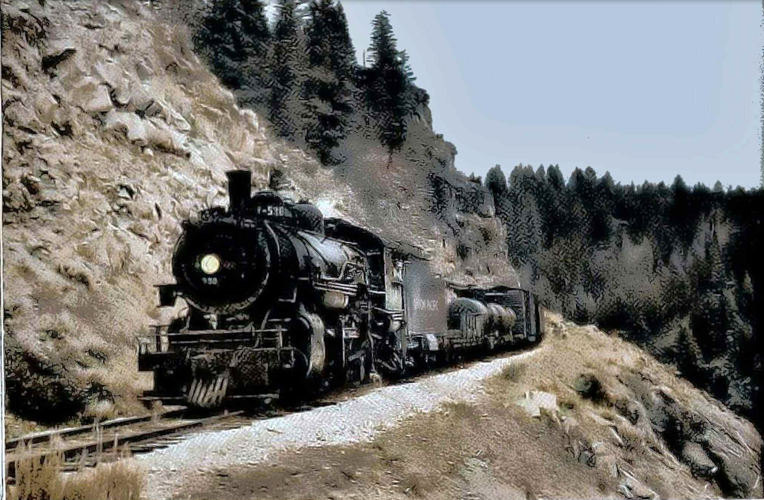
According to the article “Whistles and Smokes” by the Idaho Humanities Council, Ashton grew substantially thanks to tourists, agriculture, local traffic and the trains.
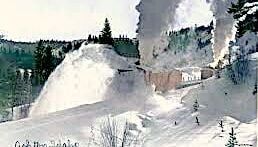
Blizzards often shut down the tracks. To keep trains running, railroad workers attached a “rotary” or snowplow to the front of trains to open up the tracks.
“Snow always played a factor in the schedule,” the council wrote. “Each winter the track to West Yellowstone blew shut, and, in March, a rotary would be brought in to open the tracks north Ashton. In order to keep the track safe, once the rotary had opened it, an open car called a ‘speeder’ was sent up the track every morning toward West Yellowstone before the train was due to check for any problems.”
Eventually the railroad grew tired of fighting Mother Nature and built the now abandoned tunnel enabling the trains to continue rolling through the snow.
“Slides occurred at Warm River which resulted in the railroad building a tunnel to bypass the slide area,” the council wrote.
By 1960, the last Ashton passenger train traveled to Yellowstone National Park. The line was abandoned in 1979, reported the humanities council.
About 15 years ago, safety concerns motivated officials to attempt to close access to the tunnel, Howell said.
“They said they had the interior collapse in there,” Howell said. “Before that, people were walking and snowmobiling through. I do remember one time somebody got up on top there and fell through some of the rotten timbers.”
It’s largely thanks to that train that Ashton was created. Educators and real estate agents H.G. Fuller and C.C. Moore developed the “Ashton Townsite” after purchasing 640 acres of land from George Harrigfeld, E. McGavin and Asa Hendricks. Fuller and Moore later raised $15,000 to build a school and to provide building materials for residents to build homes and businesses, reported the humanities council.
In early 1906, the tracks reached the new town, and the town of was named Ashton after railroad official William Ashton, it said.
The council credited Fuller and Moore in helping the region grow and develop.
“It’s hard to imagine Ashton without H.G. Fuller and C. C. Moore using their expertise to guide the new town,” the council wrote. ‘Thanks to their foresight, Ashton and the ‘whistles and smoke’ legacy of the railroad created a town which has lasted 100 years,” it said.
The abandoned train tunnel remains a tourist attraction, albeit one that’s supposedly off limits.
They put gates up to try and keep people out,” said Howell, who said people liked to visit the old tunnel possibly because “of the uniqueness of it. It amazes me how they could have started a fire in it. Maybe there was enough downed timbers in there.”For more information on the railroad tunnel visit fremontcountyhistoricalsociety.org/.

(0) comments
Welcome to the discussion.
Log In