

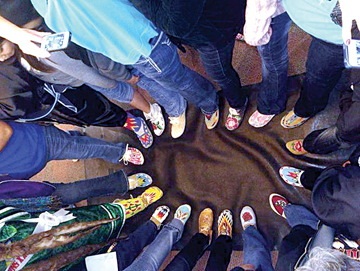
ALBUQUERQUE, N.M. (AP) — Elementary school students in western New Mexico are wearing their moccasins. So are students at Northern Arizona University, Purdue and the University of Michigan, as well as government and health officials on the Fort Hall Indian Reservation.
On the Cherokee Nation, there’s a waiting list for Friday’s moccasin-making class. And on a military base in Afghanistan, a soldier ties a beaded cross around her boot to symbolize her moccasins. Friday was “Rock Your Mocs” Day.
Coinciding with Native American Heritage Month in the U.S., the social media campaign started by New Mexico student Jessica “Jaylyn” Atsye has gone global.
The 21-year-old Laguna Pueblo member says the idea was simple — to set aside one day each year to wear moccasins to celebrate the cultures of Native Americans and other indigenous people.
“When someone asks you, ‘What do your shoes represent?’ or ‘What’s the story behind your moccasins?’ there can be endless descriptions,” she said. “They show who you are. They’re an identifier. They can bring unity.”
Randy’L Teton, public affairs manager for the Shoshone-Bannock Tribes in Fort Hall, applauds Atsye’s efforts. She agrees that the event not only draws attention to Native American Heritage Month, but also gives Native Americans a chance to share their heritage with their co-workers and friends.
“I think this is definitely a new way of celebrating Native heritage,” Teton said, adding that it’s a fun event that gets people talking and asking questions about Native Americans. “The event, ‘Rock Your Mocks,’ is part of educating the public that the tribes still exist and thrive and are very much in tune with our culture.”
Miss Northwest Indian Youth Queen Taylor Haskett, Miss Indian Nations XXI Alexandria Alvarez and Miss Shoshone-Bannock L Taylor Thomas encouraged tribal members in Fort Hall to participate in the event this year. Teton said government and health officials there showed up to work with their moccasins on Friday.
Moccasins historically were the footwear of many Native American tribes.
Though their basic construction was similar throughout the country, the decorative elements including beadwork, quillwork, painted designs, fur and fringes used on moccasins varied from one tribe to another. Indian people often could tell each other’s tribal affiliation simply from the design of their shoes, according to the nonprofit group Native Languages of the Americas.
Observers say the Rock Your Mocs campaign is helping to fuel a resurgence of Native American pride.
By Friday morning, a flurry of photographs had been posted on a Facebook page Atsye set up for the movement. On Twitter and Instagram, Rock Your Mocs hashtags showcased hundreds of images, from simple deerskin wraps to knee-high versions adorned with colorful beadwork.
Then there were the mukluks lined with fur, like the ones being worn Friday by Jessica Metcalfe, a Turtle Mountain Chippewa from North Dakota who runs the Beyond Buckskin blog.
“Moccasins can be worn and appreciated by anybody. That’s what’s really cool about it,” she said. “It’s like you’re wearing these pieces of art. They’re all unique.”
Metcalfe and others said Rock Your Mocs is a chance to educate more people about indigenous cultures. In recent months, the headlines have focused on controversies over the Washington Redskins pro football team name and backlashes against Native American-inspired fashion designs that many in Indian Country have found in poor taste.
Atsye said she wants to get away from the “whole racial thing.”
“The only way we’re going to be able to succeed is to move forward and forget all of that,” she said, outlining a string of trying times in Native American history. “We can’t change that. That happened in the past. Let’s focus on the things that we can change today.”


(0) comments
Welcome to the discussion.
Log In