


It’s time to pull the shotguns out of the gun safes and closets as the first bird hunting seasons will open over the next 10 days.
Dusky and ruffed grouse seasons start on Aug. 30 in Idaho and on Sept. 1 in Utah. Dove seasons in both states begin Sept. 1.
It will surprise no one if I describe the weather over the last nine months as unusual. Snow levels were well below average and disappeared early. It was unseasonably warm far enough into the spring to fool many plants into blooming weeks earlier than normal.
Then mid-April and late May freezes occurred. In July and August, northern Utah and southeast Idaho received enough rain showers to keep the grass growing despite high temperatures. This weather pattern, for whatever reason, resulted in few grasshoppers. The frost not only demolished peach crops in the valleys, but eliminated high elevation production of chokecherries and snow berries as well. The late blooming elderberry seems to be the only shrub with fruit.

How will these conditions affect the region’s forest grouse populations? Last year’s mild winter likely resulted in high overwinter survival. Over the last couple weeks, I’ve started to see clutches of young birds. These encounters have occurred less often than I’ve expected. This contradiction could be due to the cold snaps reducing the survival of young birds or because families of grouse are utilizing different habitats due to the lack of grasshoppers and berries. Regardless, it is likely this year’s grouse season will be as good or better than last year.
It may be harder to find dusky grouse during the first couple weeks of the season. In a normal year, these birds are usually along ridges looking for grasshoppers or near berry patches. Since these sources of food are in short supply, dusky grouse instead will likely be distributed along the interface of sagebrush and aspen stands.
These zones are shaded and the summer rain showers produced herbaceous material which is a good food source when other options are limited. By comparison, ruffed grouse are where they are every year. In riparian vegetation around springs, seeps and creeks.
There is less water across the landscape this year than in an average year. Although grouse can obtain water through the forage they eat, they’re still found in higher densities near water. That is, until the fall rains come. Knowing where isolated sources of water will not only put you around more grouse, it lets you haul less water for the dogs.
As the season progresses into October, dusky grouse move from areas with aspens to portions of the landscape with pine and fir. Pine needles are the primary forage for these birds during late fall and winter. Ruffed grouse tend to stay in the same habitats throughout the year.
It is interesting that the annual harvest of grouse in Utah is evenly split between the two species. That suggests not all grouse hunters focus on the same kinds of habitat. Over 80% of the birds I kill each year are dusky grouse. That is because I hunt areas that are relatively dry. Yet I have friends that hunt wetter spots and 80% of the birds they shoot are ruffed grouse. In the end, harvest seems to balance out and suggest good populations of both species in the region.
Grouse limits in Utah and Idaho are four a day. This can be in any combination of dusky and ruffed grouse. Success is usually higher in the morning. At that time-of-day, groups of foraging birds will spread out making it more likely either the dogs or the hunter will get close enough to cause these birds to flush.
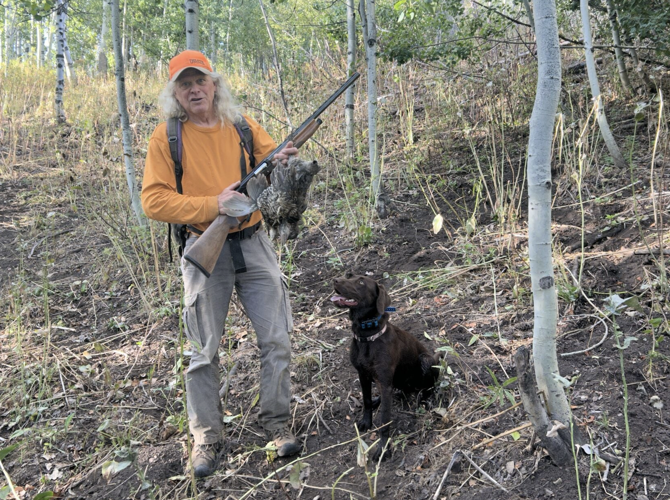
The primary weapon for grouse is a shotgun. I tend to use heavy loads (1¼ oz in a 12 gauge), shot through open chokes (improved cylinder). This allows harvesting birds that flush close or at a greater distance without damaging the meat. On steep ground or in dense cover, heavy loads increase the odds that the bird won’t fly far after being hit, making the retrieve easier. Utah and Idaho do allow forest grouse to be hunted with weapons other than a shotgun, but you’ll need to read the fine print in the regulation books to understand exactly what is allowed in each state.
Local mourning dove populations seem to be doing well this year. These birds quicky head south once nighttime temperatures drop below 40 degrees (F). For this reason, the greatest success always comes during the first week of the season. Rather than mountains, these birds are more prolific near farm fields. Doves are migratory birds so require a Harvest Information Program (HIP) validation for the state you are hunting in.
I hope everyone’s bird hunting season goes well.


(0) comments
Welcome to the discussion.
Log In