




It was a quiet Sunday evening a few weeks ago, and we were scanning our calendar for the coming month. We had our usual projects pending, but we also saw an open week that looked great for a summer getaway.
It was Dean who said, “Let’s take a trip and travel over part of the Mormon Trail.”
So we did some light packing and were off the next day, leaving Pocatello in our trusty 2011, 50-miles-per-gallon Toyota Prius. Starting off on this adventure, we never dreamed of the learning experience awaiting us.
If you wish you knew more about the Mormon Pioneer Trail, you can do what we did by retracing a part of their incredible journey. We traveled along just a portion of it in five days, and we only began to “imagine the unimaginable” of what those stalwarts went through.
Those familiar with the history of the American West recognize the date of July 24, 1847, as the observance of the entrance of that beleaguered band of Mormon pioneers into the vast and barren valley of the Great Salt Lake. As Wallace Stegner, author of “The Gathering of Zion: Story of the Mormon Trail,” wrote: “The pioneers were laying claim to an unlikely paradise.”
Every year, this historic event is marked by a huge, colorful parade through the long, wide streets of the city that has rapidly risen from sheer nothingness. In a relatively few short decades, Salt Lake City has become a major center of commerce, industry and sports recognized throughout the world.
Certainly, no one can even begin to appreciate what those intrepid Saints were to experience in their incredible trek from Nauvoo, Illinois, to find freedom to worship as they chose — not until they travel at least part of the route the pioneers traversed.
It’s for sure that those traveling in the comfort of a modern automobile are left shaking their heads in amazement at what was accomplished 171 years ago under the remarkable leadership of Brigham Young — and begun just 16 years after the fledgling church was organized.
The journey is considered to be one of the great migrations of the American West. Once the original group of 3,000 were split, military fashion, into groups of 10, 50, and 100, it is said to have been the best organized wagon train to cross the plains. Through severe weather, suffocating dust, violent thunderstorms and axle-deep mud bogs, they traveled — “whips cracking, harnesses snapping, and wagons creaking” — all the while in an orderly fashion.
Meanwhile, we set out by “walking in their footsteps” — even though by modern day auto — according to the following schedule:
DAY ONE: If you decide to drive along the Western-most part of the pioneers’ 1300-mile journey, as we did, begin by heading East through Montpelier and Kemmerer, Wyoming, then connecting with I-80 and on to Laramie where we spent our first night.
DAY TWO: We drove on through Cheyenne and dipped into the northeast corner of Montana to see the little town of Julesburg, then stopped for the night at Ogallala, Nebraska — our eastern-most point for this trip. We would love to have gone all the way back to the pioneers’ starting point of Nauvoo to begin our journey, but that was not within our time frame.
DAY THREE: We chose Ogallala so that we could head out the next morning on Nebraska’s Route 26 toward Scottsbluff through the seemingly endless waving grass — on part of the actual trail taken by the pioneers. This portion of the journey also parallels some of the Oregon and California trails, as well as the famed Pony Express Route.
We recommend a stop in Scottsbluff, especially the drive through the numerous tunnels carved into the granite mountain of the national monument to the top of the scenic overlook. Another site in Scottsbluff is the solitary grave of Rebecca Winters, age 50. Rebecca was the only Mormon pioneer with a gravestone out of some 1,900 who were buried along the trail in unmarked graves.
A total of some 70,000, in various companies, made the trek between 1846 and 1869.
Here and there, over many miles, one can see broken down and abandoned homes, most with trees surrounding them, silently speaking of that era in history. Other derelict homes beg the comparison of some of those would-be settlers looking to the future and planting stripling trees. They did so with the assurance of the shade the trees would one day provide while other treeless homes make it obvious that whoever built them gave no thought to that wonderful gift that nature would one day provide — or perhaps conditions were not right in some cases for trees to survive.
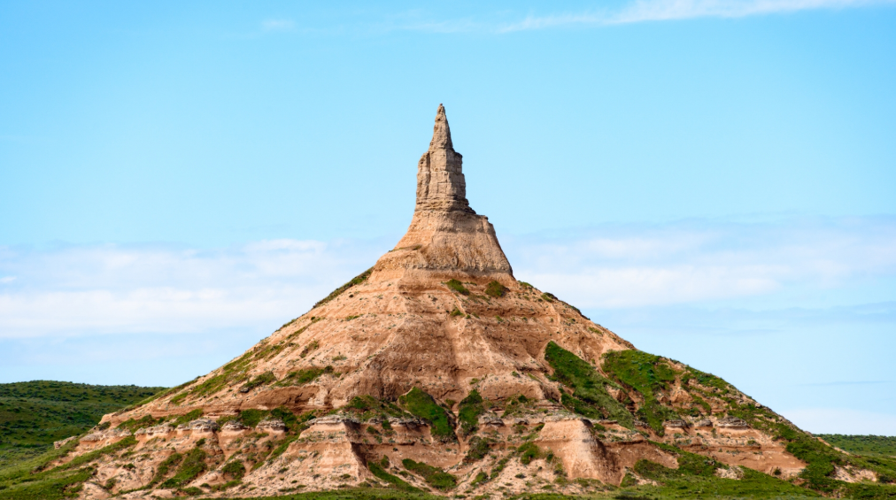
A highlight of this part of the Nebraska and Wyoming route is the iconic Chimney Rock and later Independence Rock, both isolated symbols of the faith and courage of those who forged the expansion of the American West. Independence Rock is a huge, easily climbed mound of granite covering 170 acres and located south of Casper, Wyoming.
An important stop, and one not to be missed, is Fort Laramie, a place of respite for the pioneers. Be sure not to confuse this large fort with the city of Laramie located roughly a hundred miles south on Interstate 80. The fort is impressive and served many weary travelers on their westward route.
DAY FOUR: After an overnighter in Casper, we arrived at Devil’s Gate (carved entirely by water over millennia) and Martin’s Cove. Both are memorable sites — a place with heartbreaking stories of sacrifice, unbounded faith and unmitigated suffering.
Martin’s Cove is now a beautifully maintained oasis, away from the ruggedness of the trail that existed before and after the events that occurred here.
At the cove, you can heft the handle or crossbar of a wooden hand cart such as those pulled by the pioneers for more than a thousand miles across a distant and often hostile part of our nation. They often traveled at a turtle’s pace — sometimes less than three miles a day!
Those who serve as helpful modern-day missionaries at the cove are quick to say that the ill-fated, 1856 Willie and Martin handcart companies represent “a miracle ... that no one should have survived.” The disaster of this trek 10 years after the first Mormons passed through the area is said to have resulted in the greatest loss of life from any single event during the entire Westward migration period.
The LDS Church organizes hundreds of teenagers into groups who are given the experience of “going on trek” each summer. This is so that young people, dressed as pioneers, have the experience of pulling a loaded handcart for several days, learning first hand something of the faith and determination of the original “trekkers.”
Doing so, as many modern-day youth and their leaders actually do in their annual adventures, becomes an amazing experience.
Onward from the cove, the rescued pioneers of the ill-fated Willie and Martin handcart companies pushed on into the same valley as their earlier counterparts. They, too, had to set about the immediate building of primitive log cabins and the planting of the vital crops in what was to become sprawling Salt Lake City.
When you drive over bridges and roads crossing the North Platte River — and later the Sweetwater — in the comfort of your car, your brain simply cannot begin to fathom what this remarkable journey entailed. The sheer immensity of the struggles of the pioneers is staggering. And it’s hard to reach for words to describe the endless stretches of prairies and hills — followed by ever more prairies and hills, then followed by vistas of what looked like a formidable fortress of snow-capped mountains off in the distance.
How could anyone make an assault on what seemed impenetrable? All this through endless stretches of nothingness except for sagebrush and rocks and miles and miles — and more miles — of sagebrush and rock. Those dedicated pioneers had to deal with blistering sun and incessant wind in the summertime followed by bitter cold and driving snow — along with more incessant wind — in the winter months.
Unlike those who traversed the nation to find gold or to simply settle in the green valleys of Oregon or the lushness of California, the Mormons were escaping intense religious persecution in the land of freedom. They were fleeing those who opposed the religion they practiced, many under the extermination order of the governor of Missouri at the time — the only such order even issued in the history of the United States of America. Those who began their migration from Nauvoo, Illinois, were forced to begin their journey in the middle of winter, leaving their beautiful, comfortable homes — most of them walking all the way to a virtually unknown destination.
Most were coming from homes east of the Mississippi River, where all is green, green, green, to an endless sea of brown earth, dry grasses and sagebrush with few, if any, trees along the way to interrupt the immense landscape. Some of the travelers carved messages on roadside poles or animal skulls along the trail to break the monotony.
Thoughtfully, on their way, the Mormons did make it part of their journey to build makeshift bridges and remove rocks, as well as plant crops nearby the trail for those who would follow.
DAY FIVE: After a night near Farson, Wyoming, home of “the world’s biggest ice cream cone” (about a foot high and something the pioneers would certainly have relished), we came closer to the valley. Surely, the Saints had to be thrilled to see the miles and miles of green, carpeted hills that presented themselves — this as they neared the area of South Pass — the dusty corridor on the Continental Divide that allowed a gentler passage through the rugged Rocky Mountains, the “purple mountain majesties” that had seemed impossible to cross. Today, Atlantic City and South Pass City represent what were once boom towns of the gold rush era. Atlantic City still boasts about 50 inhabitants, but South Pass City is a virtual ghost town. Both are interesting to see.
From this point on, the thrill of the final destination looms in the distance, a matter of some 250 miles of what was then the vast “interstate” of much of the 1800s — until the completion of the Transcontinental railroad. For the pioneers, this was the hardest stretch of the entire trail because of the ruggedness of the rocks and ridges of the Wasatch Mountains.
The detailed and invaluable journals and diaries they kept of their 1300-mile journey from Nauvoo to the Valley have become a national heritage.
If you decide to avail yourself of a wonderful five- to seven-day trip retracing just about half of their journey — or approximately 600 miles of the trail — be sure to take a good atlas (we recommend Rand McNally’s Road Atlas) and your GPS, along with all your imaginative powers, and have your own adventure. It’s a unique way to feel the spirit that first band of pioneers felt on their own July 24 — and a never-to-be-forgotten experience.
If you happen to go on to Salt Lake City — or whenever you visit the impressive THIS IS THE PLACE monument overlooking the city — you can say, as the intrepid Brigham Young, when first gazing down into the Valley, is reported to have actually have said: ‘THIS IS THE RIGHT PLACE!”
Dean & Nancy Hoch are local public affairs representatives of The Church of Jesus Christ of Latter-day Saints. dean.nancy@gmail.com.


(0) comments
Welcome to the discussion.
Log In