

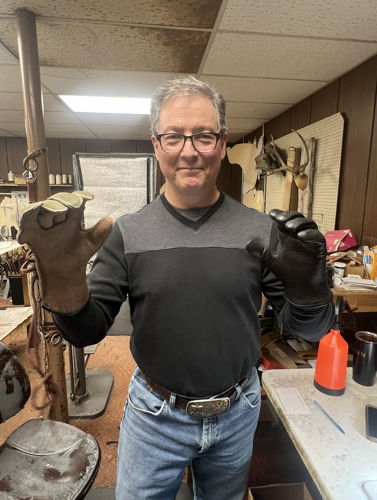
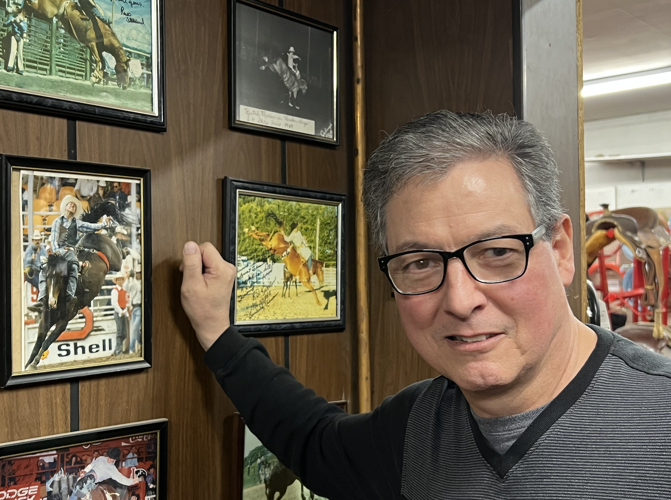
Inside the B Bar B Leather shop in Blackfoot, there’s a great action photo of Shawn Schild bareback riding at the Calgary Stampede back in the early 1990s, just a few seconds from being thrown off.
“Cost me a lot of money,” said Schild with a wry smile.
But that was part of the bareback experience that led Schild down the path to becoming “the glove guy,” the man whose design just about every bareback rider in the rodeo world uses now when they reach down to grab the rigging of their horse with their one gloved hand.
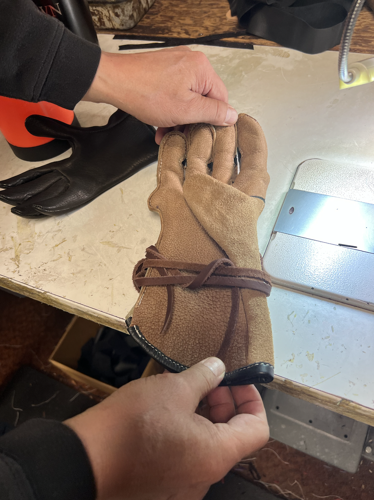
Schild spent almost 10 years trying to perfect a better design for a bareback glove. When he finally hit on one in 2000, “I basically took over the whole world of bareback riding,” he said during a recent tour of his leather shop. “So, I’ve been making all their gloves all over the world for a long time.”
The owner of three different patents for glove designs, by far the most lucrative for the 62-year-old Blackfoot native, has been the bareback glove. “All I’ve kept track of is after getting the patents done, and since that point, just bareback gloves, I’ve passed the $2 million mark,” said Schild. “But I’ve made a lot of bull riding gloves and a lot of bareback riding gloves before that.”
Schild was deep in the rodeo world himself back in the 1990s, competing throughout Canada and the Western United States, and it didn’t take a genius to see the need for a better bareback riding glove.
“All of the guys we rode with would pinch their hands so bad across the palm, because there was a great, big bulge in (the glove) that would eventually tear the hide off your palm,” said Schild of the designs that were in use 30 years ago.
In addition, with the existing glove design, riders weren’t able to fully close their hand in order to use their grip and forearm strength to ride. The design also caused the rider’s hand to bend, so if the horse jerked in a certain direction, “you were stretching or tearing ligaments in the back of your hand or your wrist,” said Schild. “People were getting hurt all the time.”
Throughout the 1990s, Schild worked on improving designs for a bareback riding glove, with the ultimate goal of getting a tighter fit and greater flexibility, while eliminating the bulge through the palm of the glove.
He estimates he spent 30,000 to 40,000 hours working on designs, sometimes waking up in the wee hours of the morning with a new inspiration and heading down to the leather shop to create a pattern to match his vision.
Each time he came up with a new design, he’d show it to his bareback riding compatriots to get their input. Finally, he came up with a design that he thought achieved all the goals he had for a good glove, and he applied for a patent.
“I had one glove, I made it and it felt really good,” Schild said. “Better than anything I’d ever made. And we hid that until we could get the patent done.”
In the meantime, a bunch of bareback riders were in his shop in Blackfoot when one of them stumbled across the new glove.
“He brought it up to me and said, ‘What’s this?’” Schild recalled. “ ‘I want this. Will you sell it to me?’
“And I said, ‘I will, but not for another 30 days. Then I’ll have the patent, and then you can have it. But I can’t show it to anyone now.”
Once the patent was secured, “It just started taking off at that point,” said Schild, who uses his patented design to custom-make the bareback riding gloves for his customers.
The key to improving the bareback glove, according to Schild, is designing a pattern that creates a curve, either in the fingers or the palm of the gloves, without generating the “bulge” in the palm.
“The finger curves work great,” he said. “There are different ways that you can do that, but ours works better because you’ve got less layers going to the fingertips, so you have better dexterity with your finger tip control.”
Schild has since expanded his design work into other areas. He’s hoping to launch two new products — work gloves and welding gloves — through a licensing agreement with a factory within the next two to three months. He’s also working on a deal with Harley-Davidson to license a design for a motorcycle riding glove.
And he’s partnered with a local doctor on a glove that can help patients with carpal tunnel symptoms. The doctor financed the patent work on that glove. Schild said each patent costs between $30,000 and $50,000 to secure, depending on the number of mechanical drawings required and the amount of verbiage the lawyer has to provide.
He already has a royalty deal in place with a company called Bare Knuckles to produce a lineman’s glove that is Kevlar-lined for power company employees. The company is also testing Schild’s designs for a fireman’s glove and extrication gloves.
“We think that could be the next huge market,” said Schild. “If those things happen, the rest of them don’t even matter anymore. That will be enough so that we’ll do great.”
As companies continue to test his designs and he waits for the next royalty pot of gold, Schild continues to work seven days a week, making custom gloves for the customer base that has kept him going for the last 30 years.
“I used to make a lot of bull-riding gloves, but I was just running out of time,” he said. “I got tired of coming to work at 2, 3 or 4 in the morning. So I just told them a year ago: ‘I’m done. You guys can find bull riding gloves all over the place.’
“But I can’t quit building the bareback riding gloves until I find somebody to buy me out and take it over,” Schild added. “Otherwise, I dump on all the customers that have given me my whole life, and I can’t do that to the guys.”
Schild said there are parties that have expressed interest in buying out him and his older brother Jeff, who have been running the business they inherited from their father for decades now.
“We grew up in this place, and we’ve worked here more than my dad did,” said Schild, “even though he started it before we were born. But I do have some people that are very interested right now, and it may happen at the end of this year, and it may happen at the end of next year. But I can’t duck out on the bareback riders when they’ve supported me their whole lives. And if I quit, they’re out of business, because there’s nothing out there that will work right.”
B Bar B Leather has two locations in Blackfoot — a retail store at 719 W. Pacific St. and a wholesale shop at 133 Elm St.
The retail store’s phone number is 208-785-1731 while the wholesale shop can be reached at 208-785-8963.


(0) comments
Welcome to the discussion.
Log In