



POCATELLO — The new owners of the onsemi plant on the city’s east side are charging forward with plans they believe will solidify the company as a premier place to work in the Gate City for decades to come.
The onsemi (known formerly as ON Semiconductor) manufacturing plant on West Buckskin Road has been purchased by the Ohio-based company LA Semiconductor. The president and CEO for LA Semiconductor, Mike Ward, says the company will run the fabrication plant as a pure-play, contract manufacturing foundry and has already inked a deal to continue providing semiconductor wafers to its predecessor for at least the next five years.

LA Semiconductor President and CEO Mike Ward.
“Where this was a small factory, as I like to say one of the many engines of onsemi where they had taken all of the other parts of the car and located them in places outside of Pocatello, our goal is to take that souped-up engine and build the rest of the car around it,” Ward said. “We want to bring in a team for marketing, sales and product development and call this place Fab One. We intend to make it our flagship fab and bring our headquarters to Pocatello.”
The plant officially changed hands on Oct. 14 after an 18-month period of negotiating and planning with onsemi, Ward said. Founded in 2021, LA Semiconductor (which has nothing to do with Los Angeles, California, but instead stands for the common electronic language of linear and analog) is the newest U.S.-owned and fully operational pure-play semiconductor foundry for analog, mixed-signal and power products, Ward said.
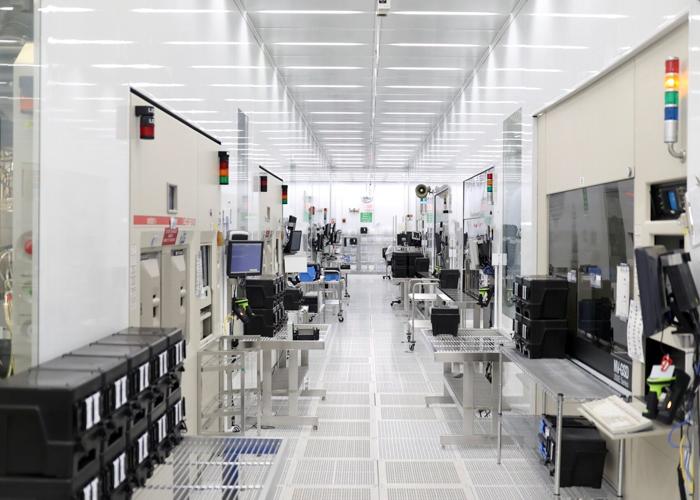
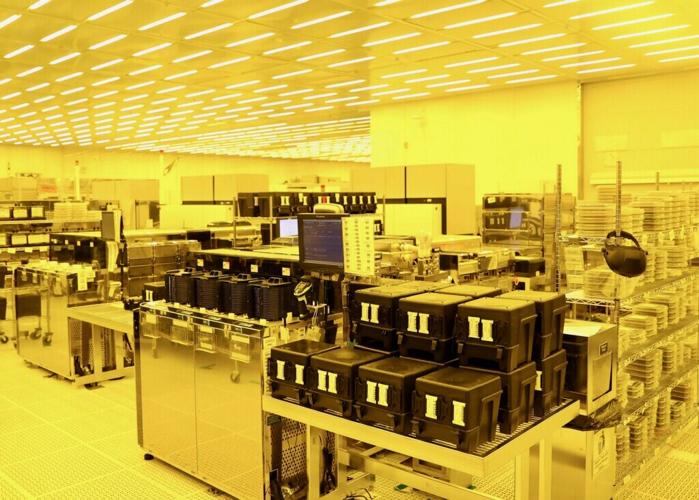
The LA Semiconductor plant is located on a 33-acre campus with over 50,000 square feet of cleanroom space and over 550,000 square feet of building space, said Ward, adding that onsemi will continue to lease some space inside the fab where their engineers will continue working on U.S. government approved projects.
The Pocatello fab currently produces 0.35 micrometer to 1.5 micrometer analog CMOS, BCD, advanced discrete, and custom technologies, Ward added.
“The semiconductor chips that are built here service the entire electronics industry, including automobiles, industrial applications, battery powered tools, medical devices, aerospace and, among others, defense satellites,” Ward said.
As a pure-play foundry, a business model where the manufacturer doesn’t offer a significant amount of its own integrated circuits but instead focuses on manufacturing products for other companies, Ward says the goal is to bring semiconductor manufacturing back onshore and away from China, something he says will bring more security to the industry.
“We need more security and serenity in the semiconductor industry,” he said. “When I joined the industry in 1991 in Silicon Valley, every semiconductor company — National Semiconductor, Texas Instruments, Fairchild — was on every corner. I watched all these factories turn into ghost towns, they are now just sitting there empty with weeds in the parking lot because they all started mass-producing in Asia.”
He continued, “Every wafer we ship right now goes straight to Asia for back-end packaging where they cut them up, put them into the little black packages and do all the wire bonding. Our plan is to have back-end packaging right here in America so that semiconductors don’t have to be shipped abroad before going to the customer.”

A clean room inside LA Semiconductor located at 2300 W. Buckskin Road in Pocatello.
Ward says relocating back-end packaging services from overseas back to America became more of a reality for the semiconductor industry following Biden signing the CHIPS and Science Act into law this past August. The act provides roughly $280 billion in new funding to boost domestic research and manufacturing of semiconductors in the United States.
The Idaho State Journal spoke with Ward on a day where he had just spent the afternoon meeting directly with his now new employees. While he came in anticipating some of the workforce would be uneasy about the transition, he says morale and buy-in is surging in the positive direction. He says employees are excited to learn that LA Semiconductor is a private company that doesn’t have to answer to private stakeholders. They are equally looking forward to the possibilities to advance their careers with a company that intends to invest heavily into the Pocatello plant.
“There is great optimism with the idea that we’re going to now bring all these new elements to this plant,” Ward said. “So if people who work here might have aspirations to be in sales and marketing, product development or design, none of that was done here before and so now they have more career options.”
Brad Miles, vice president of manufacturing operations for LA Semiconductor added, “onsemi is an international company that has factories all around the world and the name of this plant beforehand was Fab Ten. Now, we’re Fab One and everything is focused on us. We get the shot at the expansion first before any other of the old brother and sister factories. People are definitely excited about that.”
Ward said he looks forward to the opportunity to start a dialogue with Idaho State University about establishing a pipeline where students receive the necessary knowledge to graduate ready to begin working as an engineer building semiconductors here in Pocatello.
“At the University of Akron in Ohio, I met with the chair of the department and we put a grant proposal together to the state for $23 million that got approved,” Ward said. “The universities got $23 million to split amongst them and so I went in and personally installed 20 machines for students to be able to design the types of chips we build here. The next year, they put 20 more stations in for the digital guys to be able to design chips. So now they graduate probably 30 people a semester that already know how to design chips. It’s high on my list to get out and talk to Idaho State University and do the same program.”
When LA Semiconductor acquired onsemi there were approximately 310 employees. In the approximate month since the acquisition, about 40 new employees, including 20 on the first day, have been hired and the company is accepting new applicants now, Ward said. Those interested in applying for various positions can do so by visiting {span}indeedhi.re/3TOLA4L{span}.
It’s not atypical for concerns to arise whenever a large employer in the region falls under new ownership, but such isn’t the case with LA Semiconductor. The new team has made it clear they intend to not only maintain the operations that have already been established, but will also invest heavily in not just the future of the plant, but in the Pocatello community as well.
“We want to be involved in the community,” said Titus Weinheimer, LA Semiconductor chief financial officer and general counsel. “We want to support the community and establish ourselves as one of the best places to work in Pocatello.”

(4) comments
Does “to be involved in the community” in corporate doublespeak mean that LA Semiconductor will be getting several years of property tax exemption and/or permanent property tax brakes similar to the Titan Center?
“$280 billion in new funding to boost domestic research and manufacturing of semiconductors in the United States.” Please correct if I’m wrong, but it sounds like an other example of a corporate welfare. Our hard earned taxpayer money subsidizing private corporate profits Mike Ward is so exited about. How long it will take for the CHIPS and Science Act federal subsidies to run dry? And what going to happened next?
Chip war between the United States and People’s Republic of China is coming to Pocatello. How great. Congratulations Pocatello on our cheaper work force and existing fabrication facility! It will cost a lot on both sides to pay for the chip war: for the United States to rump back lost outsourced production capacities and to train the workforce; and for China to catch up and getting ahead with bleeding edge alphabet soup technologies by means of self-reliance and domestic research. But at the end of the day the simple truth is, whether you like it or not, that it still costs much less then a half for the product to be manufactured in China than here in the US. So here is the answer to the question in the first paragraph. In the long run, despite of all Biden administration policies based on sanctions, embargoes, and export bans, China’s copy-cat-culture and their government investment in technology will pay off by making them self-reliant and remain competitive. But due to the much higher costs of production, there is no win insight for us, - we are stuck with even more federal subsidies in the name of national security, rising chip prices leading to an accelerating spirals of inflation, and higher federal individual taxes here at home. And Mike Ward’s company is a winner, because he got it right, after the current CHIPS and Science Act $280 billions run out, he is expecting even more government corporate welfare.
The next questions to ask. Is it sustainable? A: No, because our product costs more and can not compete on the wold market. A good example is a solar panel facility next to the Simplot demolished recently. Q:How long it all going to last before the bubble bursts? A: We do not know exactly, but it might take a while. So be ready for an upcoming bust some time in the future.
“$280 billion in new funding to boost domestic research and manufacturing of semiconductors in the United States.” Please correct if I’m wrong, but it sounds like an other example of a corporate welfare. Our hard earned taxpayer money subsidizing private corporate profits Mike Ward is so exited about. How long it will take for the CHIPS and Science Act federal subsidies to run dry? And what going to happened next?
Chip war between the United States and People’s Republic of China is coming to Pocatello. How great. Congratulations Pocatello on our cheaper work force and existing fabrication facility! It will cost a lot on both sides to pay for the chip war: for the United States to rump back lost outsourced production capacities and to train the workforce; and for China to catch up and getting ahead with bleeding edge alphabet soup technologies by means of self-reliance and domestic research. But at the end of the day the simple truth is, whether you like it or not, that it still costs much less then a half for the product to be manufactured in China than here in the US. So here is the answer to the question in the first paragraph. In the long run, despite of all Biden administration policies based on sanctions, embargoes, and export bans, China’s copy-cat-culture and their government investment in technology will pay off by making them self-reliant and remain competitive. But due to the much higher costs of production, there is no win insight for us, - we are stuck with even more federal subsidies in the name of national security, rising chip prices leading to an accelerating spirals of inflation, and higher federal individual taxes here at home. And Mike Ward’s company is a winner, because he got it right, after the current CHIPS and Science Act $280 billions run out, he is expecting even more government corporate welfare.
“$280 billion in new funding to boost domestic research and manufacturing of semiconductors in the United States.” Please correct if I’m wrong, but it sounds like an other example of a corporate welfare. Our hard earned taxpayer money subsidizing private corporate profits Mike Ward is so exited about. How long it will take for the CHIPS and Science Act federal subsidies to run dry? And what going to happened next?
Chip war between the United States and People’s Republic of China is coming to Pocatello. How great. Congratulations Pocatello on our cheaper work force and existing fabrication facility! It will cost a lot on both sides to pay for the chip war: for the United States to rump back lost outsourced production capacities and train the workforce; and on for China to catch up and getting ahead with bleeding edge alphabet soup technologies by means of self-reliance and domestic research. But at the end of the day the simple truth is, whether you like it or not, that it still costs much less then a half for the product to be manufactured in China than here in the US. So here is the answer to the question in the first paragraph. In the long run, despite of all Biden policies based on sanctions, embargoes, and export bans, China’s copy-cat-culture and their government investment in technology will pay off by making them self-reliant. But due to the much higher costs of production, there is no win insight for us, - we are stuck with even more federal government subsidies in the name of national security, rising chip prices leading to an accelerating spirals of inflation, and higher federal individual taxes here at home. And Mike Ward’s company is a winner, because he got it right, after the current CHIPS and Science Act $280 billions run out, he is expecting even more government corporate welfare.
Welcome to the discussion.
Log In