

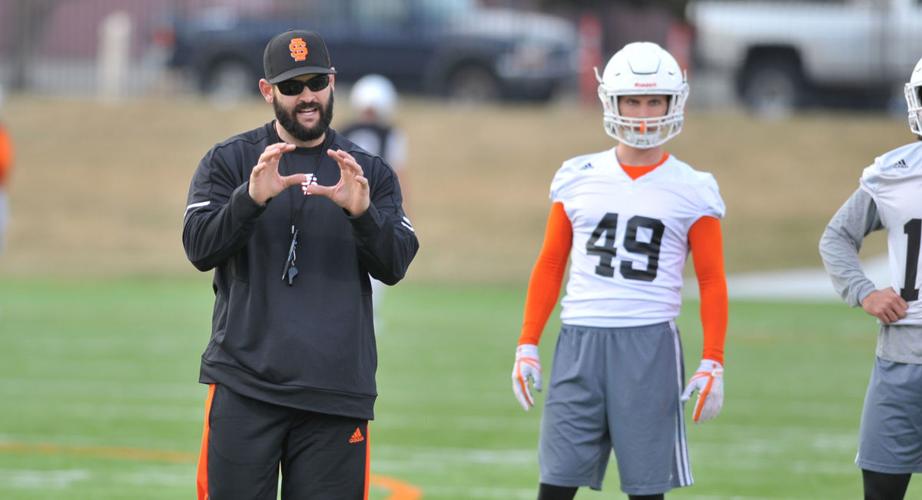
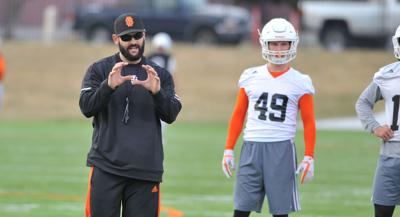
POCATELLO — Jay Staggs’ first college football coaching job was working alongside Rob Phenicie at UNLV.
Six years later, Staggs and Phenicie reunite at Idaho State with more prestigious job titles.
Staggs, who played safety for the Rebels and returned to his alma mater as a graduate assistant coach, was hired by Phenicie to coach the Bengals’ safeties in February. In his first semester as a GA in Las Vegas, Staggs helped Phenicie coach the team’s quarterbacks. The following season, UNLV played in its first bowl game in 13 years.
Staggs hopes to renew the success in Pocatello.
“I try to pattern what I do as a coach under what I learned from him,” Staggs said after Wednesday’s practice at the ICCU Practice Fields. “A lot of discipline and being very specific to how you want things, how you address your players and what’s to be expected of them needs to come from your mouth. Actions will follow.”
After UNLV, Staggs spent three seasons coordinating the defense at Division II Adams State. But following three consecutive losing seasons, former Adams State head coach Timm Rosenbach resigned, and none of the team’s defensive coaches were retained. Adams State gave up 45.6 points per game last season to rank last in the Rocky Mountain Athletic Conference. Staggs was replaced as defensive coordinator by former Idaho State volunteer assistant coach Britt Maughan.
Staggs gets a fresh start at ISU, which is also in need of defensive improvements.
He takes over for former defensive coordinator/safeties coach Spencer Toone, who had worked on ISU’s coaching staff since 2013.
Staggs’ safety group is led by a pair of veterans in redshirt juniors Jayson Miller and Adkin Aguirre, who have both netted 20-plus career appearances. The 6-foot-1 Miller is the second-tallest member of the Bengals’ defensive backfield, and Aguirre earned honorable mention Sophomore All-America honors from HERO Sports last season.
Among other areas, Staggs said he’s working with his players on improving their attention to detail.
“I got a really good group of kids,” Staggs said. “They like football, which is something I love about them. There’s a lot of passion, not just on the football field, but they take it with them when they come to our meetings and come in, meet with me one-on-one any chance they get.”
Miller, who played one game last season before redshirting the remaining games with an injury, said Staggs brings a new outlook to the position.
“He’s high energy. He lets us play,” Miller said. “He’ll correct us, of course, but he lets us get out there and do our thing. He doesn’t over-coach.”
NCAA ADOPTS KICKOFF RULE CHANGE
The NCAA Playing Rules Oversight Panel on Friday approved a rule adjusting kickoffs in college football.
Starting this upcoming season, kickoffs that are downed inside a team’s own 25-yard line will result in a touchback. The rule change is the latest in a string of kickoff alterations, which started with moving the tee from the 30-yard line to the 35 in 2012. Touchbacks were also moved from the 20-yard line up to the 25.
According to NCAA.com, the Football Rules Committee made the proposal to continue efforts to increase the number of touchbacks during kickoffs since fewer injuries occur during kickoffs that result in touchbacks than on kickoffs that are returned.
While placekickers could previously attempt to drop a kickoff just in front of the goal line to force a return and avoid a touchback, the new rules may change kickoff strategies.
For Idaho State, which started its average defensive series on the 25-yard line last season, the new rule may have little impact. Bengals kickers had two touchbacks in 61 attempts and netted 39.1 yards per kickoff in 2017.

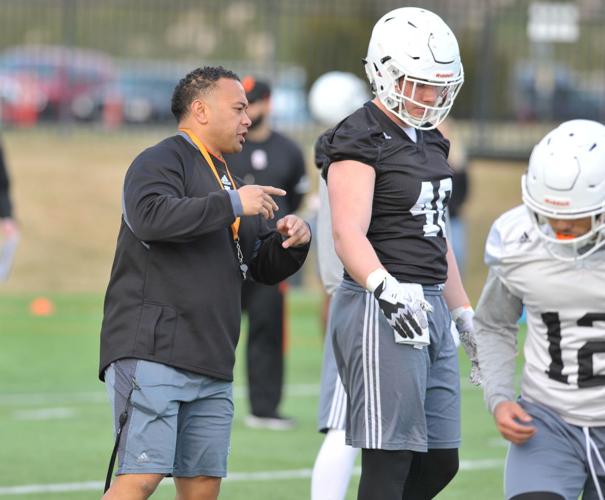
Idaho State special teams coordinator/running backs coach David Fiefia, left, talks to tight end Austin Campbell (46) during spring practice March 29 at the ICCU Practice Fields.
“As of right now, that probably helps us,” ISU special teams coordinator/running backs coach David Fiefia said after Friday’s practice at the ICCU Practice Fields. “As far as right now, I think it’s in our advantage to be able to have that rule in place.”
Fiefia also said it still makes sense to attempt to reach the end zone with kickoffs, saying “banking on them fair-catching it is probably a bad idea, because then that slows the coverage team down, giving them better field position if they do opt do return it.”
Fiefia said the biggest change may occur in kick return personnel, by inserting players with more reliable hands in place of linebackers who may be near the 25-yard line during a typical kickoff return. The Bengals averaged 18.9 yards per kick return last season, with a season-long of 44 yards.
“I’m thinking that we have to have returners, or the guys that can field the ball, on the end spots,” Fiefia said. “Because if teams try to game plan toward that, sky-kicking it toward the 25 ... we’ll probably have to put more skill guys back there versus bigger body linebacker-type bodies back there.”

(0) comments
Welcome to the discussion.
Log In