

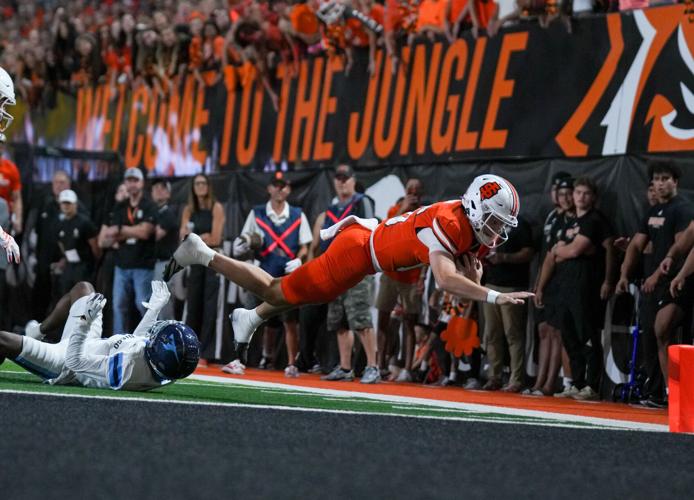





Idaho State junior quarterback Davis Harsin dives for the corner of the end zone for a touchdown against San Diego on Sept. 12 inside the ICCU Dome.
After a quarter of the 2026 football season is history, it's safe to say that this will either be a special year for the Idaho State football team — or one of the most disappointing.
The Bengals are off to a 3-0 start, their best since they started 5-0 in 1995. Of course, we all know what happened that year — ISU lost five straight and had to beat a bad Weber State team in the season finale to finish 6-5.
If you count the 4-0 run the Bengals finished up on last season, they've now won seven straight games. The last time that happened? It was 1981, when the Bengals won their final seven games on the way to the national championship.
So there is precedent for greatness. But there's a lot more precedent for disappointment. That comes with not reaching the playoffs for 43 years.
You can start with last season, when the failure to score on four downs in the red zone against Montana kept ISU from finishing with a winning record, and an outside shot at a playoff berth.
There's 2014, when a five-point loss at 12th-ranked Montana State kept Mike Kramer's team, which had only two Big Sky losses, out of the postseason.
And then there was 2002, when Larry Lewis' team, led by future NFL Hall of Famer Jared Allen, finished in a three-way tie for the Big Sky title, but was denied a playoff berth by a four-point loss at Montana, and a three-point loss at Portland State.
You can understand, then, why longtime Bengal fans still get a nervous feeling deep in the pit of their stomach when they think about starting Big Sky Conference play this weekend against Southern Utah in Cedar City.

Brad Bugger
For one thing, the T-Birds play the kind of football that ISU has struggled to defend: physical, explosive, in-your-face football with a quarterback who occasionally breaks 70-plus-yard runs, and a fireplug of a running back who wears down defenders.
Last year, Southern Utah, which was still officially a member of the Western Athletic Conference, put a hurt on a hurtin' Bengal team that was without star running back Dason Brooks, and whose quarterback, Jordan Cooke, was playing with a banged-up knee that later required a minor procedure.
I'm not sure it would have mattered if Tom Brady had lined up behind center for the Bengals that day, however. The T-Birds outgained ISU 323-23 on the ground, averaging 6.5 yards a carry to ISU's 1.4.
Running back Joshua Dye ran for 180 yards in 28 carries, and backup quarterback Will Burns came off the bench to break a 72-yard touchdown run on his way to 107 yards on just five carries — that's 21.4 yards per attempt.
We have been hearing from Bengal coaches, players and fans alike that this year's Bengal defense is different. Defensive coordinator Grant Duff describes it as "the deepest defense" he's coached, and that includes some pretty good ones when he was co-coordinator for those outstanding defenses at Weber State a few years ago.
So far, the numbers show some subtle improvement in defending the run. In their three games against VMI, an option team, FBS Utah State, and San Diego, the Bengals have yielded 626 rushing yards on 141 attempts — an average of 4.4 yards per carry. Not great, but an improvement of about a half-yard a carry over last year's average of 4.9 yards per attempt by ISU opponents.
That Bengal defense will surely be tested by the T-Birds on Saturday. Burns is back, this time as the starting quarterback, and he's averaging 6.8 yards a carry, gaining 299 yards on 44 carries, and scoring three touchdowns — including another long one, this time for 75 yards.
He's joined in the backfield this year by Floyd Chalk, a 5-foot-8, 205-pound bowling ball who is already more than halfway to a thousand-yard season after just four games, with 545 yards on 92 rushes, a 5.9-yard average, and six touchdowns.
And if you think SUU is just a running show, consider they have 10 receivers with catches of 10 yards or longer, including grabs of 75, 58, 44, 22, 18, 17, 15 and 16 yards. The T-Birds might be just 1-3 on the season after their 28-26 loss to FCS St. Thomas last week, but it's hard to put the blame on the Southern Utah offense.
Here come the Bengals, now ranked 14th in the nation and with a win over FBS Utah State in their belt, and all the incentive in the world to start off this run of nine straight Big Sky Conference games on the right foot. And eager to show this is not the same old leaky Bengal defense we've all come to know and, er, tolerate.
Even if Saturday's game evolves into a good, old-fashioned Big Sky shootout (and Southern Utah's defense is giving up 39 points a game), this year's Bengal defense is featuring something we haven't seen much of in recent years — the ability to force turnovers. Idaho State has picked off six passes so far this season, and recovered one fumble. The Bengals, meanwhile, have turned it over only twice, both on interceptions, to post a plus-five turnover margin for the season.

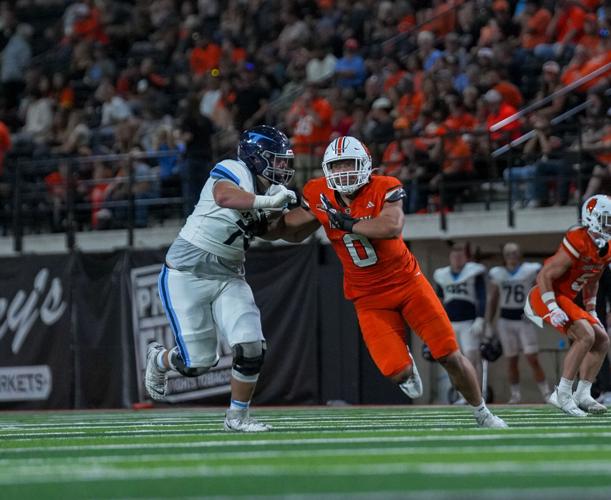
Idaho State junior defensive end Sani Tuala tries to get by a San Diego offensive lineman during a Sept. 12 game inside the ICCU Dome.
Data for FBS football shows that the team that wins the turnover battle wins the football game 78% of the time. While I couldn't find similar data for FCS schools, the teams that made the FCS playoffs last year had a combined turnover margin of plus 84.
The keys for Idaho State, then, are to contain the explosive plays the T-Birds have a knack for producing, and to stop the Southern Utah running game on the early downs in order to force SUU into more turnover-prone third-down situations.
Easy to prescribe, harder to deliver. But if the Bengals are going to escape Cedar City with their first Big Sky win of what they hope will be a special season, they're going to need (1) defenders who can force some turnovers and (2) a demonstration of that depth in the defensive front seven that we've been hearing about.
Brad Bugger has been following athletics in southeastern Idaho since 1979, as a sports writer, broadcaster and fan. He can be reached at bpbugger@gmail.com.

(0) comments
Welcome to the discussion.
Log In