

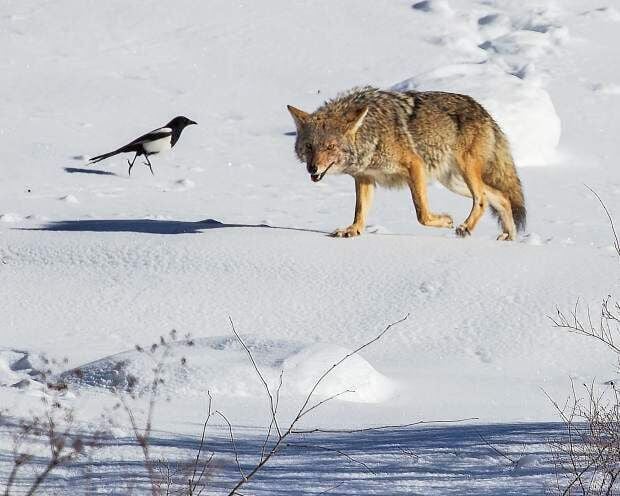
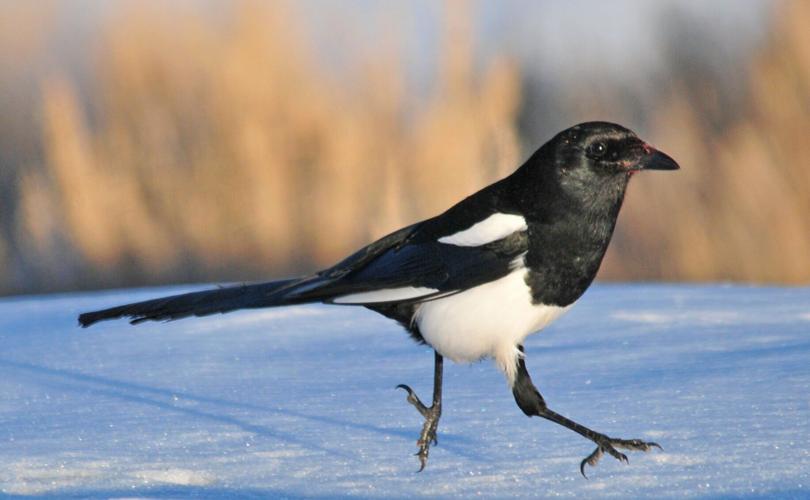
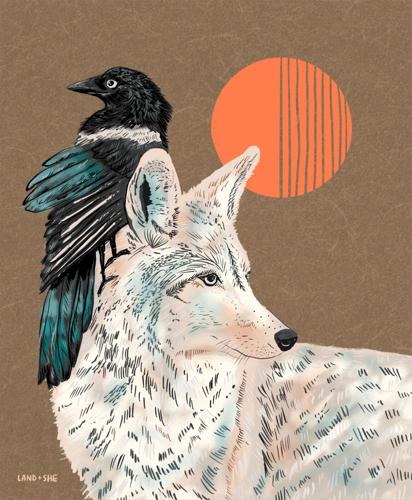
One of my favorite wildlife experiences is watching a coyote trot through the sagebrush with a black-billed magpie in tow. I’ve only seen this a few times since we moved out West in 1974, so it’s pretty rare. I always wonder about the relationship between the two animals. Do they do this often? Do they know each other? How many coyotes and how many magpies do this? What exactly are they up to?
My first assumption when seeing this pair is that the magpie will benefit from a coyote kill if the prey is bigger than a one-gulp mouse. Anything requiring some processing, for example a black-tailed jackrabbit, likely will leave some bits for the magpie to gobble down. I’d guess it will have to steal whatever it gets. Jackrabbits don’t grow on trees.
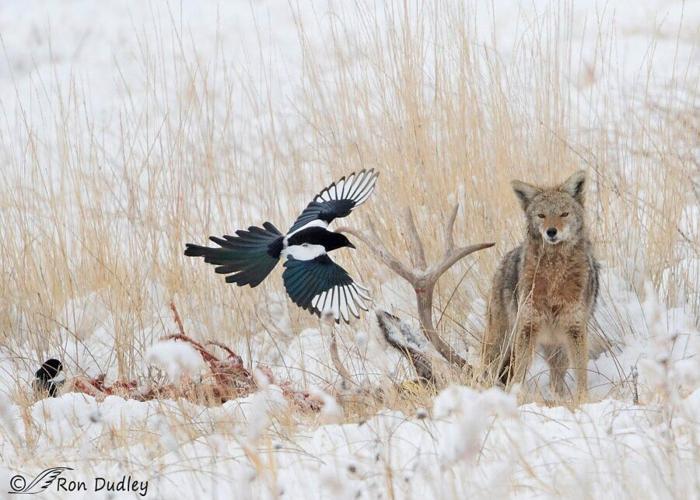
More often, we see magpies and coyotes sharing the remains of some predator kill. I recall an elk that had been brought down by a pack of wolves in the Lamar Valley of Yellowstone National Park. The wolves were full and just lying in the snow near the elk. Golden eagles and common ravens were working the carcass, with only an occasional scuffle between birds.
Black-billed magpies were also there, but more tentative, perching close by and dashing in for a bite when the opportunity presented itself. The coyotes were much more wary, lying in the snow 50 or more yards away. They had to wait until the wolves wandered off, no matter how long it might take. Wolves don’t tolerate coyotes. But with sub-zero temperatures and deep snow, even the scraps of an elk would be more food than these wild dogs would get looking for mice under the snow. Plus, waiting burns little energy. It’s worth it.
Author Hope Ryden wrote a book called “God’s Dog” (1975) wherein he explores many aspects of Canis latrans. God’s Dog is one of many Native American names for the coyote. I’ve always found that name to be powerful and sobering. Despite centuries of persecution and slaughter, the coyote is enormously successful, making a living in towns as well as in the remote reaches of North America. I would not underestimate their ability to take advantage of any clue or any partnership in their environment to find food.
One of the people Ryden talked to was Lloyd Tillett, a rancher in the foothills of the Bighorn Mountains in Montana. Tillett told Ryden, “’You want to watch magpies when you’re out looking for coyotes. I’ve often noticed they travel together … I guess each thinks the other is on the inside track of something good to eat …”
I now realize when I have seen a magpie in an unexpected place, I did not consider perhaps it was following a coyote. In sagebrush country, coyotes are readily hidden by shrubs while the magpie is above it all and much more visible. From now on, I have another little mystery to explore when I’m out in the boondocks.
Ryden further observed that in summer, it was magpies following coyotes in expectation, as I proposed above, they could get some scraps from a coyote kill. But in winter, more often the food was located by a magpie. Their behavior then attracted the coyotes, whether on purpose or not.
Adjusted for body size, canids have larger brains than most other carnivores. We know, based on our own experiences with dogs, that canids understand a lot of different things. You only have to watch a border collie move sheep around or run an agility course to appreciate that some dogs are very smart and capable of understanding many different communications from us.
One factor obscuring our evaluation of pure brain power in a species is the role of social behavior. Canids are social and cooperate, not just with other canids, but with us. Their evolutionary history and ours are similar in that we both have cooperated in hunting large and dangerous prey. The same is true for wolves, wild dogs and many other species.
The question is, do canids — coyotes in particular — have the same foresight, planning and shared intentionality as do humans? My best guess is they have those capacities to a substantial degree. Evolution is a harsh judge, and animals that learned to cooperate and to predict where prey will be, for example, will be strongly favored over millennia in the survival of the fittest.
How about the other side of my proposed partnership, the black-billed magpie? I already covered some of their cognitive complexities in ”Magpie funeral” (Aug. 23, 2023). Researchers have discovered black-billed magpies showed greater capacity for abstract-concept learning than two monkey species (rhesus and capuchin) or pigeons. Beating a pigeon may not be such a big deal, but beating a monkey is.
The Social Brain Hypothesis proposes that social group size is the primary determinant of complex cognitive abilities shown in both primate and non-primate species. This is believed to arise over evolutionary time from the requirement to remember multiple individuals, one’s own relationship with each, and at least some of the relationships among the others. You don’t need a large brain to solve ecological puzzles such as food finding, as demonstrated by millions of very simple species. This theory proposes you do need a large brain to keep track of relationships in complex social structures.
When trying to get to the bottom of various mysteries involving birds, and leaving theories aside for a moment, I like to check A.C. Bent’s “Life Histories.” These volumes contain rich natural history content, the sort of information mostly not found these days in data-driven journal articles. His volume on North American Jay, Crows, and Titmice was published in 1946. Bent conveyed a note from M.P. Skinner, who did research in Yellowstone (1928), writing, “… magpies find coyote kills so promptly that he [Skinner] sometimes thinks they follow coyotes purposely.” Despite all of Skinner’s writing about Yellowstone birds, I was surprised to see that he did not revisit this idea.
Skinner led me to a 245-page publication by Jean M. Linsdale (1937) called “The Natural History of Magpies.” Despite detailed and exhaustive coverage of many aspects of the black-billed magpie as well as other magpie species, there is no mention of a hunting connection with coyotes.
My conclusion is that either this is very rare, or it’s just not well documented. The people who know the most — cattle ranchers like Lloyd Tillett spending years out on the land — are not typically interviewed for ornithological research papers. I would love to hear from any reader who has seen these two bright animals working together.

(0) comments
Welcome to the discussion.
Log In