

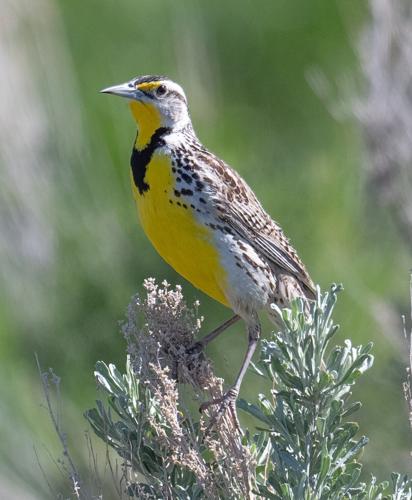
As I wrote last week, the western meadowlark is the most commonly reported bird in Idaho and Nevada. It has achieved the status of the “state bird” in six states — Kansas, Montana, Nebraska, North Dakota, Oregon and Wyoming. Only the northern cardinal has won over more states (seven).

The western meadowlark is claimed as the state bird in six states, second only to the northern cardinal.
When we lived in western North Dakota, our house was on the edge of town, with prairie extending from there well into Montana. Western meadowlarks were yard birds, not only singing from young trees in the back yard but coming around to the front to sing from utility wires. We agreed that this was a great choice for state bird.
Western meadowlarks likely have achieved this high level of recognition because they are easily seen, are colorful, and sing loud, beautiful songs. We might compare it to the northern house wren, which is also widespread and sings a loud song. But it is not colorful and spends most of its time hiding. No trophy for you!

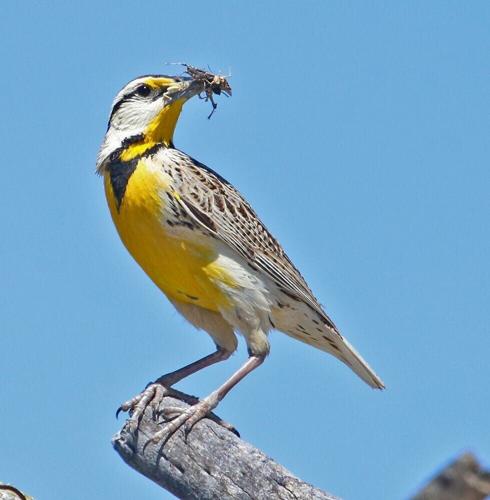
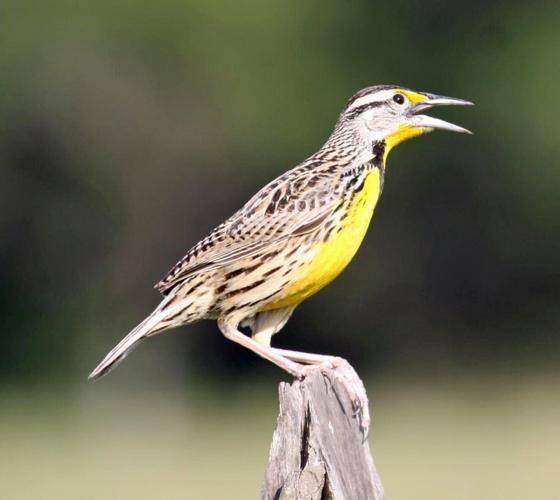
The song of the eastern meadowlark, pictured, is not nearly as melodic as the western meadowlark’s.
It’s odd that the eastern meadowlark, which looks the same and has a similarly enormous range, has not been chosen as the state bird in any state. One possible reason is that its song is not nearly as melodic as the western’s. Another is that it has to compete with northern cardinals.
And then you have Delaware and Rhode Island, who chose the chicken for their state birds. Go figure. But you do have to marvel at the ability of the red junglefowl to take over the world (see Chicken Dinner Road, 7/19/2023).
There is a third meadowlark in the genus, Sturnella. For many years, it was called Lilian’s meadowlark and was treated as a subspecies of the eastern meadowlark. Those fortunate enough to visit the birding gold mine of southeastern Arizona no doubt found this bird in the desert grasslands. The song is much like that of the eastern, lacking the rich complexity of the western.

For many years, the Chihuahuan meadowlark was known as Lilian’s meadowlark and was treated as a subspecies of the eastern meadowlark.
Lilian’s status changed in 2022 when the bird gained formal recognition as the Chihuahuan meadowlark. Along with the intention of removing all names of people from the common names of North American birds, there was no chance this would be named Lilian’s meadowlark. See my thoughts on this policy decision by the American Ornithological Society in several earlier columns.
I love the description from Birds of the World on how to separate the Chihuahuan from the eastern and western meadowlarks: “It differs from both other Sturnella species by having four white outer rectrices, pale off-white sides where the streaking rarely touches the saffron yellow of the breast, and a pale, almost sunbleached look to the mantle. The auriculars of Chihuahuan Meadowlark are clean with little-to-no streaking …”. Good luck.
According to Nathan Pieplow at Earbirding (earbirding.com/blog/archives/29), the “astute listener” may recognize the primary song of the Chihuahuan meadowlark by its overall lower pitch than that of the eastern. There is a little quiz at the end of that post. See how you do.
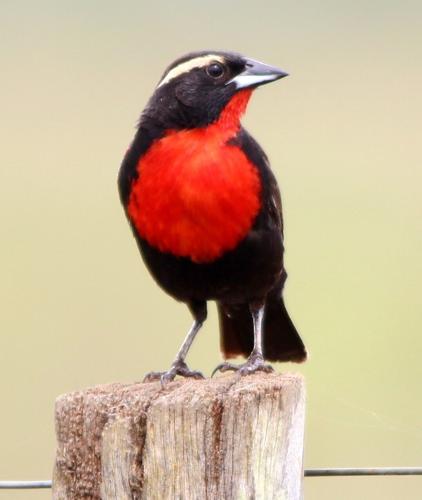
There is another genus of meadowlarks — Leistes — all found in South America. These are all red-breasted, as opposed to yellow-breasted, and include the red-breasted, white-browed, Peruvian, pampas and long-tailed meadowlarks. I’ve been lucky enough to see all of these, except for the pampas.
The pampas meadowlark has a fragmented range in northeastern Argentina and adjacent Uruguay. Unlike the other meadowlarks, it has not adapted to agriculture. While the other species have taken advantage of deforestation and the expansion of ag fields, this species has not. They need native, tall-grass prairies which, as in North America, have been nearly annihilated for crops and by cattle grazing.
Meadowlarks are not larks — family Alaudidae — with 98 species worldwide. Rather, they are blackbirds — family Icteridae — with 106 species, all in the New World. They have “lark” in their names because early ornithologists originally classified the eastern meadowlark as a lark due to similarities song and habitat to true larks.
It’s not a bad name, after all, given their preference for meadows, fields, prairies, and other open habitats. Most of the world’s larks are also species of open — even barren — landscapes. Eastern and western meadowlarks also have complex flight songs (no information for the Chihuahuan) that obviously reminded early taxonomists of the behavior and song of the Eurasian skylark.
The red-breasted and Peruvian meadowlark’s songs are similar to those of the eastern meadowlark, with a few added buzzes that remind me of a yellow-headed blackbird. They both have some kind of aerial song, but I could find no details.
The white-browed apparently has an aerial display as well. Its perched songs sound like a complex savannah sparrow. There are only two recordings of the song of the pampas meadowlark in Xeno Canto, and nothing at Birds of the World. The meager bits on file sound much like an eastern meadowlark. Getting more recordings of this species looks like a worthwhile, and probably not too difficult, project. All you need is basic equipment and a couple of weeks in Argentina. Hmmm …
Finally, the long-tailed meadowlark sounds more like a common or great-tailed grackle. Flight songs are apparently rare in this species.
One of the things I love about western meadowlarks is their pure exuberance! They sing from the tops of sage, junipers, fence posts or any other elevated perch where they can blast their song across the landscape. In the foothills, they chose spots in sagebrush amphitheaters where the surrounding bowl amplifies the song out to great distances.
From the Lakota legend “Honoring the Meadowlarks: “There was a time when the earth was pure and clean, and all living things spoke the same language. The people, the animals that flew, those that crawled, swam and lived on the earth could talk to one another.
There was peace and harmony because there was respect for everything and everyone.
Sadly, evil spirits — those against life — came among the living beings on the earth. During that time, there was one nation of people who were good messengers: the meadowlark. These people liked visiting and keeping everyone informed about the good things of life.
The joyful meadowlark sang about the good taking place so all beings of the universe would know about it. Every spring day, when the sun is coming up, you can hear the pretty song of our meadowlark relatives.”



(0) comments
Welcome to the discussion.
Log In