

An overwhelming majority of America’s farmers who responded to a nationwide survey say they cannot afford to purchase enough fertilizer to get them through the year.
The percentage who pre-purchased fertilizer varies significantly by region.
Conducted by the American Farm Bureau Federation April 3-11, the survey shows 70 percent of respondents say fertilizer is so expensive that they will not be able to buy all the fertilizer they need.
More than 5,700 farmers, both Farm Bureau members and non-members, from every state and Puerto Rico took the survey.
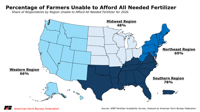
An analysis of survey results by Farm Bureau economists reveals that almost 8 in 10 farmers in the southern U.S. say they can’t afford all needed supplies this year. The number in the Northeast and West dropped to 69 percent and 66 percent, respectively, compared to 48 percent of the farmers in the Midwest.
Just 19 percent of farmers in the South pre-booked fertilizer purchases in advance of planting season. In the Northeast, only 30 percent of farmers pre-booked, followed by 31 percent in the West, and 67 percent in the Midwest. Even with higher pre-booking rates, almost one in three Midwestern farmers still report entering the season without securing all of their fertilizer needs.
The conflict in the Middle East sent fertilizer and fuel prices soaring. The closure of the Strait of Hormuz is keeping critical fertilizer supplies and crude oil from reaching global markets, putting a squeeze on supplies around the world.
“Spring planting decisions depend heavily on access to fertilizer and diesel fuel, both of which have been impacted by geopolitical risks that have disrupted global markets,” according to Market Intel. “Since the escalation of tensions in the Middle East, nitrogen fertilizer prices have risen more than 30 percent, while combined fuel and fertilizer costs have increased roughly 20 percent to 40 percent.
“Urea prices have increased by 47 percent since the end of February, marking the largest month-to-month percentage increase in the price of urea. These increases are occurring when many producers were already facing tight margins for many consecutive years.”
Many of the farmers surveyed said they will forego applying fertilizer this spring in hopes that prices will return to an affordable level later in the growing season.
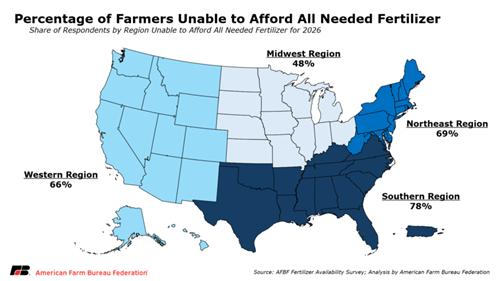
AFBF Fertilizer Availability Survey
“The skyrocketing cost of fuel and fertilizer is creating more economic hardships for farmers who have already endured years of losses,” said Zippy Duvall, AFBF president. “Without the necessary fertilizers, we’ll face lower yields and some farmers will reduce acres altogether, which will impact food and feed supplies.
“It’s too early to know how this will affect food availability and prices in the long run, but it’s a warning light that we’ve shared with leaders in Washington. We look forward to working with them to find solutions so farmers can continue to feed families across America.”
According to the survey, 94 percent of respondents reported their financial situation has worsened or remained the same since last year, while only 6 percent reported improvement.

(0) comments
Welcome to the discussion.
Log In