

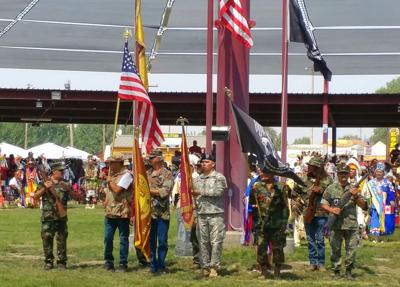
A ceremony was held to honor veterans — both Native and non-Native — at the Shoshone-Bannock Indian Festival in Fort Hall on Saturday afternoon.
The ceremony is held every year at the festival, and similar ceremonies are held at Native American powwows throughout the country.
During the ceremony, Native American men gather round a canvas — traditionally made from cow or deer hide — and drum on the canvas while singing. Native American women stand behind them as back-up singers, and the group moves slowly in a circle around the dance arbor.
Claudeo Bronco, a member of the Shoshone-Bannock Tribes who served in the Marine Corps from 1974 to 1976, said one of the songs is particularly a moving and was traditionally sung when tribes would move from camp to camp. In the present time, however, he said the song is used for soldiers to “go in a good way and come back in a good way.”
After the singers had finished their circle, Bronco also announced the names of every veteran there, as well as deceased veterans and those who were unable to attend because they were currently serving.
“Wherever the service men are at, we have them recognized so the prayers can reach them in a good way,” Bronco said. “But many (veterans) come back wounded or with PTSD. Some are wounded in action and receive Purple Hearts and Medals of Honor. Those are things that we hold highly here, so whenever we have a powwow, we honor our veterans.”
Bronco said Fort Hall has a significant number of veterans, as well as active-duty service members. This is unsurprising, considering that according to the U.S. Department of Veteran Affairs, American Indians and Alaska Natives serve in the military at a higher concentration than any other ethnic group.
Both Bronco and Tinker Perkins, a member of the Choctaw Tribe who has lived in Fort Hall for years and who served in the Marine Corps from 1966 to 1968, credit these high numbers to the desire Native Americans had to serve in World War I in an attempt to gain citizenship.
However, Native Americans would not gain citizenship until years after the war. The Indian Citizenship Act was signed into law in 1924, well after the war had ended.
Still, nearly a century after Native Americans were granted citizenship, they volunteer to serve in the military, even the younger generations. In fact, according to a VA report from 2012, half of Native active-service members of the military are between the ages of 17 and 24, compared with just 35 percent of all other active-service members.
Perkins credits this to tradition, something held in very high regard by Native American culture.
“It’s a part of our tradition now,” Perkins said. “It’s a family thing. Your fathers do it. Your brothers do it.”
Perkins said he followed his brother into the Marine Corps before the Army could draft him during the Vietnam War.
Bronco said he also enlisted voluntarily during the Vietnam War.
“My friends were all serving,” Bronco said. “(The military) came and recruited us in the high schools. They said, ‘You’re either going to join up or get drafted.’”
According to the same VA report, over 42,000 Native Americans served in the military in the Vietnam Era, and over 90 percent were volunteers.
Bronco said another possible reason for Native Americans’ continued high numbers of military service could be the lack of education and career opportunities that many Native Americans face.
The VA report states that American Indian and Alaska Native veterans have the lowest median personal income and had a higher percentage of unemployment than all other veterans.
“There’s good education benefits (to the military),” Bronco said. “Also, being a veteran gives you veteran’s preference for jobs, so you can get higher jobs.”
But whatever their reason for joining, Bronco said that once in — and out — the shared experience of war brings them closer to their fellow vets.
“It’s a brotherhood and sisterhood,” Bronco said. “It doesn’t matter what color you are. You watch my back and I watch your back, because we’re all in the same foxhole.”

(0) comments
Welcome to the discussion.
Log In