

Growing up on the Fort Hall Reservation in Southeastern Idaho, Derek No-Sun Brown didn’t know much about the Bear River Massacre other than its starkly descriptive name.
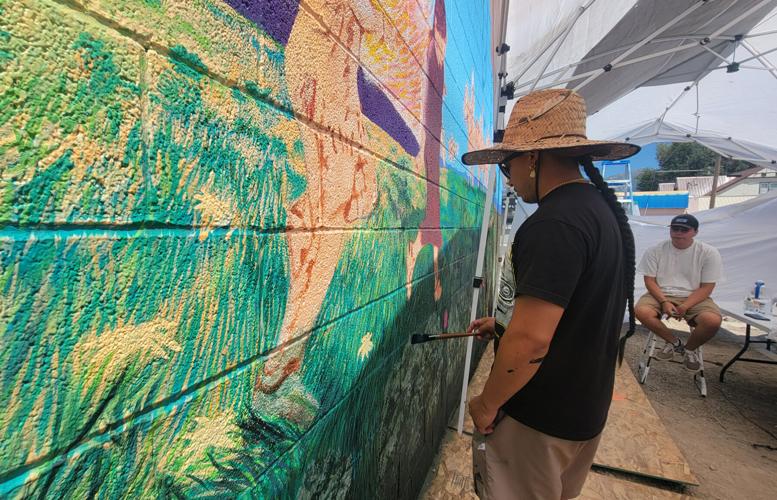
“I’d always heard about it, but never really sat down and asked, or talked, or tried to learn more,” Brown said recently on a sweltering early-summer afternoon as he worked on Tremonton’s newest mural on an outside wall of a downtown building.
When he finally did start researching the violence that broke out along the banks of the Bear River north of Preston, Idaho, where an estimated 350 Shoshone men, women and children were killed by United States Cavalry on Jan. 29, 1863, his initial reaction was a common one.
“It was a real tragedy, one of the most horrific things someone could go through as a human being,” Brown said.
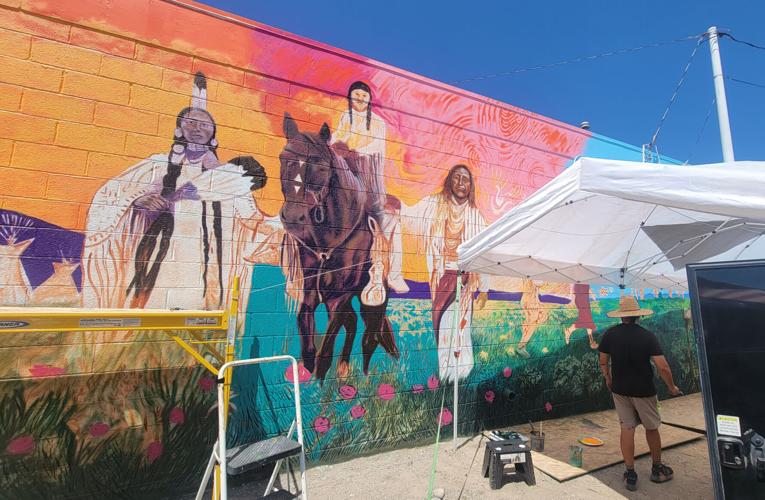
At the center of the new mural he is painting on the south wall of the Krey’s service station building at 110 E. Main St. stands Chief Sagwitch, the Shoshone leader who escaped death on that fateful day, a expression of resolve on his face while surrounded by members of his tribe.
In recent years, Tremonton has become known among Utah art enthusiasts for the murals that grace many of its buildings. Those murals depict early residents, police and firefighters, war heroes, important industries, rodeos — a variety of cultural pillars centered around white settlement — but none so far have paid homage to the people who lived in the area long before LDS pioneers first set foot in the Bear River Valley.
City officials determined that the next project would highlight and celebrate the native peoples of the area. After a competitive bidding process, they chose Brown, a Shoshone-Bannock tribal member, to help fill that historical gap.
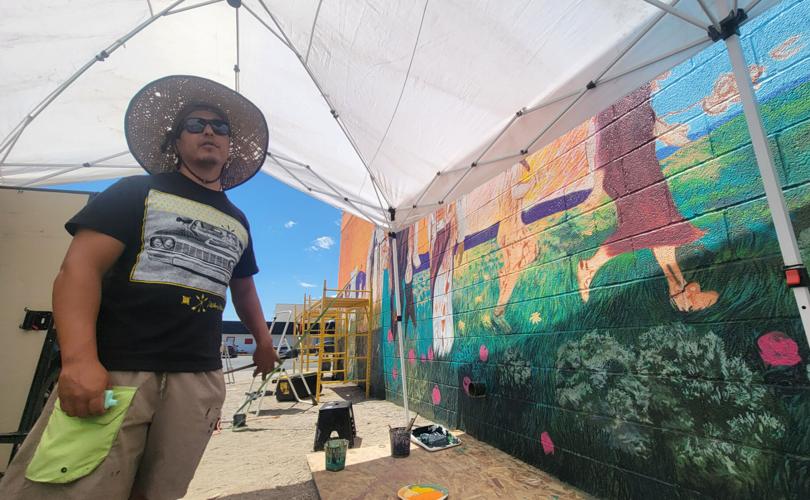
Brown, 36, works under a wide-brimmed straw hat with a long, tight-knit black braid extending down his back. He studies the textured surface and focuses with steely intent on every confident stroke of the brush.
“As far as the details and the really magical painting strokes and layers, once I put those together that kind of helps weave the story,” he said while working on Saturday, July 1. “When the light hits in certain ways then you’re able to absorb it more somehow.”
He has been painting professionally for the past 10 years and does museum shows, sells his paintings “for a pretty good amount of money now,” and works in metal and stone sculpture as well.
He also has a clothing brand called War Medicine that is primarily driven by online sales these days, especially since the COVID-19 pandemic pushed everything toward the digital marketplace. The website, www.warmedicineempire.com, sees steady traffic and provides another avenue for Brown to promote his art.
“It’s all art-based,” he said. “One of the things about art, it’s an open-ended challenge that will just never stop, so it’s always interesting.”
Brown is relatively new to murals, having created two in Portland, Oregon before winning the bid in Tremonton. He has several people he can call on to assist when needed, including his younger brother Demar Galloway, who is now preparing to graduate from college with an art degree and has been on hand to help out in Tremonton.
Brown and his family are based in New Mexico now, but working in Tremonton has allowed him to make more frequent visits to friends and family in Fort Hall, just north of Pocatello.
Working on a much larger canvas than what he’s used to has proven to be physically, mentally and emotionally demanding while being exposed to the elements, working on a tight deadline a long way from home, but Brown has embraced the challenge.
“It’s nice to come out and put some pressure on yourself, sweat, be in the sun, be physical,” he said. “Just to be outside is good.”
As he prepared his bid for the Tremonton project, it would have been easy and understandable for Brown to simply focus on what is widely considered the largest slaughter of Native Americans in U.S. history, and the deep wound it gouged into the collective consciousness of his people. But as he learned more about the Bear River Massacre, with much of that knowledge coming first- or second-hand from descendants of those who died that day or somehow managed to survive it, Brown began to see a narrative of hope.
If the writing wasn’t already on the wall before the massacre, it was writ large in the aftermath. The settlers were there to stay, and Sagwitch knew it was time to consider the future of his people in a changing world — a sentiment Brown has been working to encapsulate in his latest work.
“To me, the essence of the mural is how we’re gonna move forward together as a community,” he said. “It kind of gives a moment to stop and realize where we are in this current space and time. What has happened in the past, of course, and honoring that, paying respect, but really taking this current moment in so that we can move forward.”
The entire work is set against the backdrop of the massacre site, a combination of past, present and future; legend and legacy; the spiritual and the physical.
“When you look at the mural, the left half is kind of more metaphysical, almost like a spirit world kind of representation,” Brown said. “The right side is more our contemporary times.”
Running throughout the mural are a series of brightly colored flowers, birds, and children chasing a butterfly “as they transition from the spirit world into our current reality,” he explained. “The story of the butterfly and the flowers here, and the kids. That is the main point.”
Brown said the flowers in the mural remind him of a poem that was written by a samurai before he went into a battle from which he knew he wouldn’t return, a poem about a rose and the impermanence of its glow.
“It only lasts for so long, the beauty of that flower, and that’s why it’s beautiful — just like us,” he said.
“We only last in this moment, but in this moment we can last forever.”

(1) comment
Ya ya ya......white man is the devil. If you ever get
Tired of getting that narrative shoved down your
Throats, remember to "pay your respects".....and
They prefer cash to check. The constant shake
Down by the poor downtrodden minorities is getting old.....400 years of oppression.....massacre
This massacre that......you weren't there, you didn't live it.....get over it. Blacks committed their
Share of slavery and Indians committed their share of massacres.....so buck up buttercup.
Welcome to the discussion.
Log In