

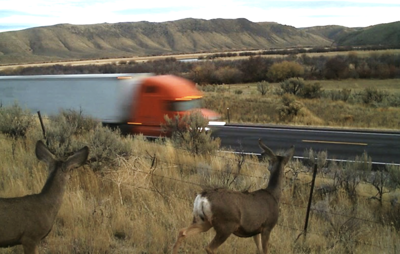
MONTPELIER — Decades of deadly collisions between vehicles and migrating mule deer on a treacherous stretch of U.S. Highway 30 near Montpelier are about to become a thing of the past.
Construction will begin this month on three wildlife underpasses along a six-mile section of Highway 30 near Rocky Point — one of the worst wildlife-vehicle conflict zones in Southeast Idaho and a critical bottleneck on a regionally important mule deer migration route.
The numbers tell the story. Of all the deer killed on a 20-mile stretch of Highway 30, about 70 percent are reported at Rocky Point — a stark concentration of losses that has frustrated motorists, hunters and wildlife managers for years.
The $12 million underpass project, funded through a federal grant awarded to the Idaho Transportation Department, will include the installation of two concrete box culverts, one bridge and six road miles of eight-foot-tall fencing on Highway 30 between Montpelier and the Wyoming border. The fencing will guide deer toward the underpasses rather than onto the highway, dramatically reducing the likelihood of collisions.
The grant is part of $125 million in federal funding awarded to 16 states through the Federal Highway Administration’s Wildlife Crossings Pilot Program — one of the largest federal investments of its kind.
For the Montpelier area community, the project is long overdue.
“Local citizens and our Montpelier shed crew have been asking for a solution here for decades,” said Alissa Salmore, ITD’s District 5 environmental planner. “It will be good to finally deliver this project, both for people and for wildlife.”
The benefits extend well beyond driver safety. Rocky Point sits squarely in the path of one of the region’s most important mule deer migration corridors, and the annual toll of deer killed on this stretch of highway has long concerned hunters and wildlife enthusiasts who value the herd as both an ecological and economic resource.
“This project is equally important to both ITD and Idaho Fish and Game and has received broad support from the Bear Lake County community because of the benefits to both human and wildlife safety,” said Zach Lockyer, regional wildlife manager with Idaho Fish and Game. “Hunters and other wildlife enthusiasts value this mule deer resource, and protecting it has added benefits to both the economy and quality of life in this part of Southeast Idaho.”
Construction is expected to be completed by fall 2026.

(0) comments
Welcome to the discussion.
Log In