

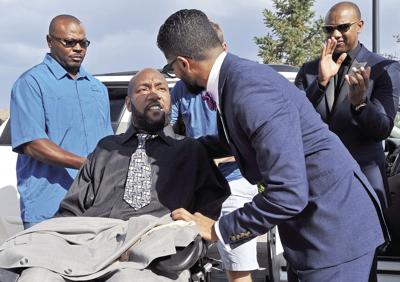
POCATELLO — Marcus Jackson, a former cornerback for the Idaho State University football team, was destined for a successful career in the National Football League. Professional scouts reveled at the All-American and All-Conference junior who had a 4.4-second speed in the 40-yard dash.
But during the second quarter of a non-conference rout against Western Montana, a game the Bengals would go on to win 47-0, Jackson — a 21-year-old senior at the time — made a routine tackle against the opposing running back that would change his life forever.
“I was known as a big hitter, so I was trying to knock his legs out from underneath him,” said Jackson, who is from Denver, Colorado, and played with the Bengals from 1993- 1996.
“The linebacker didn’t make the tackle but tripped him up. That’s when his leg hit my head.”
As Jackson dipped his shoulders for the tackle, the opposing player’s knee struck his helmet, snapping back Jackson’s head.
He was momentarily knocked unconscious and immobilized before medical staff removed him from the field on a stretcher. After a short ambulance ride to the hospital just across the street, known then as the Bannock Regional Medical Center, X-rays showed two of Jackson’s cervical vertebrae were fractured.
But that’s neither the beginning nor the end of Jackson’s story. The spring semester prior to the 1996 season, Jackson was in jeopardy of losing his spot on the team. Not because of inability to play, but because his grades fell below the acceptable levels for eligibility.
“My GPA wasn’t high enough and I actually lost my scholarship,” Jackson said. “Heading into that senior year I had a few workouts with Buffalo and Kansas City so I was trying to get my grades up to get back on scholarship.”
After full academic schedules in the spring and summer, Jackson became scholarship-eligible. He was reinstated two days before the season opener against Ole Miss.
A standout from Montbello High in Denver, Jackson received scholarship offers from several schools for football and track and field. But Idaho State University had a domed stadium and several of Jackson’s friends had already chose to suit up for the orange and black.
“That, and it was close enough to home but also far enough away,” Jackson said.
It was a regular day, Jackson said, other than it was a game day, too. He woke up that September morning, ate breakfast with his roommate and attended the game day walkthrough. The Bengals played the night game, so Jackson had some free time beforehand.
So he and his roommate purchased an aquarium and visited Jackson’s father, who had flown in from Denver to see his son play.
“And then we went off to the game,” Jackson said. “Everything that we had practiced that week was pretty much what we saw in the game, it was just a weird game. I mean, we were winning but the whole defense was talking about how it just felt like a different game.”
Just before halftime, Western Montana was in possession of the football and was simply trying to run out the clock and regroup for the second half, Jackson said.
“All I was trying to do was keep the running back in bounds, run the clock out and go to halftime,” Jackson said. “I remember the play we ran and we were blitzing. And my roommate, Jarmaine Johns, actually tipped the ball and it slowed the running back down a little bit.”
That’s when, after the linebacker tripped the ball carrier by way of a missed tackle, Jackson took a knee to the helmet that fractured his C-4 and C-5 vertebrae and bruised his spinal cord.
“It knocked me unconscious and when I woke up I wasn’t even in pain,” Jackson said. “I was just ready to play.”
Jackson said he didn’t understand why medical staff strapped him to a flat board, loaded him to the ambulance and drove him to the hospital. “But I think the doctors knew straight from the beginning,” he said.
Jackson tried to stop the doctors from cutting his jersey from his body, but he couldn’t move. He could only explain that he needed the jersey for next week’s game. Jackson wouldn’t play in that game and would never walk again.
But that hasn’t stopped him from giving 100 percent every down, distance or day.
“I never really thought it was that serious,” Jackson said. “I grew up with a couple people that broke their neck.”
It was his senior year and despite suffering a freak accident that resulted in an injury that many would call insurmountable, Jackson returned to ISU and graduated with a bachelor’s degree in business.
“After that first year I almost wanted to throw the towel in,” Jackson said. “There was just so much to adjust to. I was trying to find a way to manage my time better because things were taking a lot longer. But I had the support. My family, friends, teammates, the Pocatello community, my community back at home in Denver, I mean everybody wanted to see me successful. Everybody was so encouraging.”
After finishing his degree, Jackson returned to Colorado, where he would tutor children after school because of his mother’s connection as a teacher. Soon after she died in 2004 from cancer-related complications, Jackson started the Denver-based non-profit organization, Only the Strong, that provides financial and educational support to minority students who plan to further their education after high school.
“I started adjusting to finding out what kids in our community needed,” Jackson said. “Whether it was backpacks or words of encouragement, that was what I was going to do.”
Jackson continued, “Strength is much deeper than physical toughness. You have to be strong in the mind, strong in spirit and also strong physically.”
Though awards in his name were created at ISU and vanished over the years, Jackson’s spirit and his decision to return to ISU were never forgotten. And to honor his drive and determination, the JRM Foundation and ISU awarded the Marcus Jackson scholarship to a walk-on Bengal football player, Alvin Delve, during Saturday’s Hometown Heroes event.
“Honestly, as a man I look up to guys like (Jackson),” Delve said. “They go through crazy things and they don’t have any excuses. They put hope into kids like me and other people who are going through things so that they realize that they are not alone.”
Meanwhile, the JRM Foundation for Humanity provided Hometown Heroes awards to Shoshone-Bannock Tribes spokeswoman Randy’L Teton, founder of “Bringing Hope Today” Matt Morgan, Community Dinner Table President Lee Hammett, Fremont County Search & Rescue member Eric Thomas, cardiothoracic surgeon Dr. Jacob DeLaRosa, Barrie’s Ski and Sports owner Barrie Bennett Hunt, Coalition Against Sexual and Domestic Violence Executive Director Kelly Miller, World War II veteran Anton Newman, 20-year District 25 administrator Sheryl Brockett and retired Army Col. Craig W. Nickisch.
From Naples, Florida, Delve said his family has always struggled financially, and at one point that led to a brief stint of being homeless. But like Jackson, Delve understands the importance of education and thanked the close roots of his family for keeping him focused.
“A scholarship like this means a lot for us,” Delve said.
Jackson said Delve is a perfect example of what he tries to accomplish with Only the Strong.
“I feel great about it because that’s exactly what I’m trying to get across,” Jackson said. “I just feel like I have to help and be the best that I can be. This is exactly what I am about and what my life has been about.”

(0) comments
Welcome to the discussion.
Log In