



The National Transportation Safety Board (NTSB) released preliminary details last week about the small plane crash that killed two men in the Payette River on Jan. 27.
According to the agency’s Aviation Investigation Preliminary Report, “an amateur-built, experimental CCX-1865 Carbon Cub, N126C, was substantially damaged when it was involved in an accident near Montour, Idaho. The pilot and pilot-rated passenger were fatally injured. The airplane was operated as a Title 14 Code of Federal Regulations Part 91 personal flight.”
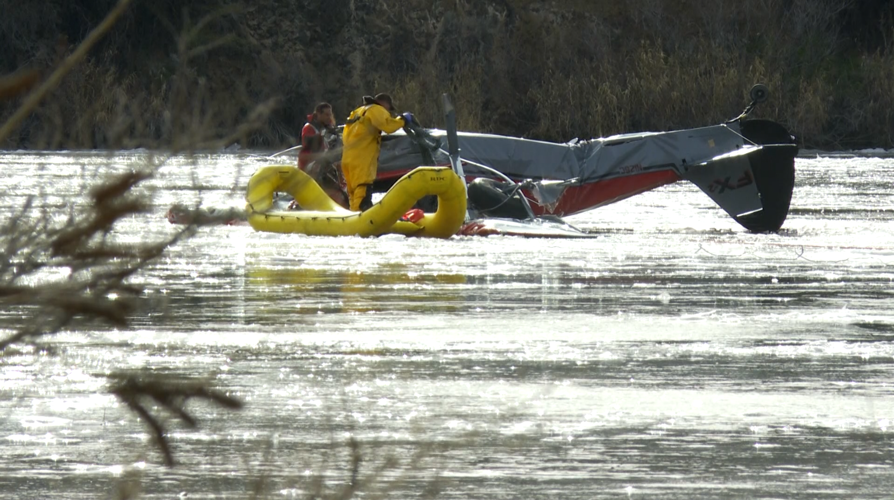
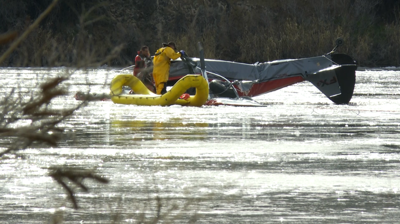
The aircraft “came to rest inverted in ice-covered shallow water” near the middle of Black Canyon Reservoir along the Payette River in Gem County.
The two men on board — CBS2 Chief Meteorologist Roland Steadham, 67, and Dallin Laufenberg, 26, of Meridian — were pronounced dead following the crash, as previously reported by the Messenger-Index.

Roland Steadham
According to the preliminary report, a friend observed the pilot pulling the airplane from his hangar the morning of the flight. The pilot refueled the aircraft with 20 gallons of fuel and conducted a short flight, spanning about 5 miles and taking 10 minutes, before meeting his passenger.
The preliminary report did not identify who was the pilot and who was the passenger.
The aircraft departed again about 10:42 a.m. and proceeded east, maneuvering near Lanham Field, a private airport in Emmett. The report states the airplane circled twice, “circled once in a counterclockwise direction then turned and circled a second time in a clockwise direction” at varying altitudes between approximately 3,850 and 4,325 feet mean sea level (msl) before heading northeast and then east along the south side of Black Canyon Reservoir.
“Upon nearing the east end of the canyon, the airplane began to descend from about 4,400 ft msl to about 3,950 ft msl,” investigators wrote. “The last data point recorded the airplane about 1.5 miles west of Montour, Idaho.” Additional third-party flight tracking data indicated the airplane continued descending and “turned left about 180 (degrees) over Montour.”
The flight data temporarily ended while the aircraft was over the town. Witnesses near the crash site described the airplane flying at a very low altitude shortly before impact. According to the report, one witness near the Payette River observed a red and gray airplane flying approximately 50 feet or less above the ground before losing sight of it behind trees. The witness reported losing electrical power to his home around 11:05 a.m. A second witness, about 0.7 miles from the crash site, reported seeing the airplane at a very low altitude before it “nosed over into the water,” at which time she also lost power to her residence.

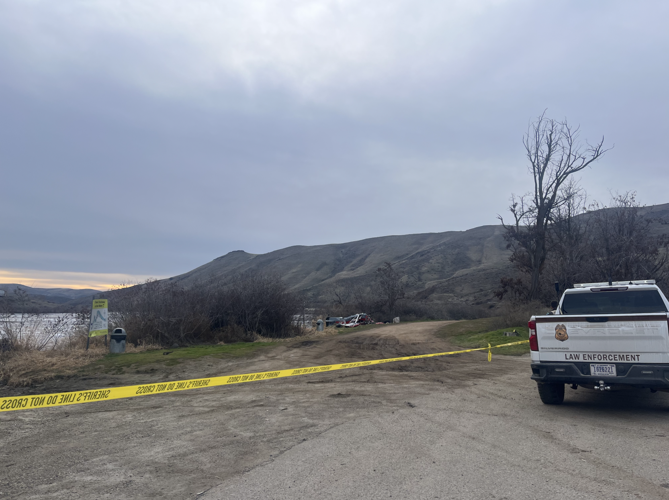
Wreckage from Jan. 27’s fatal plane crash in Gem County is visible in this photo captured near the site.
Third-party data later reappeared, showing the airplane at about 2,125 feet mean sea level and approximately 550 feet east of the accident site, and about 440 feet east of power distribution lines that cross the reservoir roughly 150 to 200 feet above the water’s surface. Investigators noted that the left main landing gear separated from the fuselage and was found nearly underneath the power distribution lines. The landing gear displayed “impact marks and striations to the leading edge of the forward strut and the left-side landing gear shock absorber.”
KTVB first reported that, before 11 a.m. on the day of the crash, more than 5,300 Idaho Power customers experienced a power outage affecting areas in Crouch, Horseshoe Bend and Placerville before power was restored later that afternoon. The outage impacted schools in the Horseshoe Bend area, prompting the district to cancel classes by 12:15 p.m. as the school could not heat buildings in the interim.
Law enforcement also reported a brief power interruption to local homes around the time of the crash. “The airplane came to rest inverted, in ice covered shallow water near the middle of the reservoir,” the report states. “The first point of probable impact was a large, fractured circle of ice directly in front of the wreckage.” All major components of the aircraft, except the main landing gear, remained attached to or were located near the fuselage. The airplane has since been recovered to a secure facility for further examination.
The NTSB investigation remains ongoing.

(0) comments
Welcome to the discussion.
Log In