

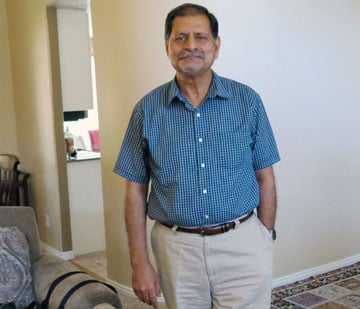

POCATELLO — Retired Maj. Mohammed Safdar said his home country, Pakistan, has been in continual transition and migration almost since its creation in 1947, but he said the Middle Eastern country was a very peaceful place to grow up and Pakistan shares many commonalities with the Pacific Northwest.
Safdar said Pakistan is home to five major rivers, the longest and the largest is the Indus River — about two-thirds of water supplied for irrigation and homes come from the Indus and its tributaries. The country has a substantial agricultural industry, Safdar said, Pakistan produces wheat, corn, sugar cane and cotton and is a world leader in textile exports.
Several Pakistani cities are also involved in the manufacturing of medical instruments.
Safdar said he joined the Pakistan Army and after being moved by the show of respect a group of soldiers paid his father’s funeral procession in 1967.
“We were carrying the casket to the grave yard and there was a military unit training there and as we passed by, they stopped and turned around and saluted my father,” Safdar said. “That was very inspiring to me. I thought, I want to be part of that, they show respect for a dead man that they don’t even know.”
He joined the military in 1971 and served until 1998.
“God blessed me, I started my service at 18,” Safdar said.
He bears a striking resemblance to Omar Sharif, Safdar is thoughtful and deliberate, but he is also humble and personable.
Safdar and his wife, Shagfda Safdar, have been married for 34 years and they have three children, and four grandchildren. Their youngest son currently lives at home and is studying mechanical engineering at Idaho State University.
The family’s home, located in the Highland area, is a reflection of Mohammed, it is elegant yet minimal — framed photos of grandchildren and family members make it personal and warm.
Mohammed has been visiting the U.S since 1998 and he’s been living in the country since 2011. He spent a year in New Jersey, a year in New York and he’s been in Idaho for almost a year. His nephews are local kidney specialists Fahim and Naeem Rahim of Pocatello.
Following his retirement from the Pakistan Army, Mohammed worked for the Khyber Pakhtunkhwa (KPK) and for the National Data Base and Registration, the program worked to provide identification cards to Pakistanis in and out of the country.
Since the division of the Indian continent in 1947, Pakistan and India have been at war three times and the conflict is still continuing at lower levels of intensity.
“India believed that Pakistan would collapse within six months,” Mohammed said.
The division also led to the migration of 180 million Muslims from Hindu-dominated India. The volatile climate was exacerbated by the seccession of Bangladesh from Pakistan in 1971.
In spite of decades-long national conflict, Pakistan has made its presence known in the world. The country was recognized for its support in bringing down the Berlin Wall in 1989 and the Pakistan’s leaders also played a crucial role in bringing the U.S. and China to the table for the first time.
“The Americans flew to China from Pakistan,” Mohammed said.
When the Russians invaded Afghanistan and during the incurring conflict, four million people fled Afghanistan and crossed the borders into Pakistan, and after Russia was expelled from Afghanistan, conflict in Pakistan’s six tribal regions increased.
“Once the Russians were gone, these people were left behind and armed, they started fighting each other,” Mohammed said. “And that’s when the Taliban emerged.”
Today, Pakistani troops are stationed along the country’s 1,400-kilometer long, eastern border with Afghanistan and on the Western portion of the state, the military are engaged with removing terrorists.
“Whatever happens in Afghanistan affects Pakistan,” Mohammed said.
Mohammed said many Pakistanis are displaced internally and forced to flee to other cities due to religious conflict within the country.
“Pakistan is a country that has accommodated four million people,” Mohammed said. “And 2.5 million of them stayed.”
As well as a similar terrain, Mohammed said the people of the Pacific Northwest are much like Pakistanis.
“The majority of the people are very friendly and helpful,” Mohammed said. “Pakistanis are very loving, very hospitable people.”
He opted to drive to Idaho from New Jersey so he could see the country, Mohammed visited Pocatello in 2006 and he said Southeast Idaho suits him and his family.
An avid golfer, Mohammed said Pakistan is also home to acres of lush golf courses. He’s taken up skiing since moving to Idaho, but says, he’s still a novice.
“I’m not a very good skier. I have skied at Pebble Creek and in Sun Valley, I like it,” Mohammed said.
Mohammed said he misses friends, family and colleagues from Pakistan, but he’s excited about his new community and anxious to be part of it.
“I would like to find some way to be involved, to give to the community,” Mohammed said.

(0) comments
Welcome to the discussion.
Log In