

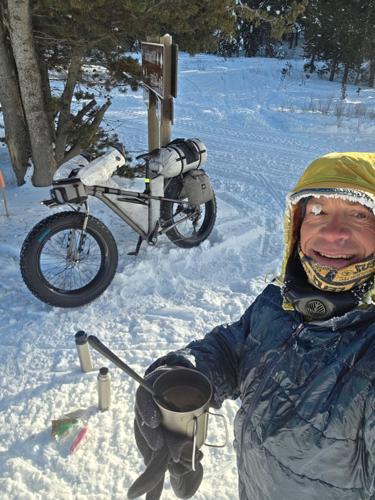
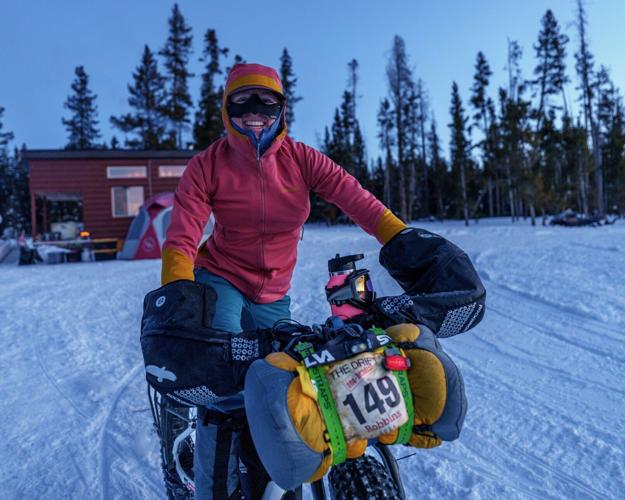
Two Teton Valley athletes are headed north this week for the Iditarod Trail Invitational, the world’s longest-running winter ultramarathon. Ginny Robbins and Jay Petervary, both experienced riders and ultramarathoners, will attempt the 350-mile route and the 1,000-mile route, respectively.
The race, which includes a 350-mile route and a 1,000-mile route, is open to skiers, runners and cyclists.
Petervary, has pedaled this course 13 times — five of which were for the entire 1,000-mile course. This year will be the first time he has raced since being badly injured cycling in Colorado two-and-a-half years ago.
“I first started doing it in 2007 and I fell in love with it,” said Petervary. “As a puzzle, as a journey, as a challenge, and as an adventure. It’s hardly a bike ride, even though we take our bikes. It’s more of an expedition.”
On the other hand, Robbins is attempting the race for the first time and has opted for the 350-mile route. Robbins, who is an experienced ultramarathoner on skis and on foot as well as on a bike, has chosen to ride her fat bike in this race.
The race, which begins Feb. 22, follows the traditional dogsled Iditarod trail. From its beginning at Knik Lake (near Wasilla), the route travels northwest for 350 miles to McGrath. This first stage of the event features seven checkpoints along the way. Racers must pack survival gear and provisions, although some food and amenities are provided at the checkpoints. At two points along the route, airdrops of pre-packed supplies are staged for racers.
The second stage stretches from McGrath all the way to Nome, passing 650 miles through even more remote territory. Racers attempting this section can mail prepackaged supplies to nine communities along the route, with an additional airdrop where there are no postal services.
In October, this coastal part of Alaska was severely affected by a pair of storms back. However, despite damage, the route is open and local communities have rallied to support the upcoming race.
On Oct. 8, the first pair of Pacific storms slammed into the coast of Alaska, causing widespread damage, including flooding and erosion which led to declarations of disaster and some community evacuations. On Oct. 11, the remains of Typhoon Halong followed up with hurricane-force winds and a tidal surge which interrupted relief efforts and caused additional damage to many remote communities.
In response to the difficulties faced by these communities who have supported this event for many years, many racers, including Petervary, have joined forces with the non-profit Intrepid Path Foundation to raise funds for these communities rebuilding after the autumn storms.
As of Monday, Feb. 16, over $26,000 had been collectively raised through their efforts.
In August of 2023, while racing in the Great Divide Mountain Bike Route from Alberta to New Mexico, Petervary was struck by a car outside Hartsel, Colorado, and sustained a broken wrist, arm and a spinal fracture. Recovery from these injuries has been slow, but this past summer Petervary cycled 3,000 miles along the Mississippi River, averaging 150 miles per day.
“I did that with no problems, and feeling good,” he said. Realizing that he could once again sit on a bike comfortably, Petervary’s mind turned back to the Iditarod. “When I got back from that trip, the gears started turning, and the Iditarod just made sense. It is a journey I love, and I just can’t stop tinkering with it. I would get depressed in years if I couldn’t do it.”
Petervary has continued to rehab his injuries and train.
“I’ve been very disciplined with that,” he said. “I feel great. I’ve been putting in the work, and messing with the gear and the logistics, and envisioning this journey, which is big, and can be overwhelming. But it just seems like I’m ready, and something is calling me. I belong out there at this time.”
“This has been a good winter to be on a fat bike,” Robbins said. “Terrible winter to be a skier, but the two are a perfect combination.
Robbins is a natural competitor and she is feeling confident about the makeup of the course. She says she is looking at this challenge as more of an adventure than a race.
“I’m not going into it with any expectation of pushing hard, or racing, or anything,” said Robbins. “All along, my goal has been to go and have a really cool adventure and see everything, and meet people, and just fully embrace being there, and doing all the things and getting good sleep.”
The course’s conditions and the weather will ultimately determine her pace, but Robbins hopes to finish the 350-mile course in five or six days. Robbins has a lot of experience in long distance races which have helped her plan the logistics of a weeklong winter bike trip. But while she is not daunted by the possibility of hungry bears coming out of hibernation early, wolves, weather, or spending a week on a largely self-supported bike trip in the depth of the Alaskan winter she is nervous for one thing: reassembling her bike.
She is flying to Anchorage for the race, meaning her bike will be partially disassembled when she arrives at the race.
“I’m so intimidated,” she said with a laugh, “Reassembling my bike when I arrive in Anchorage with my bike in pieces in a bike bag, and I have to put it back together. We’re going to work on taking it apart this afternoon, and I’m going to write a detailed list of what order you do things and take pictures of everything and making sure everything is marked so I can get it lined up correctly.”
The Iditarod trails have been used by indigenous people in the region for thousands of years, winding along the coast and up into the mountains. During a gold rush over a century ago, the trails were used heavily by gold seekers. When an outbreak of diphtheria hit Nome, Alaska in mid-winter of 1925, teams of sled dogs transported a vaccine serum 674 miles along this route to save the townspeople. The annual Iditarod races commemorate the history of these trails.
Anyone interested in living vicariously can follow the progress of the racers in real time on the race’s website. Teton Valley News wishes Petervary and Robbins the best of luck on their upcoming challenge and hopes they will bring some snow back with them when they return home.



(0) comments
Welcome to the discussion.
Log In