



POCATELLO — A Bannock County jury Thursday found Idaho State University liable for retaliating against a Black woman pursuing a doctor of pharmacy degree who raised concerns about racial discrimination, awarding her $160,000 in damages following an 11-day trial.
A 12-person jury consisting of eight men and four women delivered the verdict in the case of Chanica Sintima v. Idaho State University before 6th District Judge Robert C. Naftz after deliberating for roughly nine hours, from 11:20 a.m. to 8:20 p.m. Thursday.
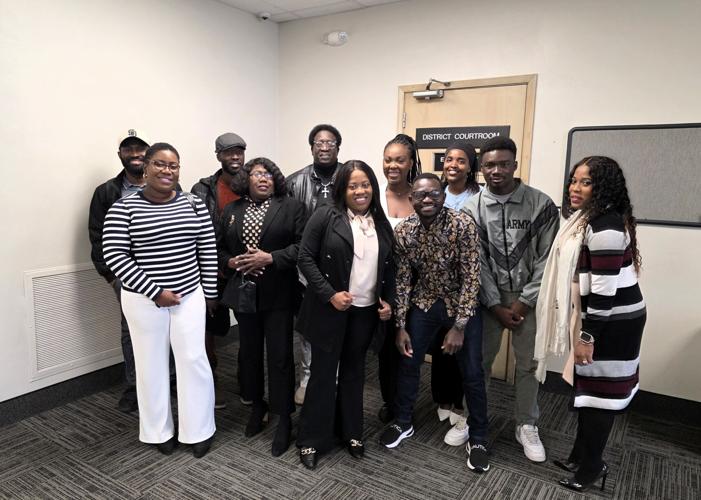
Sintima, who enrolled in ISU’s Doctor of Pharmacy program in the summer of 2020, let out a sigh of relief and buried her face in her hands when the verdict was read, telling the Idaho State Journal immediately afterward, “I am very happy and grateful that justice was served in this case.”
Sintima’s husband, Dicken Bonsrah, added, “Most importantly, she can move forward in her life. This was institutionalized but now it’s out in the open. What she knew all along was true. Now she can actually move on and become what she’s always wanted to be. We are very grateful for the verdict.”
Evidence presented during the trial included recordings of university administrators, text messages between faculty and Sintima’s own emotional account from the witness stand.
The jury ruled in Sintima’s favor on claims of retaliation under Title VI of the Civil Rights Act of 1964, the Idaho Human Rights Act and the First Amendment of the United States Constitution, but ruled against her on a count of negligent infliction of emotional distress.

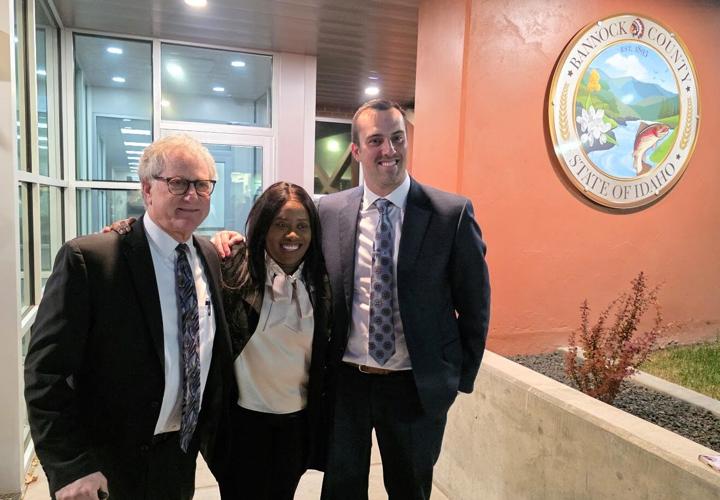
Chanica Sintima, center, pictured with her Boise attorneys J. Grady Hepworth, right, and Howard A. Belodoff, left, outside of the Bannock County Courthouse Thursday evening.
Though her attorneys — J. Grady Hepworth of Boise’s Hepworth Law Offices and fellow Boise attorney Howard A. Belodoff — estimated total damages of about $3.4 million, the jury awarded $160,000, the bulk of which — $111,000 — was for the cost of vocational rehabilitation or retraining. The jury also awarded $40,000 in lost past earnings, $5,000 in medical expenses and $2,000 each for harm to reputation and shame, mortification or hurt feelings.
It awarded nothing for future lost earnings or pain and suffering.
ISU’s Boise attorney, Michael E. Kelly of Kelly Law PLLC and a special deputy attorney general, declined to comment immediately after the verdict. ISU provided the following statement Friday.
“Idaho State University has established policies and processes in place to ensure students have a safe and respectful learning environment, and ISU’s employees work diligently to create a supportive educational experience for all students,” the statement read. “ISU will continue to make every effort to ensure that university policies and processes reflect that commitment. While we do not agree with the conclusion that retaliation occurred, we respect the judicial system and look forward to moving beyond this issue.”
Sintima alleged that ISU professors Dr. Erin Berry and Dr. Kasidy McKay, and 10 unnamed individuals retaliated against her after she raised complaints about racially disparate treatment during her Block 4 Advanced Pharmacy Practice Experience, or APPE, rotation at Eastern Idaho Regional Medical Center in Idaho Falls in the fall of 2023.
According to a press release Hepworth provided to the Journal on Friday, Sintima was a fourth-year student mere months from her expected graduation in May 2024 when the dispute began.
Hepworth told the jury in closing arguments that ISU destroyed his client’s dream of becoming a pharmacist.
“The only thing that stopped Ms. Sintima from achieving that dream was the illegal retaliation of Idaho State University,” Hepworth said. “(ISU College of Pharmacy) Dean Tom Wadsworth retaliated, Dr. Erin Berry retaliated, Dr. Kasidy McKay retaliated. The progressions committee retaliated. ISU retaliated — and their retaliation didn’t just break that dream, that retaliation broke Chanica Sintima.”
According to the complaint and testimony at trial, Sintima began her Block 4 rotation at EIRMC on Sept. 18, 2023, under the supervision of Berry. She alleged Berry applied attendance and tardiness policies inconsistently between her and a fellow white classmate and created an educational environment in which Sintima felt disenfranchised.
On Oct. 5, 2023, Berry verbally told Sintima she was meeting most clinical expectations and could expect a “B” at her midpoint. That same day, Sintima emailed ISU’s Office of Equity and Inclusion describing the situation and asking how to file a discrimination complaint.
During the fourth week of the six-week rotation, Sintima learned that her counterpart had already received her written midpoint evaluation while she had not. Sintima raised the disparity directly with Berry on Oct. 16, also informing Berry she intended to file a formal grievance with the Office of Experiential Education, which oversees the clinical rotations as part of the doctor of pharmacy degree path.
According to testimony and evidence presented at trial, Berry responded by threatening to report Sintima to McKay, who is also the chair of the department of Pharmacy Practice and Administrative Sciences. Berry also contacted hospital staff at EIRMC, expressing concerns about Sintima and possible plans to leak protected health information to the media, according to evidence presented at trial.
EIRMC placed a “be on the lookout” alert on Sintima and banned her from the hospital unless in need of medical attention, according to evidence presented at trial.
McKay subsequently barred Sintima from returning to her rotation unless she first met with McKay in person — during a time when Sintima was scheduled to be at EIRMC and was experiencing transportation difficulties, evidence showed. When Sintima proposed a Zoom meeting and later offered to schedule a meeting after the rotation ended, McKay referred the matter to ISU’s Progressions Committee.
On Nov. 6, 2023, Berry submitted a failing “no pass” grade for Sintima despite her having completed five of the six weeks of the rotation. The Progressions Committee voted to expel Sintima from the College of Pharmacy on Jan. 26, 2024, providing her with an official letter dated Feb. 2, 2024. ISU’s Scholastic Appeals Board sustained that decision in June 2024.
Kelly argued throughout the trial that ISU and the named defendants acted in good faith and that Sintima’s removal from the rotation was due to unprofessional conduct and her failure to complete a required meeting, not her race or any protected activity.
Hepworth argued in closing that the jury did not need to find that any defendant held racist beliefs — only that Sintima reasonably perceived she might be receiving disparate treatment because of her race and exercised her legal rights in good faith in response.
“We do not have to prove that Ms. Sintima’s midpoint grade was influenced by the color of her skin,” Hepworth told the jury. “We just have to prove that Ms. Sintima had a reasonable concern that she might be being treated differently because of the color of her skin.”
Sintima had maintained a 3.62 grade point average and earned multiple Dean’s List recognitions before the Block 4 rotation, having received “A” grades in each of her three prior APPE blocks. Expert witnesses testified about her lost earning capacity as a pharmacist and her ongoing treatment for PTSD and adjustment disorder.
According to the press release, Sintima also engaged in First Amendment association with the Pocatello chapter of the National Association for the Advancement of Colored People as part of her protected activities. The release states Sintima looks forward to using the verdict as an opportunity to further her lifelong dream of becoming a doctor of pharmacy.
Bonsrah said Thursday he believes that dream remains achievable.
“I believe the attorneys are going to make sure that that happens,” he said. “I know that she will one day become the pharmacist that she’s always wanted to be.”

(3) comments
Sounds like ISU needs to review their policies and processes because this one fell through the cracks. Instead of saying they don’t agree with the conclusion of retaliation. Obviously a whole 12 jury saw what they didn’t.🤣🤣 Good for her for standing up for herself!
We'll never know the whole inside true story. She probably was at serious fault for something that even here grades couldn't overcome, so she used the race card. Even her lawyers admitted may not have been racially motivated. But some fancy legalese convinced, confused the jury into her defense.
An 11 day trial with a jury from here in Bannock county .... had to be some evidence that they found persuasive ... but I never knew the case was even being tried until this article ... but it - the jury verdict
Well what ever the reason was, it was proven beyond a reasonable doubt! Sounds like 2 people need dismissed like she was.………
Welcome to the discussion.
Log In