

POCATELLO — A woman arrived frothing at the mouth. Fluid had filled her lungs, driven there by a dangerous spike in blood pressure that her body could no longer contain. A midwife watched helplessly as a Namibian woman drowned in her own fluid. The baby she was carrying died too.
Dr. Jonathan Cree has never forgotten hearing that story.
“If someone goes through an experience like that, they have to deal with it in order to continue in their professional life,” said Cree, a board-certified family medicine physician and educator. “The majority of people in America have prenatal care, and this is diagnosed and prevented before it ever gets that bad.”
That account did not leave him. It was never meant to.
Cree traveled to Namibia in 2019 alongside Dr. David Hachey, a pharmacist at Idaho State University who had spent years building an academic partnership with the University of Namibia centered on HIV treatment and education.
“The passion to make that country better internally is just palpable,” Hachey said. “To be able to be a part of that — to provide education and support and shape students as their programs grow and expand — is special.”
On that first trip, Cree met Professor Louise Pretorius, head of the university’s Advanced Midwifery Program, and asked what ISU could do to help.
Midwives are medical professionals trained to guide women through pregnancy and childbirth. In rural Namibia, they are often the only health care provider a mother will ever see.
“I hate it that my midwives lose so many of their mothers and babies in childbirth,” Pretorius told him.
Namibia, a vast desert nation in southern Africa slightly larger than Texas, has maternal and infant mortality rates far higher than those in the developed world. The two leading causes are severe bleeding after delivery and dangerous spikes in blood pressure during pregnancy — both treatable and even preventable with the right training and tools.
Many rural Namibian midwives had neither.
That is what Cree and his colleagues at ISU’s Department of Family Medicine set out to change, though they quickly learned that change, in medicine as in life, is rarely straightforward.
Bringing American medical practices into a different cultural and medical landscape comes with friction. Beliefs held by communities for generations do not yield easily to outside instruction, and standard procedures that American providers take for granted are sometimes met with skepticism.
Some cannot be carried out without equipment that does not exist in rural Namibia. Cree and his colleagues learned early that the goal was never to transplant American medicine into Africa, but to work within what exists — building trust, understanding local context and finding common ground between what the science demands and what the community will accept.
“Going and putting on programs and just leaving unless you have changed things,” Cree said, “that’s not enough.”
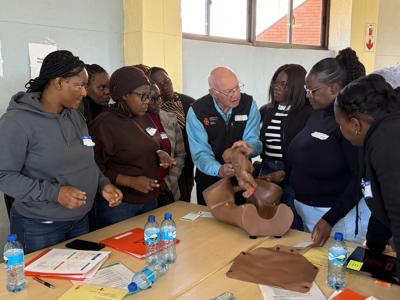
Starting in 2024, Cree has led teams of ISU residents and faculty to Namibia to deliver intensive, hands-on training courses built around simulation — lifelike medical models that bleed, seize and struggle to breathe — so midwives can practice responding to emergencies before facing them in real deliveries.
Teams travel to Windhoek, the capital, and push further out to remote areas including Outapi in the northwest and Katima Mulilo on the Zambian border, where isolation makes the stakes even higher.
The program focuses not just on individual midwives but on training local university faculty to become certified instructors themselves, ensuring the knowledge keeps spreading long after the ISU teams fly home.
While Cree and Hachey have anchored ISU’s work in Namibia, Dr. Zachary Warnock has been building something of his own on the other side of the world.
Warnock, a family physician at ISU, first traveled to the Philippines 18 years ago on medical missionary work. A friendship forged on that trip — with a physician who now runs a maternity center on the island of Mindanao — became the foundation for what is now a growing annual mission.
He travels to Mindanao each year, teaching lifesaving obstetric courses to midwives and physicians in both cities and remote rural communities. ISU residents travel with him, staying behind to staff rural clinics under supervision — gaining clinical experience that no classroom in Pocatello could replicate.
Taking residents abroad has always been central to the mission. Cree and his colleagues believe young physicians need to see the world beyond Idaho — not as a side benefit, but as essential to their training. In places where technology is scarce, residents rely on their hands, their ears and their instincts in ways that no American hospital demands of them.
“Lots of residents come into this field with a service heart,” Warnock said. “And then we put them through the wringer and almost beat that out of them. This kind of experience reawakens that.”
For Warnock, the pull back to the Philippines runs deeper than any single course or clinic. The relationships he has built there over nearly two decades have become something he cannot easily set aside.
“When you develop these relationships, they become a part of who you are,” Warnock said. “You care so much for those people that that drives you to continue working on that relationship and working together to educate each other.”
That was made clear when a doctor he had trained told him she wished she had learned a particular skill just one week earlier.
“She said, ‘If I had known this last week, that patient wouldn’t have died,’” Warnock said. “Just the fact that we’re teaching things and providing education that actually saves lives in their day-to-day practices is really motivating. It makes you want to expand the program as much as possible and get as many people involved as possible.”
Together, the Namibia and Philippines programs have reached more than 230 obstetric providers across two countries. They are funded entirely through grants and private donations — no Idaho state dollars go abroad.
The program gained critical support in March 2024 when Dr. Rebecca Kinney and her Beckon Foundation provided funding that made expansion possible. A Boise-trained family physician, Kinney had collaborated professionally with Hachey and saw in the program a direct reflection of her foundation’s commitment to closing gaps in global health care access.
That investment follows ISU’s residents all the way home. In places without X-ray machines or ultrasound equipment, doctors learn to listen harder, examine more carefully and trust what their hands and ears tell them. Those instincts return with them to Pocatello, where patients who need that kind of attention — including migrant farmworkers navigating a health care system not built with them in mind — are already waiting.
“Those health disparities are right here in Southeast Idaho,” Cree said.
The story Cree carried home from Namibia — of a mother who drowned in her own fluid, of a baby who never had a chance — is the reason the program exists. What he and his colleagues are building, one trained midwife and one returned resident at a time, is the bridge between existing knowledge and the women who need it most.
“Philosophically, we should be aware of disparities in healthcare, life expectancy,” Cree said. “Why should the life expectancy in Namibia be in the ‘50s, and it’s in the ‘70s, in the States? It’s the same human race, same planet.”

(0) comments
Welcome to the discussion.
Log In