

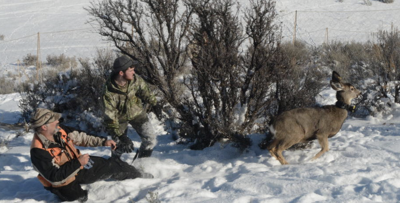
Good news is on the horizon for Idaho’s deer and elk herds — and a mild winter deserves most of the credit.
Statewide winter survival for mule deer fawns and elk calves has come in well above average through the end of February, according to Idaho Fish and Game. Of the collared animals being tracked across 14 different units, 89% of mule deer fawns and 99% of elk calves are still alive — numbers that have wildlife biologists cautiously optimistic heading into spring.
“Right now things are looking promising for both deer and elk,” said Toby Boudreau, Fish and Game’s deer and elk coordinator. “We’ll know for sure what survival will look like in the coming month and a half after we’ve tallied up the final numbers. But this is exactly what we were hoping for — back-to-back mild winters to help get herd numbers, specifically in Southeast Idaho, back on track.”
To put those numbers in perspective, the long-term average for mule deer fawn survival through winter is about 60% — meaning this year’s 89% survival rate is a significant improvement over what biologists typically see. Here’s how this winter stacks up against recent years:
2025-26: 89% fawns, 99% calves
2024-25: 78% fawns, 95% calves
2023-24: 92% fawns, 95% calves
2022-23: 72% fawns, 92% calves
2021-22: 84% fawns, 92% calves
2020-21: 83% fawns, 92% calves
This year’s winter — if you can even call it that — has been one of the mildest in decades. That’s bad news for skiers and potentially for the fire season come July. But for deer and elk, it’s been about as good as a winter can get.
The animals aren’t out of the woods yet, however.
March and April are historically when fawn and calf mortality peaks. After a long winter, fat reserves are largely depleted and young animals’ digestive systems need time to transition to fresh spring forage, Fish and Game said. A stretch of cold, wet weather in early spring can substantially drop survival rates, and biologists have recorded winter-related deaths as late as May.
The spring weather risk is real, Boudreau said. While most people associate a hard winter with deep snow and bitter cold, a prolonged stretch of cold and wet conditions in early spring can be just as deadly for young animals still recovering from winter.
Why does any of this matter to hunters? Fawn and calf survival has a direct impact on fall harvest opportunities. Yearling bucks typically make up a significant portion of the overall mule deer harvest, meaning a strong fawn class this year translates to better hunting opportunities down the road, Fish and Game said. The survival data also helps biologists estimate overall population health and set seasons accordingly.
For now, the outlook is encouraging — and after several difficult years for deer herds in Southeast Idaho, that’s welcome news.

(0) comments
Welcome to the discussion.
Log In